While development surges in Monroe County, this environmental review is overlooked
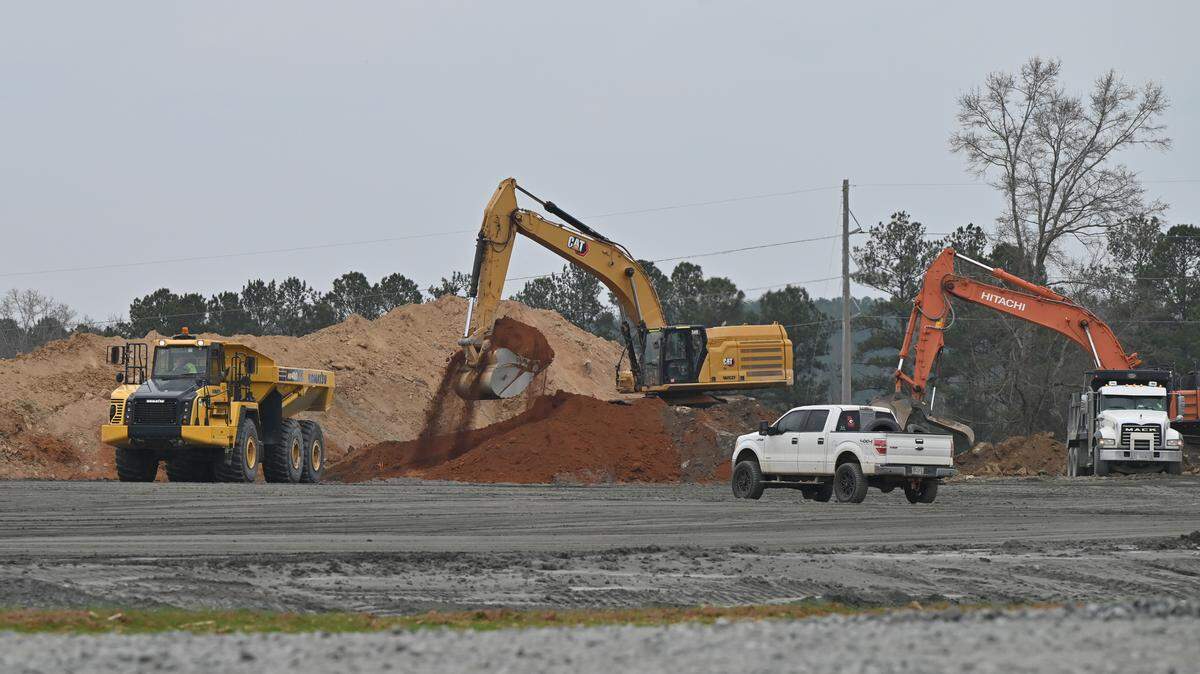
The surge of new development in Georgia over the past few years has reached beyond the state’s largest cities into smaller communities, including Monroe County.
Monroe County has attracted two planned data center projects, a Buc-ee’s gas station and a new auto parts distribution center, among other projects. But there’s one thing none of these developers have been required to conduct: a tree survey.
In a county like Monroe that remains heavily forested, a tree survey may seem unnecessary given the sheer abundance of trees. But surveys do more than quantify overall canopy — they help identify and protect specific trees and habitats that could otherwise be lost during development.
Even with a high percentage of tree coverage, tracking canopy loss over time can still be a “great tool” for counties making management and budget decisions about whether to protect or replace tree canopy, according to Seth Hawkins, urban and community forestry program coordinator for the Georgia Forestry Commission.
“Tracking a county with a lot of cover will also provide a TON of ecosystem services over time that can be tracked and evaluated in dollars,” Hawkins said in an email to The Telegraph.
These services evaluate air pollution and runoff avoided, and total carbon , for example, according to a Georgia Forestry Commission and Georgia Tech mapping dashboard.
Tree surveys also depict the species, size, age and location of trees, and are often used to determine and document which trees will be preserved and what impacts the development will have on the site and surrounding environment.
What tree surveys do — and why they matter
In order for developers to be required to conduct a tree survey, it must be written into a municipal code or ordinance. Its purpose is to be a tool to help ensure sustainable development.
“If there’s no local code to dictate someone to do any kind of tree survey, then it really just depends if that developer leaves the tree or not,” Hawkins said. “You definitely find out a lot about the trees on site. ”
Neither the Rumble Road Technology Center, a nearly 950 acre project, nor the proposed Forsyth Technology Campus, a 1,630 acre project, conducted a tree survey on the respective properties, according to Kelsey Fortner and Rachel Floyd, community development directors for Monroe County and the City of Forsyth.
The City of Forsyth also does not require a formal tree survey or comprehensive inventory of existing vegetation before development approval. Instead, tree preservation is addressed through a design review process that relies on landscape surveys and plans submitted by the developer, proposing which existing trees can be preserved or replaced.
While this process allows for some oversight and buffering, it does not require documentation of all trees on a site, leaving broader environmental and biodiversity impacts largely unexamined.
“Developers usually ask what I require and since we don’t require one, they didn’t turn one in,” Fortner said. “So, if they did one, I don’t have it.”
When asked Tuesday if developers conduct tree surveys or similar assessments voluntarily, or if there was a tree survey done for the Forsyth Technology Campus in the absence of a requirement, Trammell Crow, the developer of the data center, declined to comment.
Development without a formal tree inventory
Without tree surveys, county officials and the public have little record of which mature or ecologically important trees might be cleared during grading and construction.
Projects of such size still won’t erase that canopy by themselves, but they do remove sizeable chunks of forest in single moves, with no public record of what was there beforehand.
This could lead to important native species or century-old trees being cleared without anyone knowing they were present.
Large-scale tree removal can have cumulative consequences, including increased heat island effects, erosion, sedimentation in nearby waterways and the loss of wildlife habitat, according to Hawkins. Clearing and soil disturbance also raise the risk of invasive plant species, which are quick to capitalize on newly exposed soil and sunlight.
“It is hard to replace a community forest through replanting that is as effective at providing ecosystem services as an established forest patch consisting of native species,” Hawkins said.
Hawkins also noted that surveys can also reveal when trees are unhealthy or poorly suited to a site, underscoring their role as a planning tool rather than a purely environmental safeguard.
Many Georgia counties and cities have tree ordinances or protection sections written in their development codes, including the City of Perry in Middle Georgia, though the scope and specific survey requirement triggers vary by jurisdiction.
Many Georgia counties and municipalities have adopted tree ordinances or tree protection sections within their development codes; a state survey found that dozens of counties have some form of tree ordinance, though the scope and specific survey triggers vary by jurisdiction.
This story was originally published January 28, 2026 at 2:27 PM.