Forest Service plan will open Georgia’s wild forests to logging, mining, roads
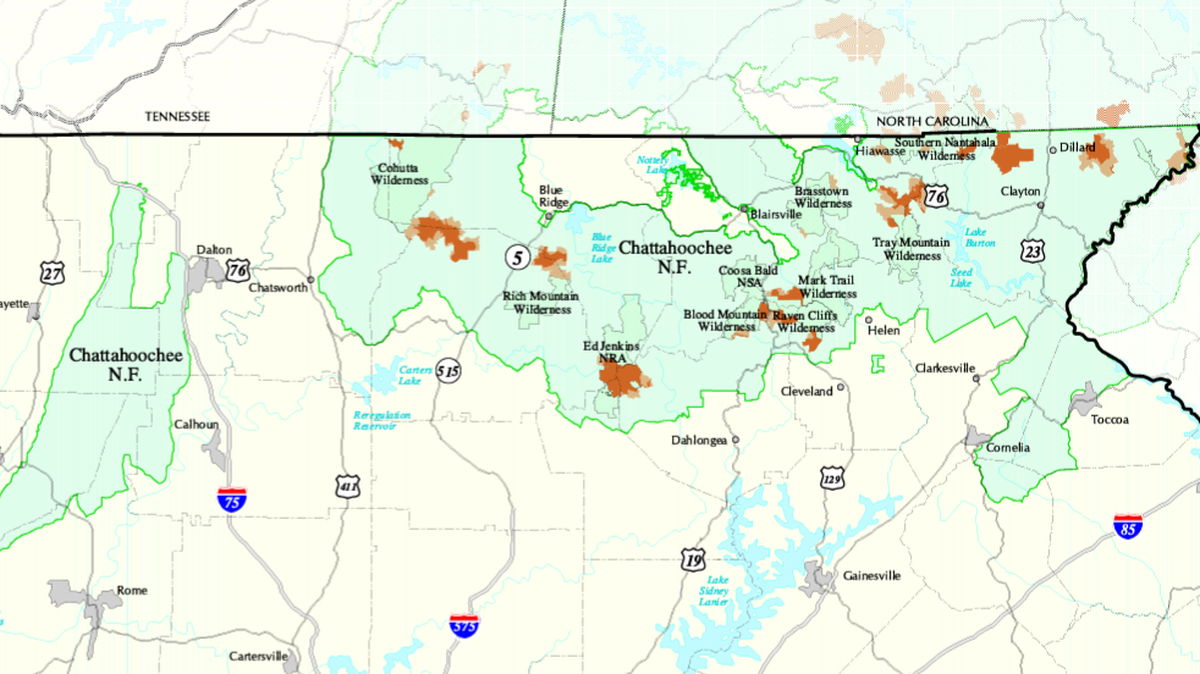
Roughly 63,000 acres of Georgia forest are federally protected from roadbuilding and commercial logging, but the U.S. Forest Service is moving to roll back those safeguards, it announced late last month.
The 2001 Roadless Area Conservation Rule protects some of forests’ most wild areas from new road construction and prohibits the commercial logging in those areas.
In the Peach State, all of these protected pockets are scattered throughout the Chattahoochee National Forest in North Georgia.
The Forest Service says the intention behind rolling back the rule is for better wildfire suppression and active forest management, the agency said in a news release.
“For nearly 25 years, the Roadless Rule has frustrated land managers and served as a barrier to action – prohibiting road construction, which has limited wildfire suppression and active forest management,” said Forest Service Chief Tom Schultz. “The forests we know today are not the same as the forests of 2001. They are dangerously overstocked and increasingly threatened by drought, mortality, insect-borne disease, and wildfire. It’s time to return land management decisions where they belong – with local Forest Service experts who best understand their forests and communities.”
The release also notes how this move aligns with President Donald Trump’s executive order, “Unleashing Prosperity Through Deregulation.”
“The proposal aligns with President Trump’s Executive Order 14192, Unleashing Prosperity Through Deregulation to get rid of overcomplicated, burdensome barriers that hamper American business and innovation,” the release reads.
But environmental groups such as the Southern Environmental Law Center and Environment Georgia argue that these forests are crucial for wildlife, clean water, recreation and preserving some of the nation’s biggest and oldest trees, which are usually more resilient to wildfire, according to Jennette Gayer, state director of Environment Georgia.
“The network of roadless areas throughout the Chattahoochee National Forest help keep logging at bay and provide vital water and wildlife protections for the nature surrounding two of Georgia’s most treasured natural spaces, the Appalachian and Benton MacKaye trails,” Gayer said. “It is more important to protect these areas than to get a little more wood, build one more mine or construct one more road. Let’s keep our wild forests wild.”
A recent study from a national environmental group, the Wilderness Society, concluded that building roads into roadless areas is likely to result in more fires, and that the highest wildfire-ignition density was in lands within 50 meters of roads.
Rescinding the rule would open these areas to mining, oil and gas development and timber production, according to a release from the Southern Environmental Law Center.
“Roadless protections are especially important in the southeastern United States, where much of our public land has already been fragmented by roadbuilding to extractive industry,” the SELC’s release reads. “The Roadless Rule ensures that backpackers, mountain bikers, climbers, and kayakers have a place to get away from roads, machinery, and noise.”
The Forest Service filed a “Notice of Intent,” which is the legal step that kicks off the rulemaking process to rescind the protections, in the Federal Register at the end of August. The public gets a chance to comment on the proposed change.
The public comment period ends Sept. 19.
By posting the notice of intent in the Federal Register, the Forest Service is formally notifying the public and other stakeholders that it intends to start the process of rescinding or changing the “Roadless Rule.”
“People in the Southeast and across the country want a place to get away from the noise and commotion of roads and development,” said Sam Evans, who leads the Southern Environmental Law Center’s National Forests and Parks Program. “The Roadless Rule promises that our least-developed public lands can be enjoyed by all of us for generations to come without the threat of reckless roadbuilding and other destructive projects.
“Getting rid of it will degrade popular recreation areas, imperil already-rare wildlife, and do long-lasting harm to our national forests as well as the communities and local economies that depend on them,” Evans said.
This story was originally published September 10, 2025 at 6:00 AM.