
‘Backdrop of climate warming’ plays into extreme Georgia heat. What to know
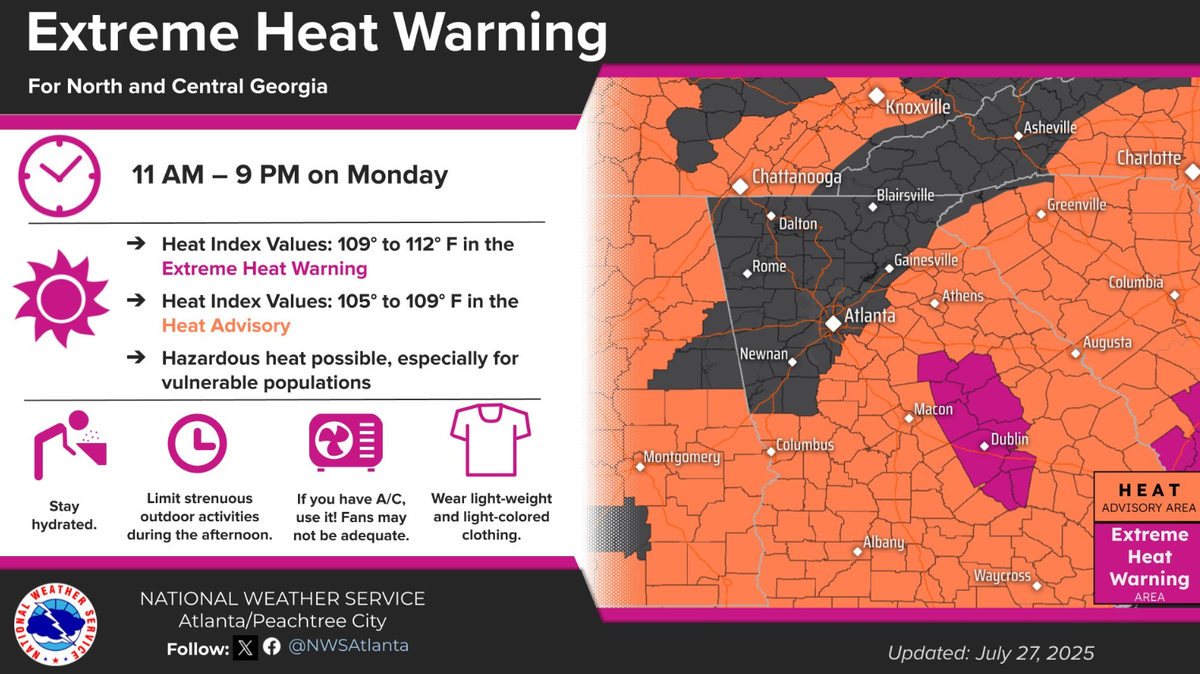
Georgia is experiencing another heat wave, and Middle Georgia is getting the most extreme of it.
Heat index values were expected to reach up to 107 degrees Monday and Tuesday, with high temperatures reaching up to 100 on Monday and 98 on Tuesday, according to the National Weather Service. Climate change is playing into the extreme heat, experts say.
“It is important to note that though this is a ‘natural’ weather pattern it is likely amplified by the backdrop of climate warming,” said Marshall Shepherd, director of the Atmospheric Sciences Program at the University of Georgia. “Studies show that heatwaves are becoming more intense and/or frequent.
“Yes, it is supposed to be hot in July, but we are looking at air temperatures and heat index values well above normal.”
Shepherd said it’s not a question of whether a heat wave is caused by natural weather patterns or climate change. It’s both. Climate change is the backdrop that makes natural extremes more extreme.
“We have to get the public used to the prospect that it is not ‘either/or,’ it’s ‘and’ when it comes to natural variability and anthropogenic climate change.”
What’s causing this extreme heat is a typical high-pressure system known for triggering heatwaves — commonly referred to as a “heat dome.” But in this case, it’s been especially intense, according to Shepherd.
A heat dome is a weather pattern in which a strong, stationary high-pressure system traps hot air over a large area for days or even weeks. This suppresses cloud formation, allowing the sun’s rays to directly heat the surface, according to The Weather Channel. Instead of the warmth rising and escaping, the high-pressure system forces that warm air downward, compressing the air and making it even hotter.
As the Earth warms and temperatures rise due to human-induced climate change, the energy available to be trapped under high pressure systems increases. That means when a heat dome forms, it’s already operating in a hotter environment, and that produces more extreme surface heat.
Climate Central found climate change made the daily high temperature at least five times more likely, according to the Climate Shift Index, and that the expected high temperature is 10.7°F hotter than normal for July 29.
The United Nations’ Intergovernmental Panel on Climate Change has also found that human-caused climate change already made heatwaves more frequent and more intense, according to the group’s Sixth Assessment Report. The report warns that as the planet continues to warm, these extremes will become even more severe.
For every 0.9 degrees of additional global warming, the risk and severity of dangerous heat events increase “significantly.”
Beyond just rising temperatures, scientists say climate change is also making heatwaves more uncomfortable with increasing humidity.
“Something else that adds to the climate change impacts on discomfort is the fact that a warmer climate can accommodate more moisture,” Shepherd said. “The Gulf waters are warmer too, which means more evaporation and humidity.”
Extreme heat and high levels of humidity pose public health concerns, too, according to Shepherd.
“To someone reading this saying, ‘It’s hot in Georgia in July get over it,’ yes, it is hot but as we push temperatures and humidities up, we are getting into dangerous heat for outdoor work, commerce, road infrastructure, agriculture and public health,” he said.