Want to help save the bees? Georgia field studies offer a chance to do so
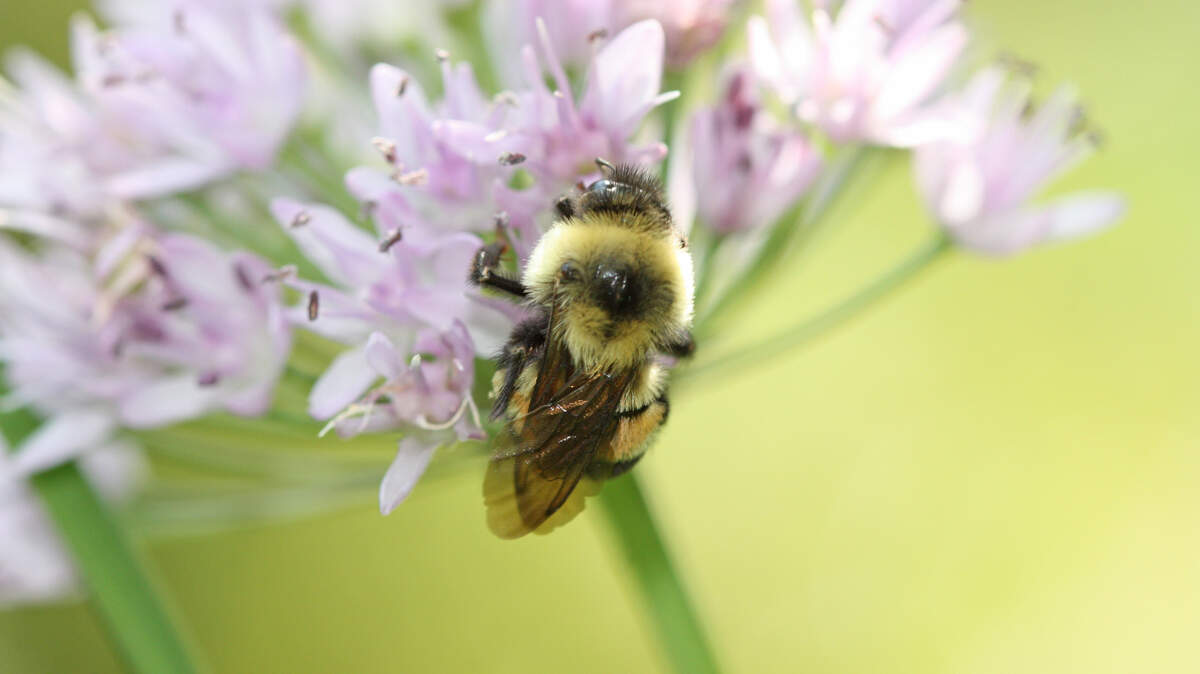
Bumble bee populations are in heavy decline across the U.S., and Georgia is no exception.
In efforts to conserve these pollinator populations, the Xerces Society for Invertebrate Conservation started the Bumble Bee Atlas project, where the group mobilizes volunteers across the U.S. to track declining bee populations through training sessions and field days.
Georgia is a part of the Southeastern Bumble Bee Atlas project, along with North Carolina, South Carolina and Tennessee.
The Southeastern project coordinator, Avery Young, was just hired last week and has already begun planning training sessions and field days that will be hosted between May and September.
The first training session will be virtually held on May 20. Field days and other training sessions for the Southeast region should be scheduled by the end of the month, according to Young. When the events are added, they’ll be accessible on the Xerces website.
“It’s gonna go over some ecology and conservation issues surrounding bees,” Young said. “But then we’ll also go into the protocol and the specific details of how to conduct a survey in the field.”
The purpose of the field days are to identify species of bees and their host plants.
The Bumble Bee Atlas projects are statewide or region-wide census efforts to get a better understanding of the population status and habitat needs of bumble bees, in order to give recommendations to management agencies about how to manage land for these animals and help populations recover, according to Rich Hatfield, the Xerces Society’s senior endangered species conservation biologist.
“Georgia is, frankly, one of (our) biggest targets for this year,” Hatfield said. “We’re hoping to dive deeper into rural Georgia in this coming year ahead, so that we can get a better understanding of how species are doing.”
All pollinators, including bumble bees, are crucial to food security and a healthy, thriving ecosystem, which makes the current rate of decline concerning on many fronts, according to Hatfield.
“The fear is that we’re entering a landscape where eventually food security becomes at risk,” Hatfield said. “As humans, plants that were pollinated by bees provide 33% of the food that we put into our bodies every day. These animals are not just pollinators for humans on farms, but they’re also pollinators for any wildlife that eats fruits, nuts, berries, seeds, roots, or uses those plant structures for shelter.”
Bumble bees aren’t the only invertebrate population that’s struggling. Butterflies and honey bees are too. This is due to a host of different factors that, stacked on top of each other, cause a “suite of threats that’s just too much,” according to Hatfield.
He points to climate change, pesticides, habitat loss and disease as main drivers of the decline.
Climate change creates unpredictable weather conditions such as droughts, floods and fires, affecting if and when flowers bloom, which are bumble bees’ sole food supply. These bees need flowers from early spring through late fall to complete their annual life cycle. If flowers disappear too soon, or if bees emerge before flowers bloom due to an early Spring, it becomes harder for them to reproduce or survive hibernation.
Around 30 years ago, a new class of insecticides was introduced into the market called neonicotinoids. Once sprayed, plants absorb these chemicals which then expresses itself in the tissue of every single cell of the plant, making their pollen and nectar poisonous to bees.
“So that means, from a from a bumble bees perspective, that every grain of pollen and every drop of nectar that the plant produces has that insecticide in it,” Hatfield said. “And that’s the only source of food for bumble bees. Their protein source is pollen and their sugar source, their carbohydrate source is nectar.”
This means every time the bumble bee drinks or eats, they’re getting a dose of it. Though often not a lethal dose, neonicotinoids affect a bee’s ability to navigate and reduces their foraging efficiency, which then affects their ability to reproduce and bring resources into the nest — the ultimate driver of population growth.
“(Neonicotinoids) are everywhere — they’re water soluble,” Hatfield said. “Which means that most crop plants and even a lot of wildflowers at this point, are having these micro doses of insecticides in them, and every time the bumble bee drinks or eats, they’re getting a dose of it.”
Another big problem is that these chemicals last a long time — just one application can stay in a plant for up to seven years, according to Hatfield, continuing to harm to the animals that visit the plant years after a single application.
“More than 90% of pollen samples from bee hives in agricultural landscapes and more than 90% of stream samples are contaminated with more than one pesticide,” the Xerces website reads.
Agriculture and urbanization have resulted in habitat loss for bumble bees by converting areas into crop fields and developed land, which destroys essential nesting sites like underground burrows and brush piles.
“The loss of habitat to development, agriculture, and a changing climate is likely having a profound effect on all wild bees. Native prairies and grasslands are ideal for bumble bees, yet nearly all North American prairies and grasslands have been lost to land conversion, and what remains is heavily fragmented,” the Xerces website reads.
On top of climate change and pesticides, a sub genus of bumble bees that included the rusty patch bumble bee, was especially susceptible to a certain fungal pathogen that was known to have occurred in an outbreak in commercial bumble bee facilities. Bumble bees are bred commercially to use as pollinators of agricultural crops such as greenhouse tomatoes and cranberries.
“The (agriculture) industry figured out how to grow bumble bees in boxes and then ship them out to farmers so they could deploy them in these greenhouses,” Hatfield said. “We know that there were fungal pathogen outbreaks in those facilities in the ‘90s, right before these declines started, and we have evidence that there are higher incidences of this fungal pathogen close to greenhouses too.”
Bumble bees are bred commercially for use as pollinators of greenhouse crops.
“It has been clearly documented that commercial bumble bees carry high pathogen loads and regularly interact with wild bumble bees near greenhouses and in open field settings, providing a clear mechanism for infection,” the group’s website says.
The rusty patch bumble bee is a federally endangered species and is one of several that have “more or less disappeared” from the Southeast U.S., according to Hatfield. The other three bumble bees he noted as species of concern are the American bumble bee, the variable cuckoo bumble bee and the southern plains bumble bee.
There hasn’t been an observation of the rusty patch bumble bee in Georgia since the late ‘90s, but there has been a relatively recent population discovered in Virginia and West Virginia, so Hatfield said they’re hopeful that a population might exist somewhere in the high altitude regions of Georgia.
The other species that disappeared from the lower 48 states is the variable cuckoo bumblebee, which is dependent on another struggling species, the American bumble bee, as its primary host.
The American Bumblebee appears to be declining in the northern parts of it’s region, but not as much in southern areas. The Xerces Society has a few records of the American bumble bee in southeast Georgia in recent years.
Hatfield compared the state of the American bumble bee population to the Southern plains bumble bee.
“The species was never terribly common, but does seem to have disappeared from northern portions of its range, but we have found a scattering handful of records in the southeast,” Hatfield said.
The Xerces Society for Invertebrate Conservation is a science-based nonprofit organization dedicated to protecting invertebrates and their habitats through research, education and advocacy.
“Part of the reason that we’re doing these Bumble Bee Atlas programs is that there’s an incomplete understanding of invertebrate populations,” Hatfield said. “We’re literally decades behind where we are with mammals and birds in terms of our understanding.”
This story was originally published April 24, 2025 at 10:06 AM.