Was more clean energy attainable in past Georgia Power plans? Energy experts explain
Editor’s note: This story is part of a series covering Georgia Power’s energy plans, the public’s response to these plans, and how the Public Service Commission influences the state’s progress in using renewable energy. Read part one here.
When Georgia Power presented its energy plan in 2022, meant to help guide the company for the next two decades, fossil fuels played a noticeable role. And, despite an increasing use of renewable energy, fossil fuels still were prevalent when the company introduced an updated plan to state regulators just one year later.
Much of the public took issue with maintaining or expanding the lifespan of existing coal and natural gas power plants, citing worries about negative health effects, the climate crisis, and investing in power sources that other states are moving away from. Even though it’s updated every few years, the Integrated Resource Plan leaves a lasting footprint on how the state is powered for the next couple of decades.
Clean energy advocates have pushed for Georgia Power to pursue a plan that relies less heavily on fossil fuels. But has weaning off of natural gas and coal actually been possible for the Peach State energy giant in recent years? And if so, is that idea entertained by Georgia Power and the agency who regulates them, the Georgia Public Service Commission?
The case is made for more renewable energy
There are energy experts who say 100% renewable energy is possible. Those experts testified in front of the Public Service Commission when Georgia Power sought to get approval for its 2022 Integrated Resource Plan, a document that has to be approved by the PSC and lays out how the company will provide energy to its millions of customers.
Three experts found two main reasons why Georgia Power’s own plan and operations kept them from integrating and increasing renewable energy into their mix:
Not enough residential rooftop solar, and removing incentives to expand or keep the net metering solar program that encouraged rooftop solar.
A lack of efficiency in the state’s energy capacity, and an approach to energy that incentivizes building more power plants instead of better-utilizing existing facilities
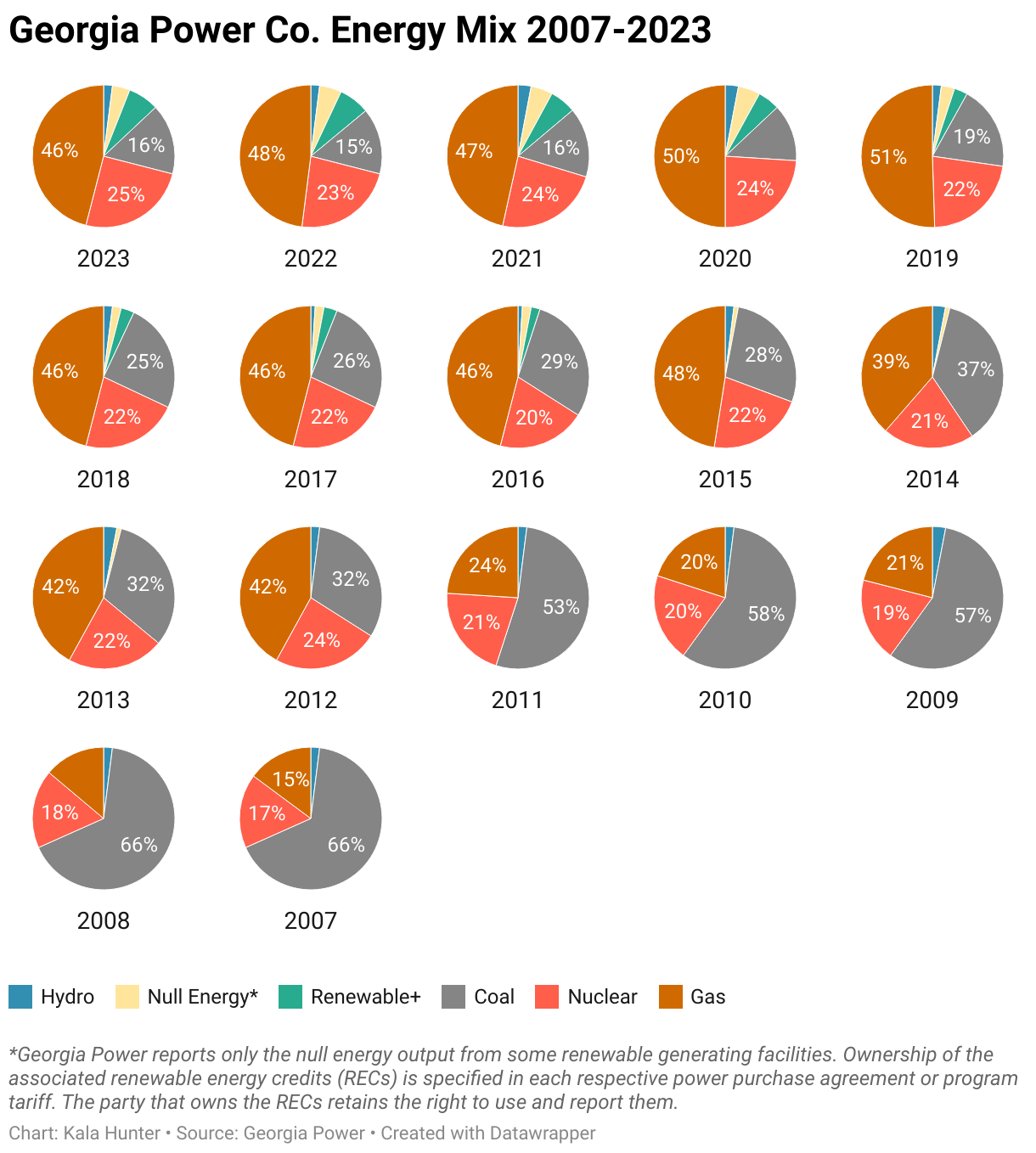
When the 2022 IRP was presented, only 6% of Georgia Power’s energy mix came from renewable energy, most of which was solar. Three percent came from hydro-electric energy (dams, water power), and 24% nuclear energy (from Vogtle units 1-4, which is emission free).
In total, about 33% of the company’s energy is carbon and fossil fuel-free.
The approved 2022 IRP kept coal and natural gas plants Scherer and Gaston in operation until 2028 and added 2,300 megawatts of new gas capacity contracts. That locked in a steady reliance on fossil fuels in the state for the coming years.
Not enough solar, incentives
Alden Hathaway, an energy consultant and electrical engineer who testified in the 2022 IRP hearing, is confident that if Georgia Power could get solar on all rooftops at homes, businesses and warehouses, it could double or triple the percentage of renewables and remove the need for more coal or natural gas in the mix.
“If we tap just half the roofs in Georgia for solar we could improve the percent of renewable energy up to 20% and reduce peak demand,” he said. “Every watt of solar would reduce our summer peak demand.”
Georgia is seventh in the nation for utility solar, which includes solar farms and fields owned and operated by Georgia Power. But the Peach State doesn’t do nearly as well when it comes to putting solar panels on homes and businesses: it ranks 43rd in “distributed” solar, which is also known as rooftop solar.
There are about 3,000 megawatts of solar coming from large-scale solar plants, mainly in the southern part of the state, which make up the majority of the renewables in Georgia Power’s mix.
In 2019, the PSC allowed Georgia Power to pilot a net-metering program, in which Georgia Power customers could put solar panels on their homes to power their own property, then supply the grid with excess energy and receive bill credits. It was capped at 5,000 homes. This net metering program was eliminated in the 2022 IRP.
Marilyn Brown, a professor of sustainable systems at Georgia Tech and a previous commissioner of the Tennessee Valley Authority, testified on behalf of Southern Alliance for Clean Energy and Southface Institute during the 2022 IRP. She asked the PSC to keep net metering to increase renewables.
Brown said that while Southern Company, the parent company of Georgia Power, doesn’t permit net metering in Mississippi, Alabama or Georgia, 33 other states use it.
The net metering pilot program had 4,000 or so Georgia Power participants that created about 40 MW of energy when Brown testified in 2022.
In Brown’s 2022 testimony, she referenced a study she co-authored that highlighted the Georgia has the technical potential to supply 24,300 MW of energy, by putting solar panels on every available roof in the state. That’s enough to power over 4.1 million homes, but putting solar panels on every roof wouldn’t be realistic.
More realistically, Brown said Georgia could add about 1,500 megawatts from rooftop solar while considering “costs, benefits and stakeholder acceptance.” Still, that’d be a big jump.
“That is 36 times what was done from the pilot program,” Brown said in testimony.

Larry Legg, Georgia Power’s director of pricing and rates, testified in a 2022 hearing about energy rates that the company found an extra $1,356 per year for the average monthly net metering participant and an annual cost shift of $1.4 million that went onto its other customers’ bills.
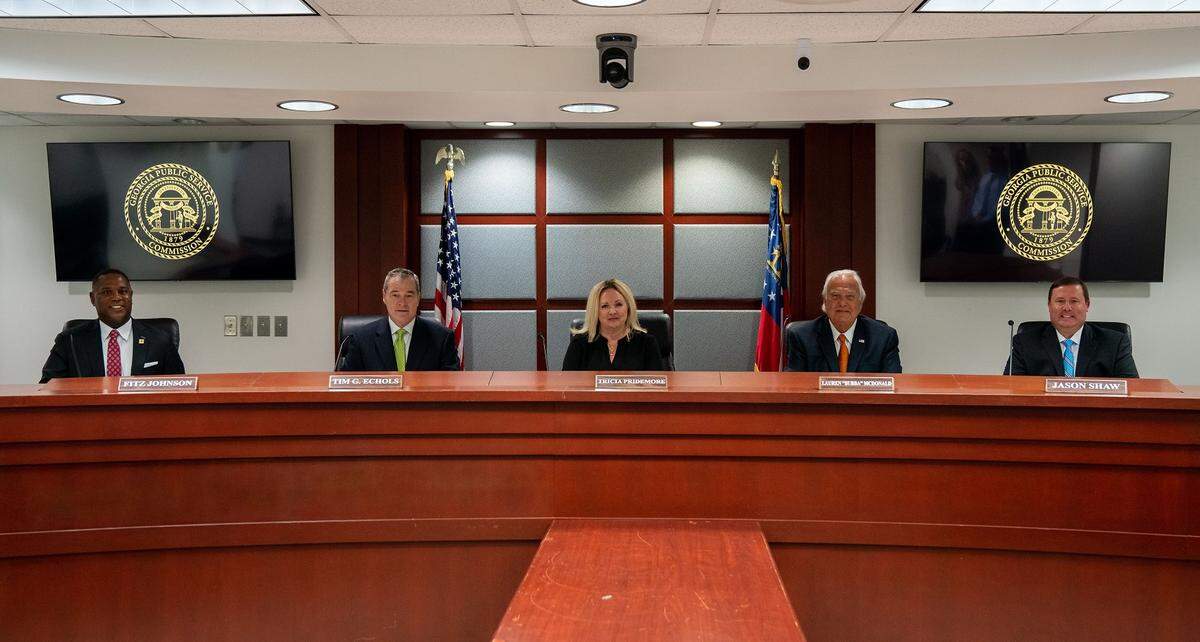
Public Service Commissioner Jason Shaw was an avid supporter of the pilot program in the 2019 IRP. But in 2022, he voted to cut the program, siding with Lee’s argument.
“The reason we backed off net metering” was because it “caused unfair upward pressure on a certain class of ratepayers,” he said.
Georgia isn’t alone in pulling back from net metering. Illinois, Arizona and Wisconsin used net metering before moving away from it. Shaw pointed to California’s change of switching its net metering policy due to cost shifts, and said that was a reason for his hesitancy.
But Hathaway argues the cost shift issue wouldn’t be a problem if the entire energy system was more efficient, and says it could be improved.
Issues with Georgia’s power efficiency?
Arguments about clean energy use in Georgia are often focused on capacity, but Hathaway has concerns about how well Georgia Power uses the electricity it already has.
“We suffer from a relatively low load factor in Georgia,” Hathaway said.
Load factor is a measure of efficiency that considers consistency and steadiness of energy output. It provides insight into how efficiently peak grid capacity is used over time.
The average load factor in the U.S. electrical system is about 50%, and Georgia Power’s is below average at 40%, Hathaway said in his 2022 testimony.
“To put it another way, the plant runs, but it only runs at 40%, and that means 60% sitting idle,” Hathaway said. “It’s been the case for a while because we haven’t had focus on improving load factor – it isn’t something the utilities want to talk about because to do so would take the control out of their hands to be able to build more power plants, which is where they make their money.”
Hathaway compared Georgia Power to a shark, saying they have to keep building to survive, or in the shark’s case, keep moving and eating to survive.
“If we do (rooftop) solar near the load, it reduces peak demand, improving system load factor it would diminish the need for additional transmission and power plants,” he said. “That’s where solar makes the most sense. So we’ve mis-amplified the solar opportunity.”
Hathaway argued that improving the load factor reduces cost for rate payers as well. In his testimony he pointed to Vermont, which focused on load factor for a 20-year period and dropped expenses.
“They focused on efficiency and delivery of electricity around the clock, reducing operating costs by 4% when they went from a 55% to 70% load factor,” he said.
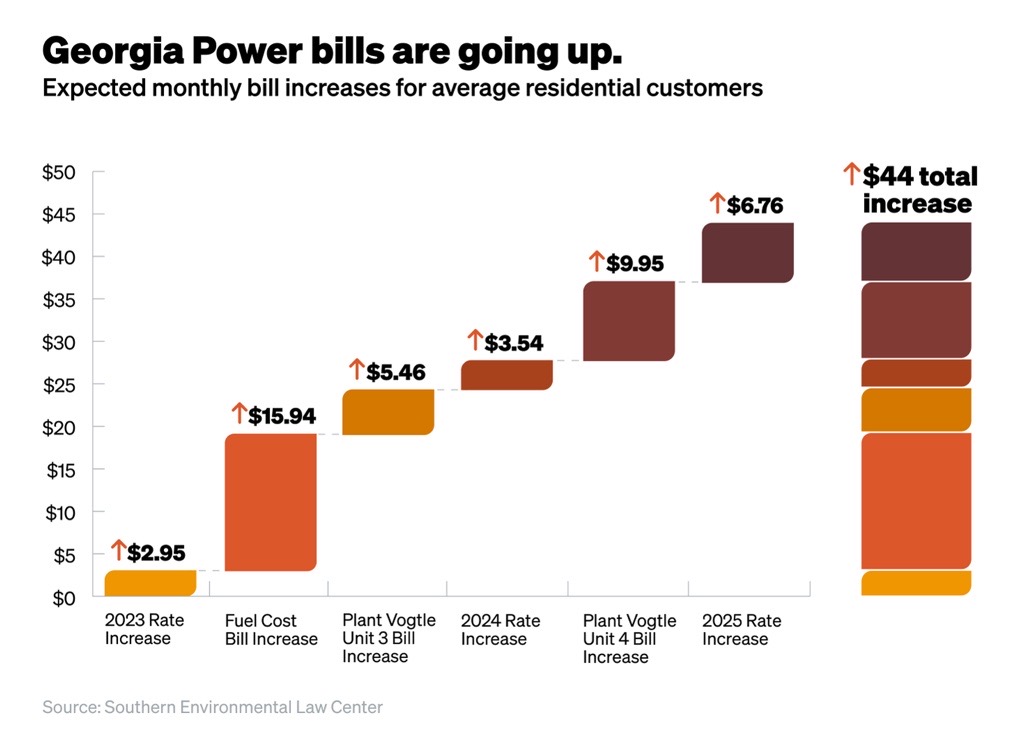
Georgia Power customers have had a jump of over $44 dollars per month from six rate increases since 2023, according to the Southern Environmental Law Center.

Improving load factor and adding more rooftop solar, including net metering, would not be a cost shift but a cost saving, according to Hathaway’s testimony. It would save $300 to $400 per solar home in Georgia.
“The commission, through Georgia Power, should be doing all it can to see that consumers can put solar on their roofs to help lower costs for all ratepayers,” he said.
A third expert in the 2022 IRP hearings, Peter Hubbard, who runs the Georgia Center for Energy Solutions and has been part of the energy management consulting energy sector for 13 years, believes the forecasting models that Georgia Power uses benefit more infrastructure.
“They constrain models to produce an output favorable to building more infrastructure and natural gas,” he said. “Georgia Power modeling and forecasting say this is what is optimal.”
Hubbard called the 2022 IRP “technically flawed” in his testimony.
“The barriers to faster renewable energy integration are not technical,” Hubbard said. “The barriers are embedded in the 2022 IRP.”
Hubbard added that sharing resources among states was absent in the 2022 energy plan and that would help incorporate more renewables in the mix.
“Georgia Power needs to share (renewable) resources geographically with all of our neighbors like Tennessee Valley Authority to the north and Florida to the south,” he said. “You can share those resources among regions, that gets you closer to that 100% renewables.”
So is 100% renewable energy possible?
While Georgia Power did add thousands of megawatts of utility scale solar capacity and battery storage capacity in its 2022 and 2023 IRP plans, the power company does not have a clean energy goal. The Southern Company, Georgia Power’s parent company, does have a net-zero energy by 2050 goal, according to Jacob Hawkins, Georgia Power’s director of corporate communications.
Hawkins did not directly answer whether getting to 100% renewable energy is possible or realistic for the Peach State.
Incorporating more efficiency, incentivizing rooftop solar across Georgia and more resource sharing could have pushed the fossil-free dial up in the 2022 IRP.
But Hubbard argues getting from 33% to 100% clean energy is a lot harder than it sounds, and could cost a lot more money.
“Getting to 100% is a very different thing than getting to 95% or 90% or even 80%,” he said. “We shouldn’t make perfect the enemy of the good. Really our sights should be set on, say, an 80% target and then we figure the rest out from there.”
Washington and Vermont hit that 80% target that Hubbard mentioned in 2022, according to the Environmental Protection Agency’s 2022 data, repopulated in this chart from Canary Media.
Other states – such as Oregon, Idaho and Kansas – are nearing 70% clean energy generation, while southeastern neighbors Tennessee and South Carolina, have well over 50% of their total energy generated from carbon-free sources.
The longest-serving member of the current PSC isn’t optimistic of the possibility of getting to 100%.
“One-hundred percent clean energy? Don’t ask me that.That’s ridiculous,” said Bubba McDonald, Georgia Public Service Commissioner. “I’m a fossil fuel person and a nuclear person. I want to keep some coal because it’s a solid base load.”
But Hathaway said Georgia Power could use nuclear as a base for its energy and add renewables to fill the electric grid, eventually.
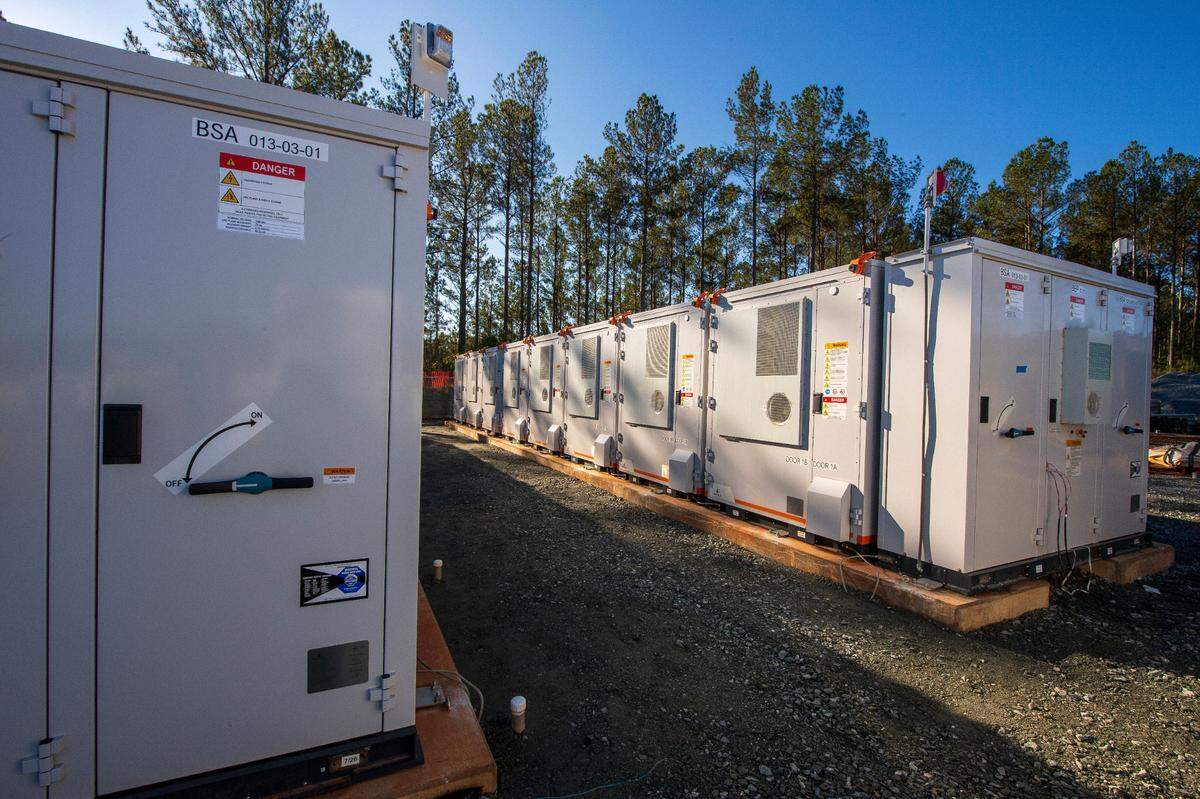
“There is a place for batteries and renewables at a much lower cost on the electric grid,” he said. “We can do a mix of renewable energy, battery storage to take up the peak demand and diminish the need for additional fossil (fuels).”
Hathaway, who has been an electrical engineer for 42 years, said he’s amazed and disappointed in the lack of “energy acumen” by Public Service Commissioners around the country.
“Many utility regulators are forced to rely on the utilities they regulate because they do not understand common utility terms, like load factor improvement, which has been proven to lead to lower rates,” he said. “Regulators tend to be career politicians as opposed to career energy people and beholdens them to the utilities they regulate.”
Data Centers powered by batteries?
Georgia Power sought to update its power plan in a 2023 IRP update, which broke from the norm of submitting an IRP to the PSC every three years. But Georgia Power said it was necessary because gargantuan data center growth made for a much greater energy need. The company wanted approval to use more fossil fuels as well as more renewable energy and battery storage.
The 10,000 megawatts of renewables from the 2023 IRP update are not set to be added until 2035.
The Georgia Power 2023 Integrated Resource Plan update requested three “advanced class, duel-fuel” combustion turbine engines at Plant Yates in Coweta County. The updates at Yates, a natural gas plant, could create up to 1,410 megawatts of energy generation, while also polluting greenhouse gas emissions.
One expert, Chelsea Hotaling, a resource plan and load forecasting expert with Energy Futures Group, testified in February 2024 that Georgia Power’s anticipated growth of 3,141 megawatts by 2028 could be handled by expanding Battery Energy Storage Systems.
“The Yates combustion turbines are not necessary to support Georgia Power’s projected capacity needs between now and 2028, even if the commission uses Georgia Power’s extreme growth estimates,” Hotaling said during her testimony to the commission in February.
Georgia Power Chief Financial Officer Aaron Abramovitz said the resources in the 2023 IRP update will ensure reliability to customers and put downward pressure on rates.
In 2024, the Commission approved the Yates plant combustion turbines at the natural gas plant.
“BESS are sufficient to meet Georgia Power’s capacity needs between now and 2028, and they can be competitively procured,” Hotaling said.
This story was originally published March 5, 2025 at 6:00 AM with the headline "Was more clean energy attainable in past Georgia Power plans? Energy experts explain."