Trump thinks FEMA should go away. Did the agency do its job Georgia in 2024?
In the last five years, the U.S. has faced a swarm of catastrophic storms that have left millions of Americans in need of financial help from the Federal Emergency Management Agency.
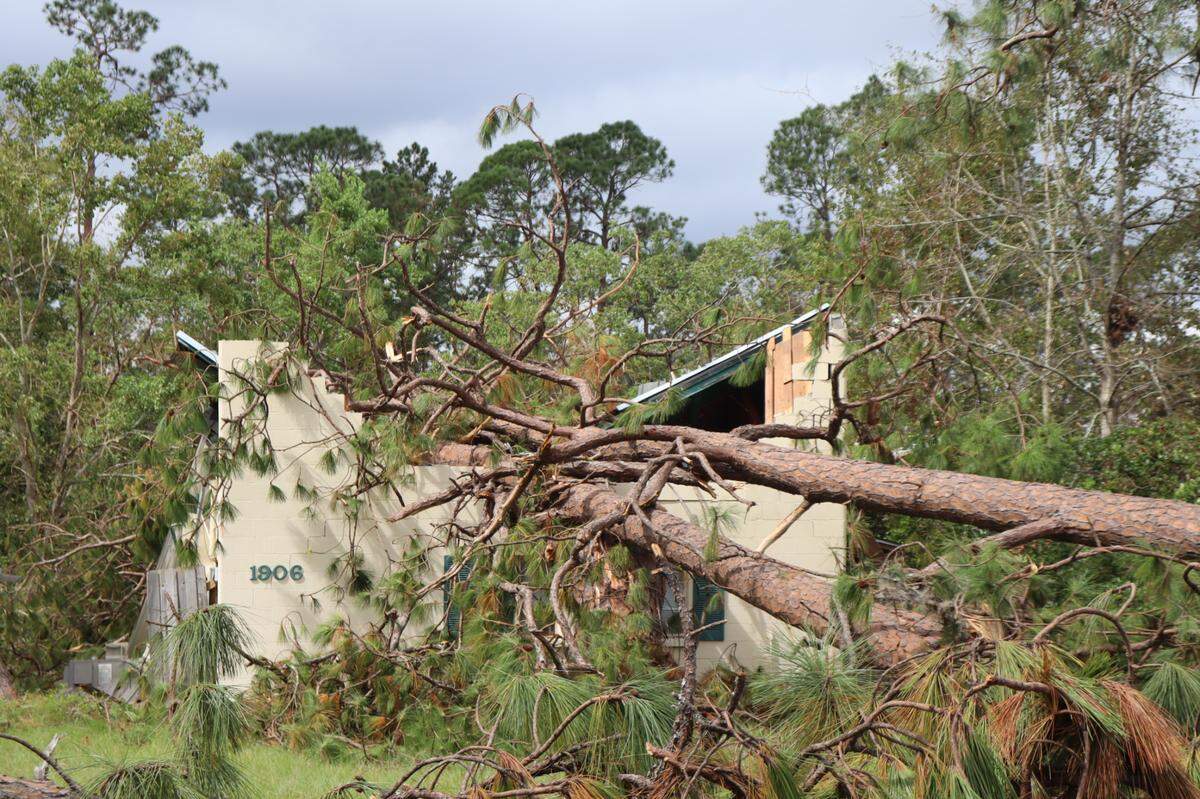
In August and September, Georgia was victim to the multi-state major disaster, Hurricane Helene, and southeast Georgia was rocked by Tropical Storm Debby. Together the storms did enough damage that a “major disaster declaration” was issued in more than half the state’s counties.
FEMA has approved individual assistance totaling $320 million from both storms, according to agency websites, helping more than 214,000 households. The latest estimate for total public assistance damage is $1.76 billion, according to the Georgia Emergency Management Agency. Help efforts are still going on – some disaster recovery centers in Georgia were open up until Feb. 28 and thousands of financial assistance applications are still being processed by FEMA.
The millions and billions of dollars put toward aid and the months of long-term recovery responses have created heated discourse among politicians and storm survivors about FEMA’s effectiveness, particularly when it comes to providing money to victims. Some have defended the agency while other political leaders have bashed FEMA’s response to disasters.
President Donald Trump has been one of the biggest critics. Four days after his inauguration, he suggested “getting rid of FEMA” after visiting disaster sites in North Carolina, which suffered extreme damage from Hurricane Helene, and California in the aftermath of the devastating Los Angeles wildfires.
Disaster experts across the U.S. and local Georgia officials who experienced FEMA’s work first-hand have a different take.
“FEMA is the envy of other nations,” said a long-time disaster and planning expert, Robert Olshansky, a retired but still active disaster professor from the University of Illinois. “There are no better models out there. Japan is in the process of setting up a comprehensive emergency management agency, taking learnings from FEMA.”
What does FEMA do? An expectation disconnect
Olshansky and other experts believe FEMA does exactly what it is set up to do.
But there’s a disconnect in what is expected from FEMA and what the agency actually does, said Jennifer Trivedi, a disaster anthropologist at the University of Delaware.
“There has always been an expectation disconnect,” Olshansky said, speaking to what FEMA does. “FEMA itself has been saying this for years.”
When a disastrous event leaves local and state governments overwhelmed, a county needs the state governor to request and receive a “major disaster declaration” from the president. That’s when FEMA steps in to help affected people.
FEMA is basically a major coordinator during the disaster and helps provide finances to get people back on their feet.
“FEMA becomes the coordination hub to help get things rolling and get things coordinated, because there’s actually a lot of different federal agencies involved with recovery,” Trivedi said.
Georgia’s recent experience with FEMA
In August, Tropical Storm Debby brought a “very serious flooding situation” to Bulloch County, according to the Statesboro Mayor Jonathan McCollar. There were at least 75 water rescues from the disaster spurred by lakes overflowing and flooding from 12 inches of rain in 48 hours.
FEMA provided funding for rescue teams and Georgia search and rescue, Bulloch County Emergency Manager Corey Kemp said.
The Statesboro city manager’s assistant, Olympia Gaines, worked as the city’s point person with FEMA and described a helpful experience in the wake of recovery.
“Our FEMA representative was very helpful and came with a wealth of knowledge,” Gaines said. “We met weekly to go over documents and through the recovery process she was helpful in ensuring organization.”
As of mid-February, 180 homes in Bulloch County were still uninhabitable and responders were “still doing preliminary damage assessments.”
The debris removal is also under FEMA’s scope, Trivedi said.
“We had a lot of debris in the right of ways that we would consider harmful,” Gaines said. “We hired a debris removal company and per FEMA guidelines, whenever you have a debris removal project, you also have to have a debris removal monitor.”
In Lowndes County, which was very badly damaged from the hurricane in September, 1.2 million cubic yards of organic debris had to be removed, which came out to $53 million in expenses, according to Valdosta Mayor Scott Matheson.
The misconceptions about what FEMA does drives a lot of public misunderstanding and misinformation, Trivedi said.
“FEMA can come in and act as a support space,” she said. “There are some misconceptions and knowledge issues around FEMA. People may think FEMA should be doing everything and making people’s lives whole after (a disaster) and that’s not really what they’re set up to do. They can’t fully fund your complete home reconstruction, for example.”
In Bulloch County, Kemp said FEMA helped with loan paperwork and setting up temporary living space for people whose homes were uninhabitable.
“They also provide long term recovery aid, and help with hotel reservations after the flood, help set up – not run – recovery aid to fill out small business loan paperwork,” Kemp said, emphasizing FEMA doesn’t run the aid programs. “That’s where the miscommunication is. They don’t stay here and it is our job to get roofing estimates and quotes.”
Matheson, to his dismay, has become well acquainted with hurricanes and disaster recovery. Valdosta experienced three hurricanes between 2023 and 2024, including Idalia, Debby and Helene. Matheson said there is a misconception that the public thinks FEMA does more for them than what is in their job description.
“The public does have unrealistic expectations,” he said. “The mentality of the free check, ‘My neighbor got one, why didn’t I?’ attitude is where things get problematic. “Part of (the city’s) job is to temper expectations.”
The mayor told the Ledger-Enquirer FEMA was “fantastic at every turn” in responding and managing Hurricane Helene.
When asked if the federal agency showed any bias in helping certain people, he responded, “yes, if you mean low-income and elderly,” because that is who they tended to first, he said. “They are biased in a needed way.”
And he added FEMA was vital as the “largest financial puzzle piece.” Large sums of money have been approved to be sent out in Georgia.
Of the $313 million that have gone to individual assistance in Georgia from Hurricane Helene, $29 million went to Lowndes County from 20,000 financial assistance applicants.
In Richmond County, where Helene devastated Augusta hours after it swept through Valdosta and Statesboro, $56 million has been distributed and over 40,000 financial applications have been approved. Twenty-two homes were destroyed, according to a spokesperson at the FEMA Region 4 news desk in Atlanta.
And in Bulloch County from Debby and Helene, over $1.6 million has been approved and distributed.
How long can aid take?
Entering the sixth month since Helene devastated Georgia and several other U.S. states, some individual financial aid applications haven’t been processed.
In Richmond County alone, as of Friday there were still over 20,000 financial applications being reviewed by FEMA, according to a FEMA Region 4 spokesperson.
“Payments are made on a case-by-case basis,” the spokesperson wrote in an email. “Each applicant is paid based on the amount of damage reported by the survivor and verified by the inspector.”
The deadline for applying for assistance was Feb. 7, and FEMA said it’s still reviewing applications for a variety of reasons, such as appeals on denied applications, or waiting on additional documentation.
“Some may be for those who have missed the application deadline due to numerous issues whether it be related Access or Functional Needs, medical, or other hardships,” they said. “We strive to give everyone affected the opportunity to apply. Regarding the number of outstanding payments, each survivor has unique needs.”
Numerous Georgia survivors have taken to social media to vent about their frustration in payment delay.
Reddit is host to several subreddits where Georgians are confused and frustrated about how long the financial payment has taken or the fact that they unjustifiably never received anything.
Many said they didn’t receive financial assistance when they should have or were in “still pending” status on their FEMA financial assistance application.
On a Reddit page created five months ago called r/HurricaneHelene, a user reached out for help with getting a quicker FEMA response.
A month later two users responded:
“I’m still waiting on the $700 anyone else still having this issue,” one said in November.
Another Reddit user responded, saying, “Still waiting here as well…it seems ‘serious’ and ‘immediate’ are open to interpretation even in a declared county. I’ve uploaded upwards of 15 documents, called and checked with an agent to make sure everything was filled out correctly (rinse/repeat 3 more times). I requested an inspection on 11/4, but crickets.”
The user said in February they were still waiting.
But some immediate financial relief did come quickly.
“Most everyone in Valdosta lost power for a week and some even longer than that,” Matheson said. “The immediate $750 payment from FEMA to get groceries that may have gone bad in their fridge was great.”
The $750 Matheson is referring to is the Other Needs Assistance payment, which is separate from housing assistance. Other Needs Assistance includes a variety of needs such as moving and storage, childcare, medical needs associated with the disaster, a FEMA Region 4 spokesperson wrote in an email.
Disaster expert Olshansky said part of the reason it takes so long is the process of verifying and the compounding factor of more storms.
“If I were FEMA, I would be extra careful,” he said. “It’s often very bureaucratic and very slow. And being extra careful slows everything down.”
Plus the way FEMA operates doesn’t necessarily mean money can come faster.
“Nobody’s reallocating funds and giving them more money to hire more staff to be able to process these things faster,” Olshansky said. “It’s usually, usually the other way around. They have to keep begging, going back and begging Congress for more money each year.”
In October, Trump and his allies falsely claimed that FEMA was giving money to “illegal aliens”, creating a conspiracy theory that FEMA later had to confirm was a rumor.
Between 1992 and 2004, FEMA spent an average of about $5 billion annually from its disaster fund, according to federal data.
In 2023 and 2024, the agency’s budget was near $30 billion, and in both years the organization asked for around $20 billion in supplemental Disaster Funding Relief from Congress.
A climate of breaking records
Storms in 2024 set records for the number of on-the-ground FEMA personnel needed to respond. Hurricane Helene caused 34 deaths in Georgia, and 219 throughout the country, second only to Hurricane Katrina in 2005.
Since 2019, major disasters have been declared 448 times across the U.S. The amount of money put toward individual assistance since 2020 has reached $12 billion, according to FEMA.
“The increase in disasters and the capacity of FEMA to be able to keep up with that has really been challenged,” Olshansky said.
In the 1980s there were an average of three disasters per year that cost over $1 billion. , In the 1990s and 2000s that jumped to six per year, and in the 2010s that doubled to 13. From 2020 to 2024, there were an average of 23 events per year, with 27 reported in 2024, according to the National Oceanic Atmospheric Administration’s 2025 press release
“Human-caused climate change is increasing the frequency and intensity of certain types of weather that lead to billion-dollar disasters,” the release said.
In addition to the heightened extreme events, the NOAA report said population growth and development in high-risk areas are playing a role in the cost of the disasters.
From August to October, (including Hurricane Milton) FEMA set a record for the most number of personnel deployed to events at 16,294, since the agency’s inception in 1979, their Four Year Review report said.
Trump wants a FEMA review
President Trump told reporters during his visit to North Carolina in January that the states should take care of disasters.
“I’d like to see the states take care of disasters,” he said in North Carolina. “Let the state take care of the tornadoes and the hurricanes and all of the other things that happen ... the financial assistance to residents hasn’t alleviated the feeling of abandonment among residents who are struggling to rebuild their lives.”
Removing FEMA would require congressional action.
“If Congress were to abolish FEMA, then, yeah, it would be entirely on the state emergency management agencies, and they would and they’d have to come up with whatever money they need to come up with to meet their needs,” Olshansky sad.
Disaster Anthropologist Trivedi, emphasized that any changes made at FEMA must continue to include local voices and local emergency management.
“If we’re talking about making any changes to FEMA moving forward, emergency managers have to be involved and part of the conversation,” she said. “This can’t purely be a political discussion.”
Just days four days after his inauguration day, Trump called for the creation of a 20-member committee to vet the efficacy of the Federal Emergency Management Agency within 90-days of his signing they would have to have a plan and in 180 days execute that plan.
This story was originally published March 3, 2025 at 6:00 AM with the headline "Trump thinks FEMA should go away. Did the agency do its job Georgia in 2024?."