How Trump’s federal freeze is impacting Georgia’s solar economy, low-income residents
An order last week from President Donald Trump’s administration to pause federal funding has left clean energy grant recipients in suspense of future work, as access to their money is frozen.
While the pause was rescinded, thousands of grants, including grants from the Environmental Protection Agency that support environmental justice and clean energy initiatives, are still inaccessible. Experts say withholding of the grants is unconstitutional and lawsuits are challenging the act.
But while those battles are fought in D.C., the workforce and people dependent on those grants are feeling the funding freeze.
The ripple effects are starting to bottleneck across Georgia’s solar and environmental justice workforce, impacting tens of thousands of Georgians and hampering efforts for residential solar to take off in the Peach State.
One of the climate and clean energy grants is the $7 billion dollar Solar For All EPA grant, designed to bring solar programs to low-income and disadvantaged communities across America. The prior administration utilized the Justice40 initiative to ensure benefits from Solar For All would flow to the most overburdened and vulnerable communities. The page for that initiative has also been taken down shortly after Trump was inaugurated and rescinded former President Joe Biden’s executive order aimed at “Tackling the Climate Crisis at Home and Abroad” for Justice40.
The nonprofit Capital Good Fund created Georgia-based Georgia BRIGHT (Building Renewables, Investing for Green, Healthy, Thriving Communities) in September 2023 to pilot the fund’s low-income solar ideas with private funding.
In April 2024, Georgia’s Solar For All grantee, Georgia BRIGHT, was told it would receive $156 million. The expectation was for 16,000 homes to be served throughout the next four years with grant money, Georgia BRIGHT Director Alicia Brown said in an email. Brown is disappointed that the pause is coming so close to the anticipated launch of the initiative.
The Solar For All applications were set to begin being accepted in a few months. Georgia homeowners who lived in low-income census tracts or met the requirements calculated by combining their income — making less than 80% of the median county income —and the size of their house were eligible.
Now, Georgia BRIGHT has its hands tied, idling as it waits to see if courts will allow them to have the money to scale the program they’ve been piloting for over a year.
Setting the stage last year
Around 80 homes and seven organizations have reaped the benefits of the Georgia BRIGHT pilot program since September 2023.
One Columbus couple participated in the pilot in March, with rave reviews about how seamless the process was and how much money they will likely save from this program. The pilot had different requirements than the Solar For All grant: homeowners who owned their home, made less than $150,000 a year, and were interested in rooftop solar would be eligible for the low (and in some case 0%) interest solar lease program.
The pilot program is carrying on until the private pilot money runs out. Brown anticipates up to 30 homes will be able to utilize what’s left of the pilot funds.
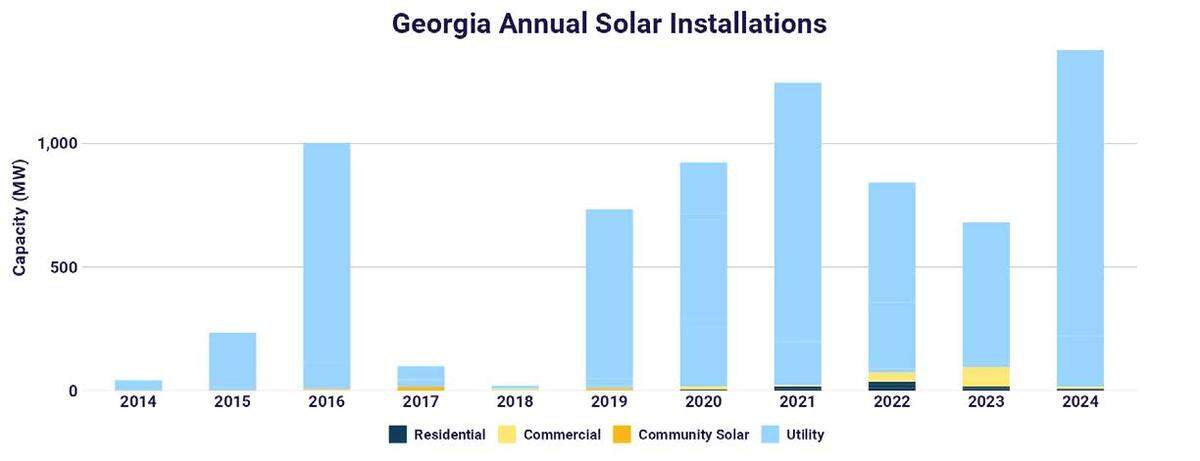
Two years ago, Georgia was 44th in residential solar, and 0.2% of all the state’s solar came from residential rooftop solar panels, according to the Solarin Energy Industries Association. The rest was from large-scale utility solar operations. As of Q3 2024, that has lowered to just 0.1%, though Georgia moved up to 39th in national rankings despite the drop, according to SEIA.
Trinity Episcopal Church in Statesboro was another pilot recipient, and the church completed its installation in July 2024. Rev. Father Charles Todd told Southern Alliance for Clean Energy the project will provide half the church’s energy needs, significantly reduce the carbon footprint and save $62,000 in 25 years.
In addition to lowering bills and creating clean energy for Georgians, the workforce to build out tens of thousands of solar projects will be greatly impacted, one expert believes.
“We can get all the solar panels here in the world, but if you don’t have people who know how to put them together and put them on you don’t have a workforce (to execute the projects),” Nicholas Creel, board member at Georgia BRIGHT, said.
Creel is also an associate professor of business law at Georgia College and State University and director of the Center for Innovation and Entrepreneurship at the university, which is in Milledgeville.
In late 2023, Creel received a $100,000 grant to train a fleet of community members in Milledgeville for one year, at no cost to them, to learn how to build and implement solar. They would learn how to become NABCEP certified, a gold standard for solar photovoltaic certification.
“(Solar for All) wasn’t just about solar panels but it’s about developing a workforce to deploy the energy of tomorrow,” he said. “We built an infrastructure and deployment plan with specific time frames. The freeze will create a bottleneck and snarl the system that will cause real and lasting damage.”
Creel said the interest in his training program at Georgia College and State University was enormous. Over 200 people applied for this program in 24 hours after it was introduced in early 2024. They only had funding for 50 people.
“They weren’t just learning how to put two wires together without electrocuting themselves,” he said. “We added an element where they learned the business and management side. They can leave their $10 an hour service job and get $35 to $40 an hour in the solar sector.”
Creel partnered with Georgia BRIGHT, knowing the nonprofit he boards would need people to help with the 16,000 homes over the next four years.
Creel said he has just one of dozens of training programs like this in Georgia that are ready to start building out solar.
Creel added there’s been a “retraction of offers,” at Georgia BRIGHT.
“The people in these programs are dumbfounded and surprised at how quickly this happened,” he said. “They want to fight but they also feel dejected. There is sadness in the air.”
Can the money freeze be thawed?
The Climate Action Campaign, an environmental justice and clean energy transition accelerator advocacy coalition said now is the time to get involved.
“If you are unhappy that this group is not getting their legally obligated funding, call your member of Congress,” Gabrielle Levy, senior director of communications at CAC, told the Ledger-Enquirer.
On Jan. 30 when the Solar For All funding freeze was announced, CAC released a statement about how vulnerable communities will pay the price for the Project 2025 agenda. Aspects of Project 2025 go along with sidelining solar projects and expanding oil and gas.
“We will continue to stand up against these attacks on our climate, our clean energy economy, and our health,” Margie Alt, director of the Climate Action Campaign, said in a statement.
Creel, as a constitutional law specialist, called the freeze a “constitutional crisis.”
“The administration has defied the courts, they are taking what was congressionally mandated funding and deciding, no, I don’t want to do it and that isn’t how are system works.”
CAC is hosting a rally in Atlanta Saturday, and 200 people have registered for attendance from across the state.
Levy encouraged participating in the rally and her director suggested calling on the new administrator, Lee Zeldin, to reverse the freeze.
“We call on newly installed EPA Administrator Lee Zeldin to reverse the Solar for All freeze and deliver on each and every one of its promised grants and contracts, as authorized by law, to the communities that need them most,” Alt said in a statement.
Editors note: This story has been updated to properly reflect the timeline of the Georgia BRIGHT pilot program and clarify that the pilot is still active with private funding.
This story was originally published February 6, 2025 at 11:46 AM with the headline "How Trump’s federal freeze is impacting Georgia’s solar economy, low-income residents."