Hundreds pleaded for less fossil fuels in Georgia Power’s energy plans. Why no change?
Editor’s note: This story is part of a series covering Georgia Power’s energy plans, the public’s response to these plans, and how the Public Service Commission influences the state’s progress in using renewable energy. Stay tuned for additional stories on whether green energy could sustain Georgia and more.
With increasing concern over climate change’s toll, and the repeated warnings from scientists and other experts about fossil fuels making it worse, Eliana Liporace was motivated to tell Georgia’s Public Service Commission what she thought of Georgia Power’s plans to use more natural gas and coal.
Liporace, a freshman at Emory University at the time, was one of nearly 1,000 people who in recent years gave feedback to the PSC, the governing body instructed to tell Georgia Power and other utility providers what they can and can’t do. At the time, Georgia Power had recently submitted its latest plans to provide electricity to millions in Georgia, a comprehensive and detailed 2023 “Integrated Resource Plan” that needed approval from the PSC.
“Georgia Power’s reliance on fossil fuels, including increased natural gas sourcing and infrastructure, not only perpetuates environmental degradation but also poses significant risks to public health and safety,” Liporace said. “I implore you to reject Georgia Power’s IRP proposal and instead prioritize investments in clean renewable energy production, battery storage, and energy efficiency programs. We cannot afford to delay the transition to sustainable energy sources any longer…”
Liporace, and hundreds of others who left comments, hoped their pleas with the energy regulators would convince them to force Georgia Power to prioritize renewable energy.
They didn’t. The PSC approved a Georgia Power plan that maintained reliance on fossil fuels.
In the last two years, Georgia’s PSC has been asked to vote on Integrated Resource Plans and customer rate adjustments, and each vote has provided the opportunity for Georgia residents to tell the PSC what they want commissioners to do or consider when making their vote.
The vast majority of those comments have opposed Georgia Power’s plans, and about 42% of all comments made to the PSC have urged the commissioners to require that Georgia Power use more renewable energy, consider the climate crisis and protect Georgians from the dangers of burning fossil fuels. But the five-member panel hasn’t listened to those comments – they have approved Georgia Power’s requests despite the opposition, and some commissioners have even suggested that the residents urging more renewable energy make up only a small minority of the state’s power customers.
“The average consumer out there wants to be able to turn the light on when they ask for it, and to be able to pay the bill,” Commissioner Bubba McDonald told McClatchy in an interview. “That’s what they want. They are not concerned whether it’s generated with coal-fired gas. There are pockets of concerns, and we hear those, but they’re just small pockets”

Those in opposition of Georgia Power’s plans sprung from every corner of the state: Decatur to Dawsonville, Savannah to Columbus and Tifton to Augusta. Doctors, high school students, college professors, public health professionals and retirees were among the many different Georgians who weighed in.
What does Georgia’s Public Service Commission do?
The PSC is made up of five elected officials who are tasked with balancing the interest of the monopoly electric utility, Georgia Power, and their 2.7 million customers around the state.
In the 150 years of the commission’s existence, its job has shifted from regulating railroads and telegraph companies, to ruling on electric companies’ plans.
In the early 1990s, the Georgia legislature created a law requiring electric companies, including Georgia Power, to present the commission with their IRP to guide the company’s operations.
The IRP legislation came after the Plant Vogtle 1 and 2 “fiasco,” according to former Commissioner Robert Baker. Baker served for 16 years, voting on Georgia Power’s IRPs beginning in 1995.
These early Plant Vogtle projects brought major nuclear energy plants to Georgia, but they ended up taking seven years longer than originally estimated and went $21 billion over budget.
“After the project almost bankrupted Georgia Power (in the late ‘80s), the state legislature stepped in and enforced more structure and planning. (The IRP) was created for alternative ways to offer energy demand, to reduce electric load and become more efficient,” Baker said.
The Integrated Resource Plan is multifaceted and complex. In this process of confirming the power company’s plan, the commission hears from different stakeholders over six months of proceedings, ranging from Georgia Power staff and their lawyers to interveners such as energy experts.
Georgia residents can take part in the process, too, through in-person testimony or online comment forum, like Liporace did.
At the end of the months-long deliberation process, which can include amendments or changes to the IRP, the commission should take all they’ve gathered into account and vote yes or no on a final IRP, requiring a majority vote for the plan to be enacted.
The plan forecasts up to 20 years of demand, and they’re supposed to be proposed every three years.
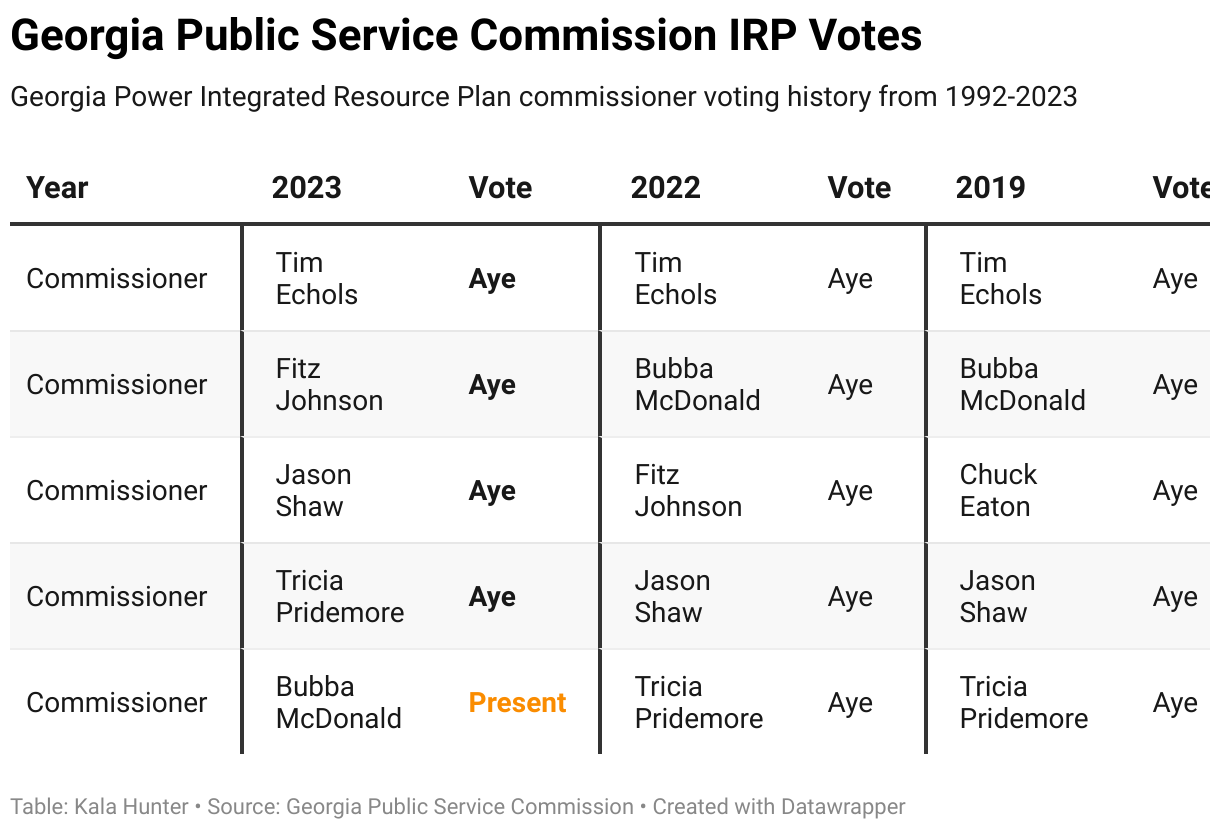
There is a state rule governing how the PSC should handle each IRP:
“The overall objective of the plan should be based on current Commission policy concerning minimizing customer bills, minimizing overall rates and maximizing net societal benefit,” the Georgia IRP state rule says.
Historically, the commissioners have considered three factors when reviewing the energy plan: safety, reliability and affordability.
But state regulators started getting feedback about energy sources – and climate impact – in the 2000s. Baker recalled groups such as the Southern Alliance for Clean Energy and the Sierra Club getting involved and coming to hearings around 2007.
More than 15 years later, Georgia has faced devastating impacts from climate change, such as increasingly powerful hurricanes and extreme heat. Those issues have prompted more and more residents to raise concern about whether Georgia Power is using enough renewable energy, and some are advocating for the source of the energy to be considered just as much as its cost, reliability and safety when the PSC considers plans from Georgia Power.
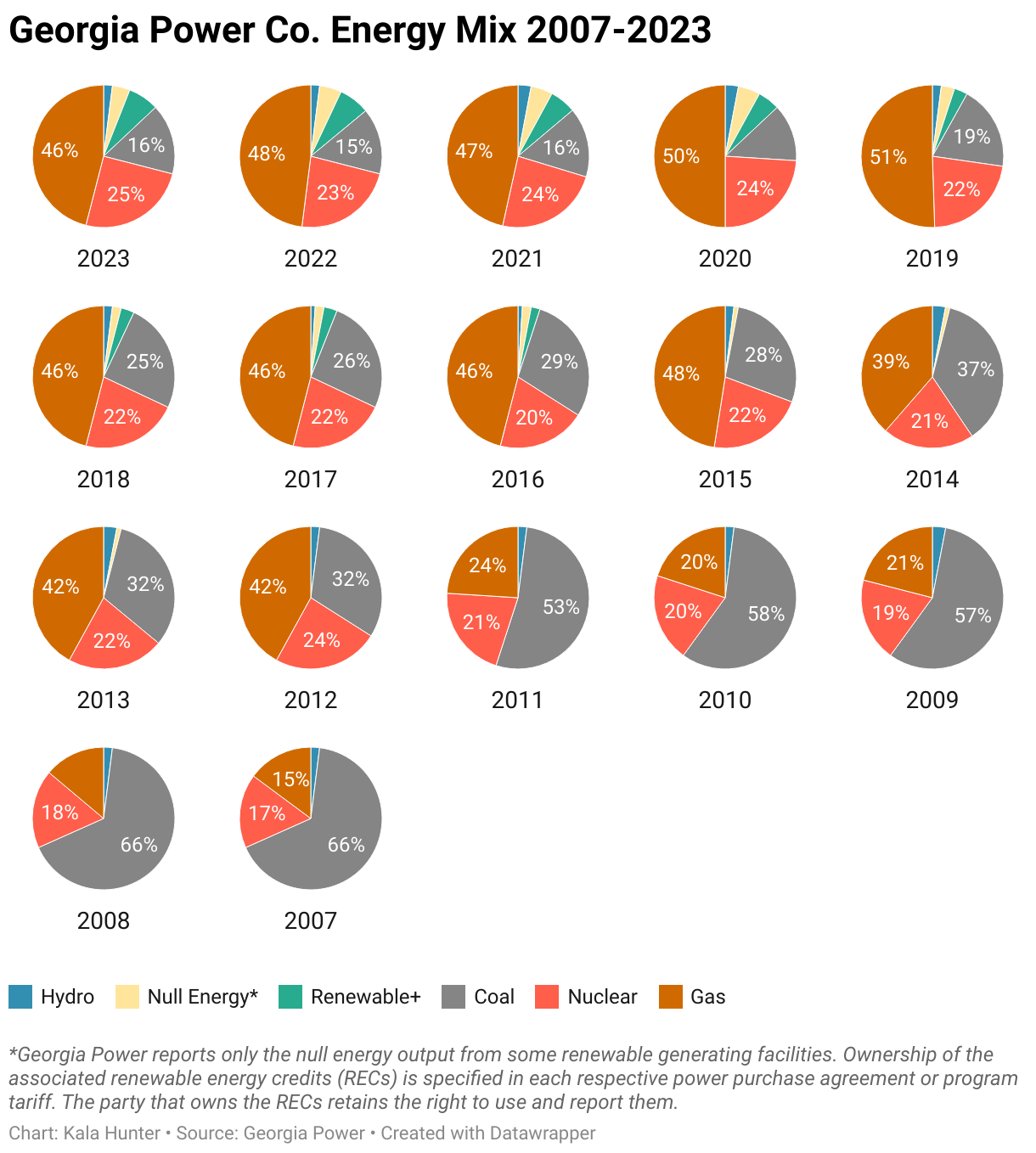
Georgia Power’s plans consistently rely on fossil fuels, such as natural gas and coal power plants that pump carbon and methane into the atmosphere, further fueling climate issues.
Since 2015, gas-fired power plants have been the primary source in the power company’s energy mix, with renewable energy making up only 7%. Coal power has decreased substantially – it provided two-thirds of the energy mix previously but was as low as 13% in 2020.
While progress has been made in recent decades to increase renewable energy, Georgia Power’s submitted plans in 2022 sought to maintain the status quo by adding thousands of megawatts of natural gas generation and maintaining thousands of megawatts of coal usage. The 2022 IRP proposed 3,400 MW of natural gas generation at Plant Yates, which emits methane. And it kept the 3,500 MW at Plant Bowen in operation, which uses coal.
A typical coal-fired power plant in the United States emits around 1 ton of carbon dioxide, the most common greenhouse gas, per megawatt-hour of electricity generated, according to the U.S. Energy Information Administration, though this can vary. Natural gas produces methane, which has a higher global warming impact. It’s approximately 82.5 times more potent than carbon dioxide, and is measured in kilograms.
A 2019 study found methane emissions range from 8 to 135 kg of methane per hour at natural gas-fired power plants.
The plan also set a target for 6,000 MW of renewable energy to be added by 2035.
The 2023 IRP update was an uncommon step. It was created because Georgia Power projected that it would need 17 times the energy than it predicted the year prior because of a surge in data center development. While Georgia Power requested more non-renewable energy in order to meet the demand, the updated plan also added 1,400 MW of combustion turbine generation at the natural gas-powered Plant Yates and 980 MW of natural gas and 140MW of biomass (burning wood).
In a push for more renewables, Georgia Power also requested 500 MW of battery storage and created a target of adding 10,000 MW of new renewable resources by 2035.

Despite adding renewables to the portfolio as part of the two plans, hundreds of people asked commissioners to deny the IRPs, citing concerns specifically about fossil fuels, their children’s future, and climate change.
These are some of the remarks, obtained through an open records request, in which commenters objected to Georgia Power’s plans in recent years.
“The science overwhelmingly proves that we must continue the effort to use other energy sources. Please don’t revert to harmful energy to our community and our earth,” wrote Jeanne McCarthy.
“This is an issue that affects my family because we’re seeing more every day the disaster of relying on fossil fuels,” wrote George Robinson from Jasper.
“Climate scientists say that we must rapidly move away from all fossil fuels in order to avoid climate disaster. It is unbelievable and irresponsible that Georgia Power is planning so much new investment in natural gas and oil and gas infrastructure,” wrote Gary Reynolds.
“There are hundreds if not thousands of Georgians who would love to help create more sustainable energy by having solar panels on their roofs and yards, have net metering, and being able to buy into a neighborhood solar group or a local EMC…Georgia Power seems more interested in supporting an unsustainable industry and pleasing (its) investors rather than the general public,” wrote 77-year-old Athens resident Lili Otsz.
Lisa Cornado, speaking in-person to commissioners in April, pleaded with them.
“Please do your job, please consider future generations, please pay attention to the climate science. Georgia Power has not, and if you have to rewrite the commission rules … to make them, then that should have happened long ago. This is a critical moment. The National Climate assessment says that your actions actions we make now will affect our world for hundreds perhaps thousands of years,” Cornado said.
Survey shows Georgians care about renewable energy
Neither Georgia Power nor the Georgia Public Service Commission has ever conducted a survey asking customers what they want or what they care about regarding cost, reliability or energy source, according to Tom Krause, the Public Service Commission’s public information officer. But state-wide and national data suggests there’s large support for renewable energy
ESource, a research and consulting firm that conducts surveys on power and water utilities across the U.S., asked the question the Public Service Commission and Georgia Power have not: do you care about your energy being renewable?
A 2024 Claritas Energy Behavior online survey found one-third of Georgia customers “strongly” believe their utility should source more renewable energy.
Georgia PSC members don’t share the sentiment
In interviews with McClatchy, commissioners Fitz Johnson, McDonald, and Jason Shaw reiterated their jobs are to ensure electricity is delivered safely, reliably and affordably to Georgia Power customers. These three commissioners said they’ve read every comment and listened to comments made in-person before deciding to approve each plan.
“We get thousands of emails and we’re fortunate to be able to hear from a large variety of stakeholders, industries and consumer groups.” Shaw said.
Johnson said he doesn’t just get feedback from comment periods or submission forms – he also gets input through talking to people when he travels around, and that he hears the most about cost and reliability.
“I know our mission here – safety, reliability, reasonable cost – it’s a three legged stool,” Commissioner Johnson said. “It’s really two and one, because safety will not be compromised … but those are the two that I hear most about when I’m traveling around -- cost and reliability.”
The comments made to the PSC didn’t fully oppose Georgia Power’s plans. A few dozen supported the IRPs, and proponents suggested having multiple forms of energy.
Susan Snyder, who wrote to the commission in 2021, urged the PSC and Georgia Power to “Keep Bowen coal units open for 8 years. Clean up coal pits to protect water” as needed and only use green energy in addition to all other energy sources.
“The near term green energy agenda is utopian. All forms of RELIABLE energy should be utilized, with very little subsidies, until the market and consumer chooses the winner,” Johnny Bearden said in April 2024, regarding a potential rate increase for customers.
Shaw, who resides in Lakeland, near Valdosta, acknowledges the climate is changing and supports clean energy.
“I’m from South Georgia, we’ve experienced three hurricanes in a 14-month period,” Shaw said. “Yes, we know that things are changing. We know that this is a worldwide issue.”
But McDonald is for coal and fossil fuel as a base load of energy in the state.
“I’m a fossil fuel person and a nuclear person,” McDonald said, adding, “I want to keep some coal because it’s a solid baseload.”
McDonald, who is the longest-serving active commissioner and has been on the decision-making board since 1998, says he’s certain about what Georgians want: an affordable power bill. He said 85% of the calls he gets in his office are about the price of electricity.
“The average consumer out there wants to be able to turn the light on when they ask for it, and to be able to pay the bill,” McDonald said. “That’s what they want. They are not concerned whether it’s generated with coal-fired gas. There are pockets of concerns, and we hear those, but they’re just small pockets.”
McDonald also suggested that some of the in-person testimony that the PSC hears comes from “hired guns.”
Commissioner Tim Echols told McClatchy via email that he has solicited social media feedback on many platforms such as Twitter/X, conducting polls and asking people about what they want. He added he is constantly conversing with people at the over-40 civic groups he attends each year.
Commissioner Tricia Pridemore did not speak to McClatchy in early January, saying the interview request was too close to the release of Georgia Power’s 2025 IRP, which was submitted Jan. 31. She said didn’t want to seem “pre-judgemental.”
Johnson said he finds out what people want by talking to customers “all the time,” whether it’s at a grocery store, or in a park or before or after a conference, noting that most people have never heard of a public service commissioner. He shared the sentiment with McDonald that the public comments that McClatchy reviewed are a “small sample size,” and added that comments will likely include just complaints.
Baker, the previous commissioner, said those who care about energy sources are a “tiny minority.”
“You can’t cater to a tiny minority at the expense of a vast majority of low-income customers,” he said.
This story was originally published February 5, 2025 at 5:00 AM with the headline "Hundreds pleaded for less fossil fuels in Georgia Power’s energy plans. Why no change?."