Lack of rooftop solar & surge in data centers in GA are among top concerns of environmental groups
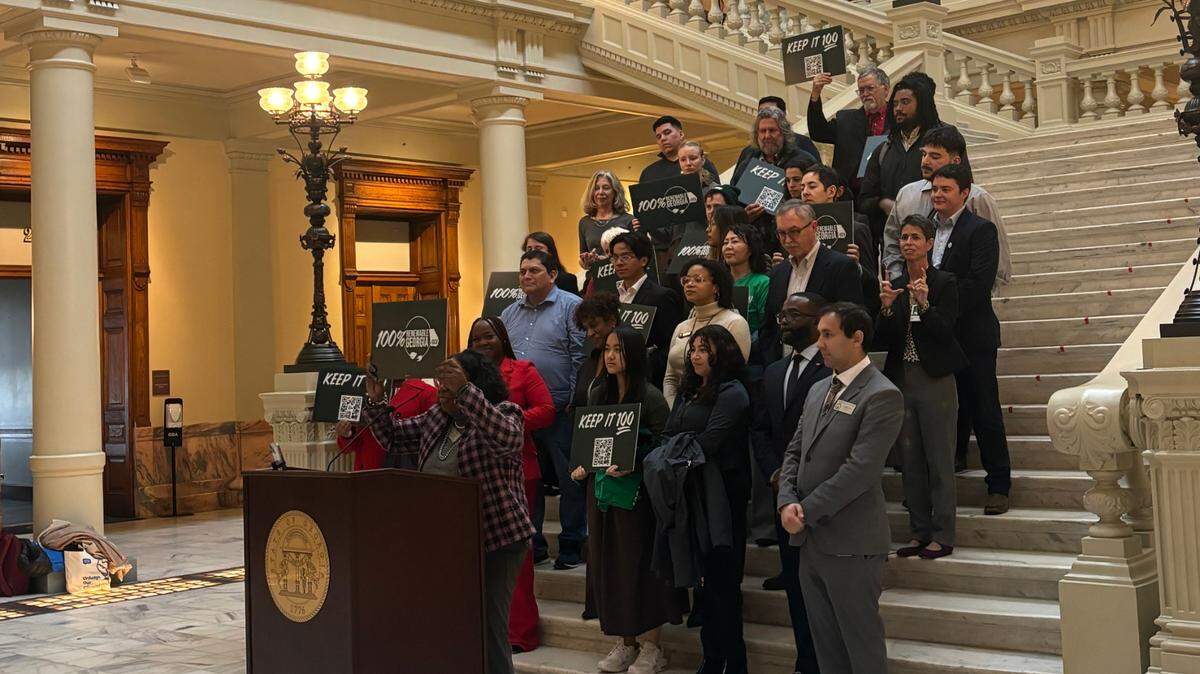
An environmental group on Monday called on state leaders to protect Georgians by pushing for cleaner, safer and more affordable sources of energy.
The organization, Georgia Conservation Voters (GCV), speaking at a press conference inside the state capital, said two of its top concerns were a lack of distributed solar, or rooftop solar panels, and a surge in data center development.
“I want you to know Georgia ranks next to the bottom 10 states for distributed solar,” Georgia Conservation Voters’ executive director, Brionte McCorkle, said in an opening statement.
Which may come as a surprise, considering that the state is a national leader in solar power manufacturing, installation and generation. However, most of the state’s solar power strides have been in utility-scale solar, not distributed solar.
Distributed solar is an energy generation approach where solar panels are installed directly on homes or businesses to produce electricity right where it’s needed, or close by.
In addition to providing power where it’s installed, when connected to electric utilities’ distribution lines, distributed solar can also help support the delivery of clean, reliable power to additional customers, according to the EPA.
“Georgia ranks poorly for distributed solar because Georgia Power blocks something called ‘net-metering,’” McCorkle said. “Without net-metering, solar panels don’t save (Georgians) money, so fewer businesses and families install them.”
When talking about the national ranking, McCorkle is referencing a study conducted by Environment America in 2022 called “Rooftop Solar on the Rise,” which ranks Georgia 38 nationally for small-scale solar generation. The same study ranks the state among the top 10 states for rooftop solar potential.
The Georgia Homegrown Solar Act was proposed last year to help address this issue through something called “community solar,” which allows businesses and nonprofits to build solar arrays and lease portions to individuals who would then get a credit on their power bill, according to Connie Di Cicco, Georgia Conservation Voters’ political director.
“Georgia Power has a program they call community solar, but it specifically prevents anyone from saving money with it,” Di Cicco said. “This bill would fix that.”
Though this solar bill didn’t pass last year, some legislators at the press conference discussed similar legislation being considered this year that would address some roadblocks discouraging distributed solar.
“We also have some bills that are going to be looking at solar and looking to expand the opportunities for Georgians that would like to get critical energy and solar power,” Rep. Kim Schofield said.
Bills seek to curb costly data centers
There’s also legislation expected in both the Senate and the House to protect Georgians from the economic and environmental burdens of data centers — Senate bill, SB 34, and House bill, HB 1192.
The Senate bill was introduced by Sen. Chuck Hufstetler, R-Rome, which “basically hopes to ensure that the costs of expanding the grid for data centers over 100 MW doesn’t get passed on to ratepayers,” according to Paul Glaze, a spokesperson for Georgia Conservation Voters.
But data centers pose more threats than just an unwanted financial expense on ratepayers. They require massive amounts of energy and water to build and operate.
“Data centers currently under construction ... already utilize 1600 MW, which is equivalent to power needed for 720,000 homes,” according a press release from Georgia Conservation Voters. “Adding four recently announced projects increases the demand to nearly 4,000 MW, enough to power 1.8 million homes.”
The House bill would pause tax breaks for data centers in Georgia, explore clean energy options for powering the data centers, invest in efficiency standards and help local development authorities assess resource consumption, according to the Seirra Club’s Georgia chapter director, G Webber.
“These data centers use tremendous amounts of energy, and in response to meeting that energy demand, we have a power company that’s insisting on building more gas facilities and is insisting on expanding polluting coal facilities in the state of Georgia,” McCorkle said.
Speakers at the press conference encouraged Georgians to contact their legislators and get involved with groups like Georgia Conservation Voters and the Sierra Club which actively advocate for this kind of environmental change at the legislative level.
“These are not a Democrat or Republican issue,” said former EPA Region 4 administrator Daniel Blackman at the press conference. “These are Georgia issues.”
This story was originally published January 29, 2025 at 4:11 PM.