Could US Fish & Wildlife buy land around Georgia’s Okefenokee, halting nearby mine?
For the last 10 months, the decision on whether a titanium mine can be built just 3 miles outside the Okefenokee National Wildlife Refuge has been in the hands of the Georgia Environmental Protection Division.
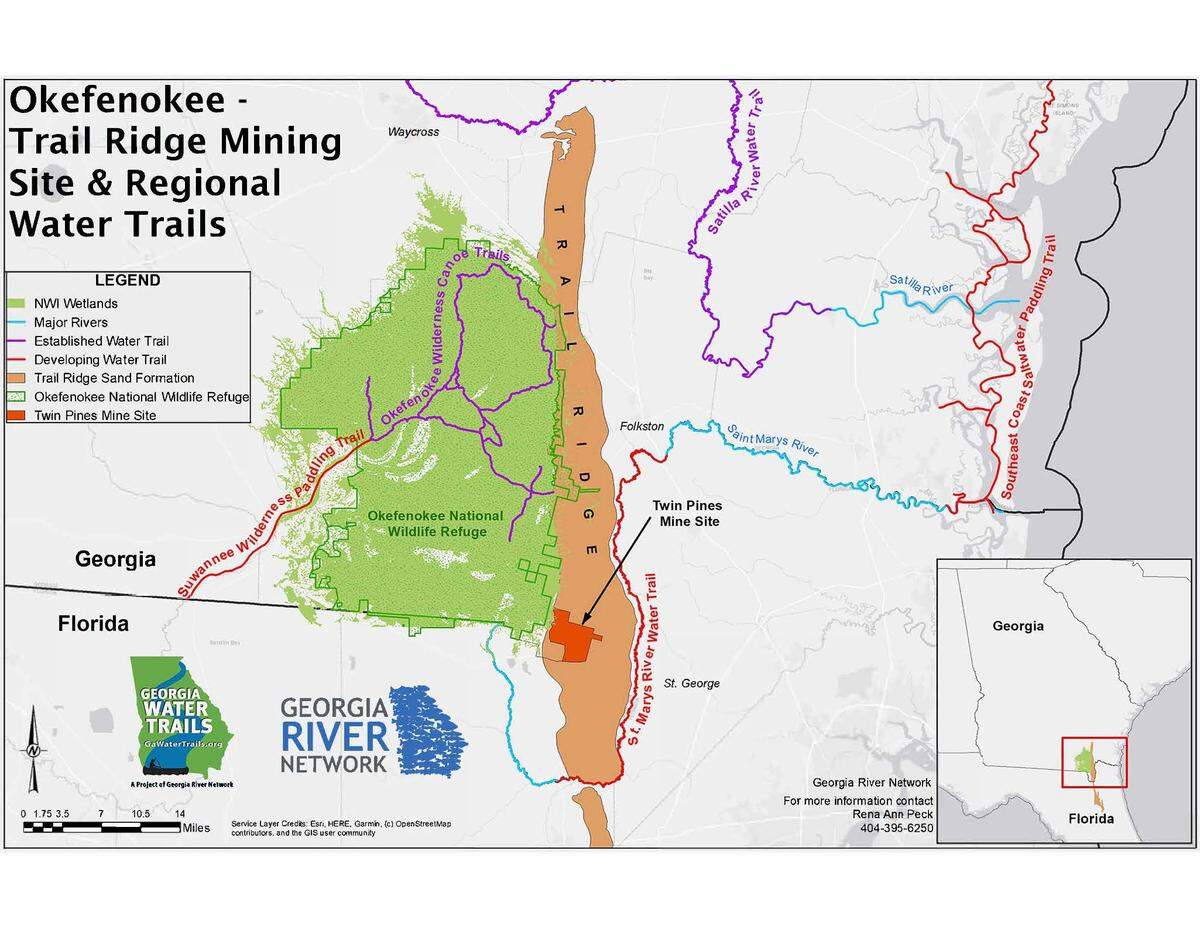
Hundreds of thousands of Georgians, including environmental lawyers, city and local governments, scientists, and environmental advocacy groups have expressed concern about allowing Twin Pines Minerals LLC to mine for titanium and zirconium at Trail Ridge near the Okefenokee refuge. Opponents say the mining operations proposed by Twin Pines at Trail Ridge, just 15 feet above the swamp, would threaten the stability of the water volume. Twin Pines would remove 1.4 million gallons of water per day to mine the resources it needs, potentially drying out peat moss, contributing to drought and fires.
In October, the U.S. Fish and Wildlife Service got more involved in the issue by considering a way to change who owns the land surrounding the refuge. U.S. Fish and Wildlife owns and oversees the Okefenokee Refuge. The agency proposed a “minor expansion” of the “acquisition boundary” around the refuge. That would allow Fish and Wildlife to buy the land, if current owners were interested in selling, and preserving it.
“When there is a threat to a natural resource, (expanding the boundary) is one of the things the USFWS considers,” said Bill Sapp, senior lawyer at Southern Environmental Law Center. “It signals that the Fish & Wildlife Service and the federal government are interested in protecting the swamp and feel that they can purchase the land and maybe turn it into a conservation easement.”
Okefenokee is the largest black water swamp in North America and clocks in at 407,000 acres of refuge space with 115,500 surrounding the refuge called acquisition boundary. The Fish and Wildlife Service wants to add 21,355 acres to the existing boundary, which would include the 8,000 acres of Twin Pines’ land. The closest point of the 8,000 acres Twin Pines owns is just 400 feet from the Okefenokee Refuge.
But even if U.S. Fish and Wildlife successfully expanded the boundary, Twin Pines would have to want to sell. A representative for the company says that’s currently unlikely. Cindy House-Pearson, senior vice president of TTL, which consults and communicates with the Georgia EPD on behalf of Twin Pines Minerals, said Twin Pines isn’t interested but “things change every day.”
Acquisition Boundary
It’s not the first time the Fish and Wildlife Service has taken this approach at Okefenokee. The agency proposed a minor expansion in the late 1990s and early 2000s when DuPont wanted to mine heavy minerals on the east side of the refuge, Michael Lusk, Okefenokee Refuge manager, said at a virtual public comment meeting on Dec. 9. In 2013 that came to fruition helping make today’s current boundary.
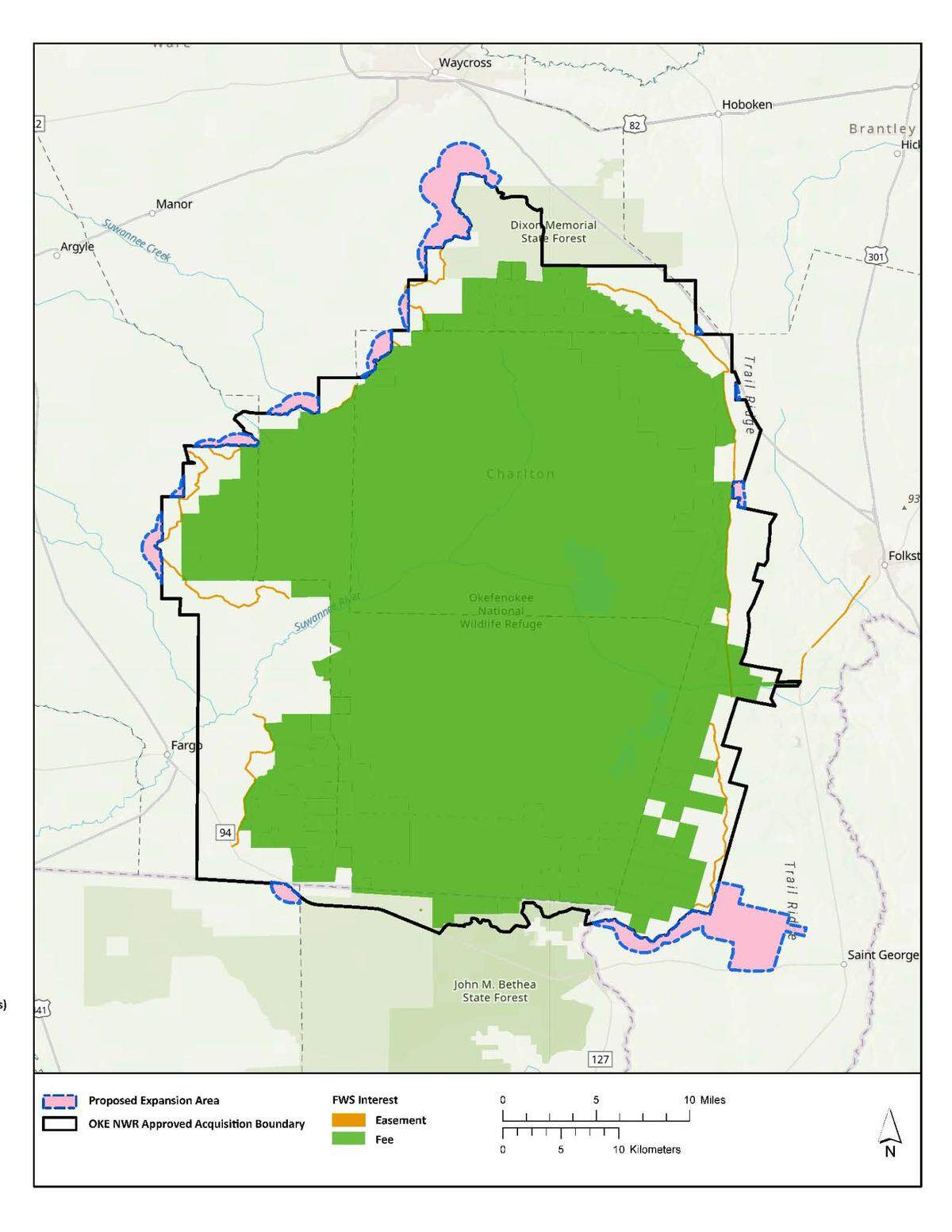
“This (expansion) would give us the opportunity to buy land from existing owners,” Lusk said. “We would be able to talk to them about setting up a conservation easement or acquiring the land.”
A main driver for the acquisition boundary expansion is to create a fire resilience buffer to control wildfire that straddles the refuge boundary and protecting the water and species. They would add a 1-mile fuel reduction zone adjacent to the refuge. The benefits include providing habitat for gopher tortoise, mitigating impacts of wildfires and severe droughts, and providing opportunities for longleaf pine restoration to benefit the red-cockaded woodpecker, according to the USFWS.
The funding to buy this land would come largely from the Land Water Conservation Fund. Some funding also would come from the Migratory Bird Conservation Fund, according to Steve Seibert, realty officer for the southeast region at the Fish and Wildlife Service.
Lusk said he has not had discussed this Twin Pines LLC to find out whether they would be willing sellers.
“I have let them know that we are proposing this minor expansion and their land would be part of the discussion. If someone else in the Fish and Wildlife Service had those discussions I’m not aware,” he said.
The minor expansion requires the Fish and Wildlife Service to review all public comments before making a decision. The deadline to make public comments to the about the minor expansion was Friday.
The expansion drew support from at least one federal lawmaker. Democratic Sen. Jon Ossoff wrote his support for the minor expansion last Wednesday in a letter to the Fish and Wildlife Service.
“It is vitally important that we continue to protect the Okefenokee Swamp and its irreplaceable ecosystem that is an economic driver for our state and a cherished treasure for millions of Georgians,” he wrote.
What about Twin Pines’ EPD permits?
Fish and Wildlife’s proposal to acquire this land and the Georgia Environmental Protection Division’s decision on whether to let Twin Pines build the mine are not connected, Sapp said. The Fish and Wildlife Service will make a decision on the minor expansion regardless of when EPD makes a decision on the permit application.
“The minor expansion plan would not affect Georgia EPD decision to file a permit in any way,” Lusk said at the virtual meeting. “All it does say is that if in the future landowners want to talk to us, we can talk to them. In the past because they are outside the acquisition boundary, we couldn’t talk to them. This would allow us to talk to them.”
Twin Pines Minerals LLC consistently tries to meet the burden of proof showing the company’s activity will not adversely impact the Okefenokee swamp, according to EPD records. Records show these two parties have been in constant contact since the public comment period for this mine application ended in March.
House Pearson told the Ledger-Enquirer that the mine “will not harm the swamp”
“We’ve done all the scientific studies to prove that the project is not going to harm the swamp and the EPA has verified those studies,” House-Pearson said.
According to a letter written in July, TTL said they were“anxiously awaiting” the EPD’s decision on the permit. “We’ve had very smart people working on this for six years now,” she said.
Sapp’s theory about why the decision to grant or deny the permit has taken so long is because of how much public weigh in there has been.
“EPD has to take a hard look at this. The public has raised so many substantive issues surrounding the weakness of Twin Pines’ application and Twin Pines has been unable to meet its burden of proof that the proposed mine will not impact the refuge,” Sapp said.
Sapp added, “We have said over and over that Twin Pines doesn’t meet that burden.”
There are over 80 scientists whose models show there is a significant risk to water if Twin Pines is granted a permit to operate, he said.
An added issue is the water that Twin Pines will draw up to mine would need to be built in a a lagoon nearby.
Sapp said the EPD is asking the mining company to build the lagoon, capture the process water, and evaporate it as a way to be in compliance.
“According to the scientists evaporating water in an area that humid is not possible,” Sapp said.
House-Person told the Ledger-Enquirer TTL expects a permit “within the next month or so”, emphasizing, “My client will mine.”
“If Twin Pines was willing to sell the property to the federal government that would be a great way to resolve the situation,” Sapp said.
The Fish & Wildlife Service will submit a recommendation internally to their Southeast Regional leadership in mid-January after reviewing all comments. If it’s adopted, the Service can work with willing landowners upon adoption.
This story was originally published December 20, 2024 at 6:00 AM with the headline "Could US Fish & Wildlife buy land around Georgia’s Okefenokee, halting nearby mine?."