What progress has been made on electrifying Macon buses? Big grants fund effort.
Macon’s streets are slowly getting quieter and cleaner through electric bus efforts funded by federal grants.
Both the Bibb County School District and Macon Transit Authority are electrifying their bus fleets with millions of dollars from federal agencies. The Bibb County School District received over $6 million in federal funding from the Environmental Protection Agency’s Clean School Bus Program for 15 electric school buses and 10 propane buses at the beginning of 2024, according to the EPA and Mothers and Others for Clean Air, a nonprofit that educates about climate change and advocates for children’s health through better air quality.
But almost a year later, these school buses still haven’t arrived in Macon. The timeline is still in “flux,” according to Stephanie Hartley, the Bibb County School District’s chief communications officer.
“The District is in the process of following the proper protocols and procedures for purchasing electric buses and ensuring they can be properly maintained upon purchase,” Hartley said.
Replacing one diesel school bus with an electric bus is estimated to rid 54,000 pounds of carbon dioxide from the air annually, according to a recent post from Drawdown Georgia, a statewide initiative aiming to reduce greenhouse gas emissions.
Mothers and Others for Clean Air is one of Drawdawn Georgia’s 2024-2025 Climate Solutions & Equity Grant recipients. Their goal is to educate school systems about access to federal money, among other things.
Over half a million children ride buses to K-12 public schools in Georgia, and the diesel exhaust they’re exposed to contains more than 40 toxic air contaminants that can cause cancer, respiratory illness and asthma attacks, according to the post from Drawdown Georgia.
The age of the school buses worsens these problems.
Nearly 30% of the state’s school bus fleets are over 15 years old, which means they pollute the most. Children riding inside these older diesel school buses breathe up to 15% more toxic emissions than a child riding in a car on the same road, according to Drawdown Georgia.
Electric school buses are better for student health and bus driver health. They also reduces air pollution levels in the community. They also save the school districts money for fuel costs, according to Mothers and Others for Clean Air’s website.
Baldwin County will also add six electric school buses to their fleet among 18 other counties in the state. Peach, Monroe and Jones counties are currently on a wait list for electric buses.
In a completely separate effort, the Macon Transit Authority plans to entirely electrify their bus fleet by 2030, according to Jami Gaudet, a spokesperson for MTA.
MTA currently has 18% of its fixed-route bus fleet electrified, and three more electric buses should be added in 2025 followed by three more by the end of 2026, according to Gaudet.
These new buses are more efficient than the electric buses currently part of the fleet, according to Gaudet. They’re 10 feet smaller with a top speed of 56 miles per hour. Plus, they can go 137 miles without needing a charge and typically only take about two to three hours to charge.
A diesel bus costs about $450,000 and an electric bus costs about $900,000, according to Gaudet. However, diesel fuel costs about $50,000 per vehicle per month while the power bills for each electric bus are only around $1,000 a month.
“Now here’s what makes (electric bus funding) all possible: the federal government pays for 80%, local taxpayers pay for 10% and MTA pays for 10%,” Gaudet said. “So a $900,000 bus costs us $90,000 right now, which is a game changer.”
In 2017, the federal government created a grant for electrifying transit. In 2019, MTA was awarded this grant as the only grantee in Georgia and one of only six transit authorities in the whole country that got the “top prize,” according to Gaudet, which was $1.75 million.
That made MTA the first transit authority in Georgia operating electric buses on public roadways, according to Gaudet. The University of Georgia and Hartsfield-Jackson International Airport had electric buses before MTA, but only operating on their respective campuses.
MTA has also electrified six of 16 paratransit vans, according to Gaudet.
In addition to the federal grant, MTA was awarded $1.1 million in SPLOST money for charging stations, which included a dozen individual bus charging stations, as well as four paratransit charging stations, according to Gaudet.
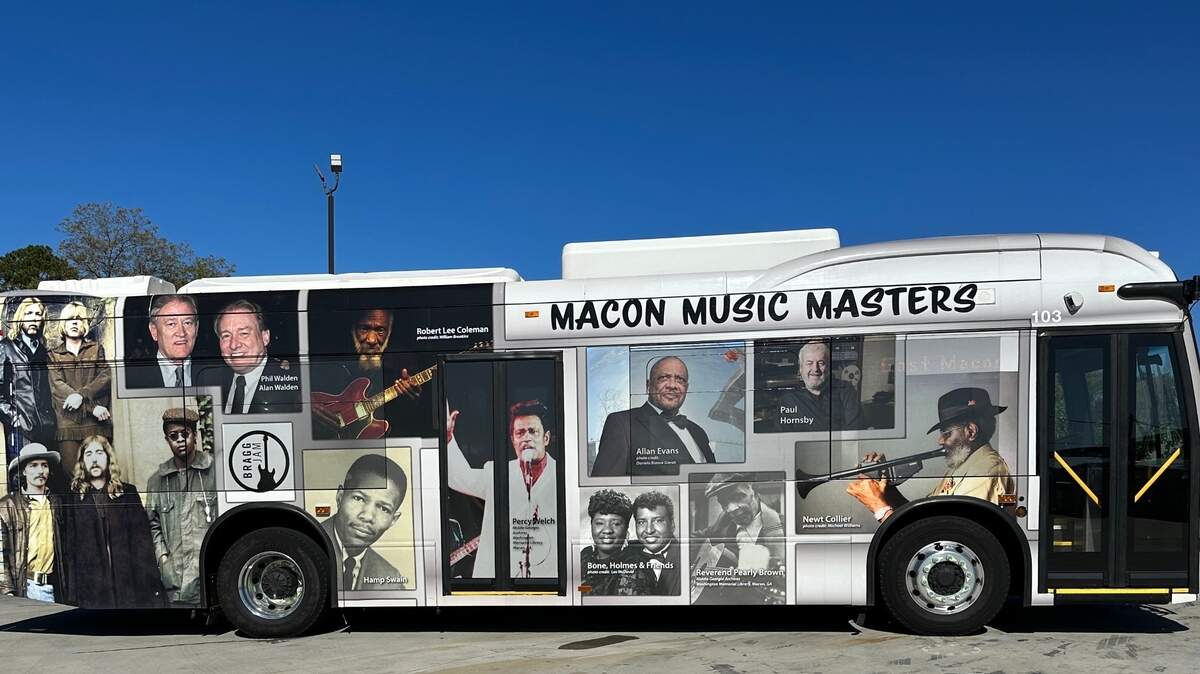
The four electric buses in the fleet have been given names: Sparky and Bolt were the first two to join the fleet in 2020, and then Toby, named for Mercer’s mascot and Melody, which is decorated with 20 of Macon’s music stars.
This story was originally published November 20, 2024 at 6:00 AM.