Power company named after Cherry St. prioritizes solar. It hopes to expand in Macon soon
Solar panel systems in Macon are already contributing energy to local buildings, and more are on the way through Cherry Street Energy.
Cherry Street Energy, a private solar power company, has its 10 systems powering local government buildings and property. Macon-Bibb County was Cherry Street Energy’s very first customer in 2015. The company’s other customers since have included the city of Atlanta to Emory University to Delta Airlines.
Cherry Street Energy CEO Michael Chain said the four new sites Mayor Lester Miller could approve are at the Brookdale Resource Center, the Elaine Lucas Senior Center, the Freedom Park Recreation Center and the Knight Road County Public Works Building. Those locations are “shovel ready, permit ready, excited to go,” Chanin said.
The systems can be installed in three different ways: on the ground, on rooftops and as parking canopies.
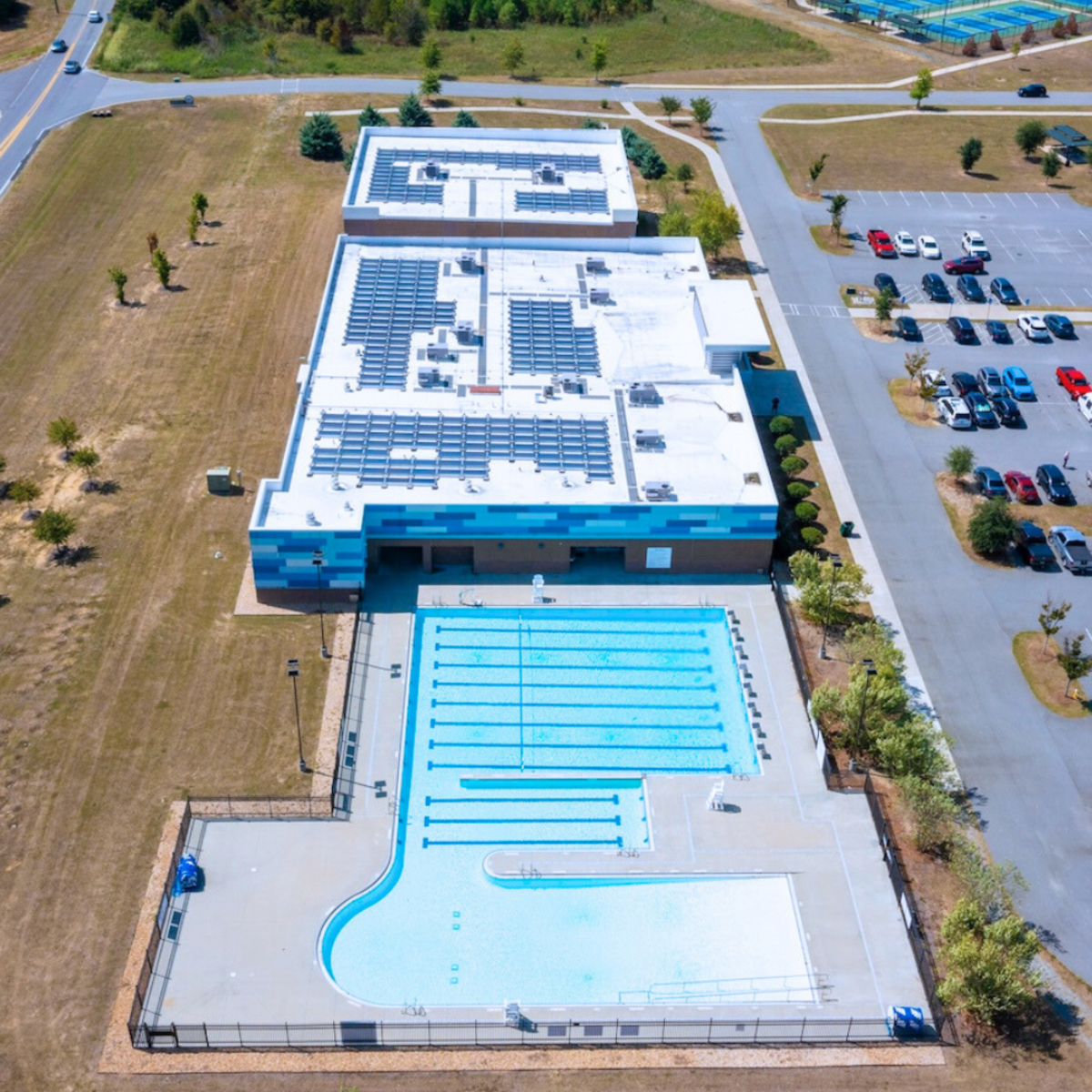
The 10 sites that Cherry Street Energy has already installed are at the Bibb County Sheriff’s Office, the Animal Welfare Center, the South Bibb Recreation Center, the Tax Commissioner’s Office, North Macon Park, the Rosa Jackson Center, the Frank Johnson Center, the Delores Brooks Recreation Center and the Bloomfield-Gilead Recreation Center, according to Ben Smith, director of marketing at Cherry Street Energy.
Altogether and to date, just these systems have generated over 3 GWh of energy, which is equivalent to over 450 homes’ electricity use for one year, 1.6 billion mobile devices charged and over 2,100 metric tons of Scope 2 emissions avoided, according to Smith.
“What’s driving the industry more than anything is price, and solar is the lowest cost of energy generation,” said Ben Damiami, chief technology officer of Cherry Street Energy. “Plus, the power that you pay us for is renewable, sustainable and on-site.”
With on-site solar, there are no fuel costs, which allows Cherry Street to offer electricity at a low price while maintaining competitive rates, according to Chanin. The company also handles everything from engineering and design to installation.
“Solar panels are a technology, they’re not a fuel,” said Chanin. “The technology had gotten to a cost where the power we can produce from a solar panel is less expensive than the utility power.”
Cherry Street’s solar panels don’t cost the customer either, Chanin said.
“Out of the gate, it was like my life savings,” Chanin said. “But now we’ve got these incredible investors and capital markets that support it.”
Cherry Street Energy receives funding from regional banks such as Synovus and national banks such as Bank of America, which covers about 70% of the infrastructure costs through loans. The rest is funded by investors, with the company’s main investor being EBSCO Industries, a family office based in Birmingham, according to Chanin.
The panels directly power the buildings where they are installed, generally offsetting about 30% of a facility’s total energy consumption, according to Damiami.
The solar industry is also great for the job economy on top of being better for the environment, according to Damiani and Chanin.
“Solar accounts for about 4 to 6% of our energy nationwide and it’s created well in excess of probably four or five hundred thousand jobs at this point,” said Damiani. “You compare that to the coal industry that supplies more like 30% of the power, but only supplies about forty thousand jobs.”
Solar provides new job opportunities for construction workers, electricians, data analysts, data scientists, bankers and even policy professionals, according to Damiani.
Cherry Street Energy started in 2015 when Georgia House Bill 57 allowed for private sales of electricity, also known as the Solar Power Free Market Financing Act of 2015.
Though named after Macon’s downtown Cherry Street, the power company is based in Atlanta. The inspiration for the name came from the founder and CEO, Chanin, who grew up in Macon, and whose grandparents had a clothing store on Cherry Street.
game-changing grant
a diesel bus costs about $450,000 and an electric bus costs about $900,000. diesel fuel costs us about $50,000 per vehicle per month per month. georgia power bills for each of our electric buses is around $1,000 a month. Now here’s what makes all this possible (our bus funding): federal government pays for 80% local taxpayers pays for 10% and we pay for 10%. So a $900,000 bus costs us ninety thousand dollars right which is which is a game changer for us.
This story was originally published November 15, 2024 at 6:00 AM.