What’s the timeline for Macon’s Ocmulgee Mounds to become a National Park? Big step soon
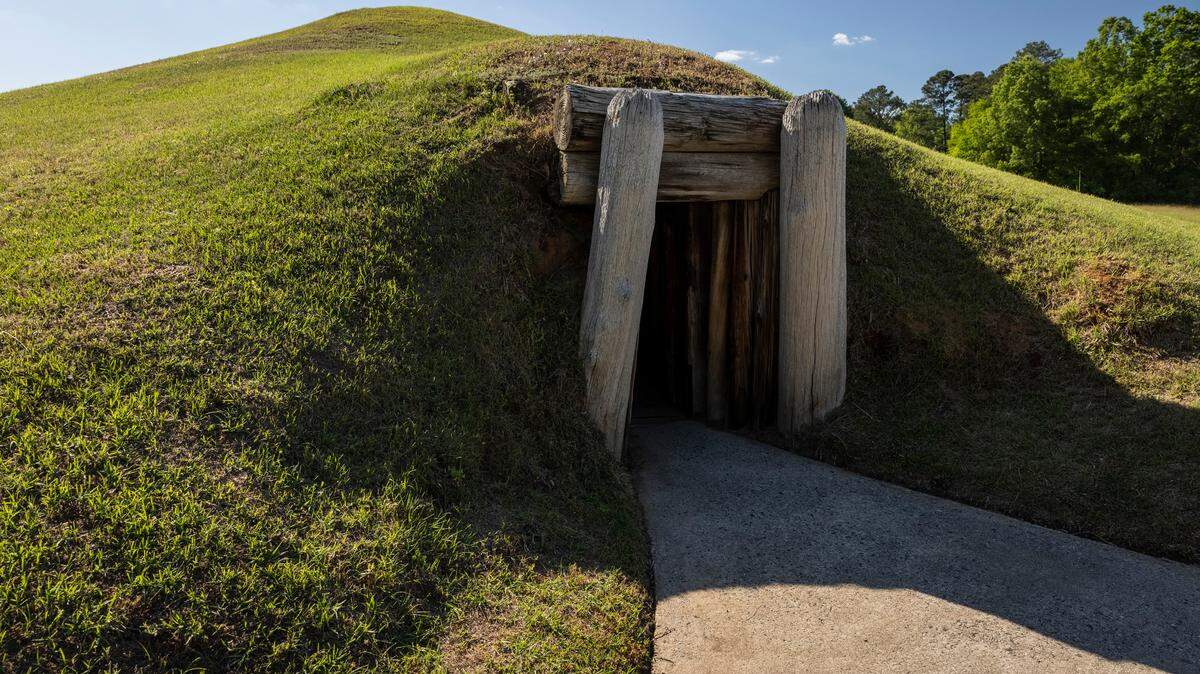
The second major step in the process of the Ocmulgee Mounds becoming Georgia’s first and only national park will take place in just over two weeks.
A federal bill to make Macon’s park a national park will be considered by the U.S. Senate Committee on Energy and Natural Resources on Nov. 19 to further the legislation determining whether Ocmulgee Mounds National Historical Park will be promoted to a national park and preserve.
There are two prospective, identical bills that could make the Ocmulgee Mounds a national park and preserve: one in the House and one in the Senate.
Whichever bill moves quicker would need to pass through the full House and Senate and then be signed by the president. None of those milestones have been reached, but if the Senate bill gets through the committee on Nov. 19, it will move to the full Senate.
One bill was sent to each branch of Congress so that multiple members of both chambers could sign onto the bills, according to Seth Clark, the executive director for Ocmulgee National Park and Preserve Initiative and a Macon-Bibb County commissioner.
This effort has “overwhelmingly” gotten bipartisan and bicameral support with Georgia Democratic Sen. Jon Ossoff and Republican Rep. Austin Scott as “standard bearers” for the issue, according to Clark.
What would this bill do?
In addition to making the mounds a national park, the bill would also draw a brand new boundary for preserved land.
The boundary for the preserve could span up to 25,000 acres through Twiggs County and into Houston County, following the floodplain of the Ocmulgee River, according to Clark.
In 2019, the mounds were renamed from a monument with 750 acres to a national historical park with around 2,900 acres. Today, the National Park Service owns around 2,000 of the 2,900 acres, according to Tracie Revis, the director of advocacy for the Ocmulgee National Park and Preserve Initiative.
The remaining thousand or so acres are privately owned. The National Park Service doesn’t claim land by eminent domain, which is the process of the government seizing private property for public use.
If Congress passes the bill, the boundary of the national park will not be expanded, just the boundaries of the preserve, according to Revis.
Protecting land can help fight climate change
“I think it’s underappreciated what the expansion of these public boundaries in Middle Georgia mean for climate change mitigation,” Clark said.
One of the most effective ways to offset climate change is the protection, restoration and mitigation of wetlands and tree forests, according to Clark.
“It’s really one of the only ways out,” he said.
Additionally, this expansion at any scale will constitute one of the largest expansions of public hunting and fishing access “in my lifetime,” Clark said.
The Ocmulgee corridor is home to an isolated population of black bears and shoal bass, which is endemic to only three rivers in the world. It’s the spawning ground for the American sturgeon and is also one of the largest, longest undammed sections of bottomland hardwood swamp habitat in the American southeast.
“(Those animals) are all still here because that floodplain is protected,” Clark said. “The habitat itself lends to offsetting carbon emissions and it’s great.”
Annual visits could surpass 1 million
If passed by Congress, the national park and preserve’s visitor count is expected to increase more than six-fold by 2031, going from nearly 208,000 visitors annually to over 1.3 million visitors annually, according to Diamonds in the Rough, a study commissioned by the National Parks Conservation Association.
The study was released in 2017 and was conducted by economists at the University of Tennessee Department of Agricultural and Resource Economics.
“The National Park and Preserve could take Macon to another level and make us a destination city where people really want to travel, not just to stay a weekend, but to live here,” Macon attorney Brian Adams said in the study.
The national park and preserve is projected support over 3,000 jobs and add $206.7 million in annual economic activity in the region, according to the study.
“It’s a very ambitious reimagining of the Middle Georgia economy,” Clark said. “It’s reimagining Macon’s economy into one focused on national park conservation.”
Partnership with native tribe
The bill also creates a co-management partnership with the Muscogee (Creek) Nation.
There are only four other parks in the country that are co-managed by tribes, according to Revis, who’s also a citizen of Muscogee (Creek) Nation.
Muscogee (Creek) Nation is the fourth largest Native American tribe and is native to Middle Georgia but is now located in Oklahoma.
“This is our ancestral homeland,” said Revis. “These are ancestral mounds and our people are buried here.”
Prior to the Muscogee Creek tribe being exiled to Oklahoma in the 1830s, they stewarded this land for over 17,000 years.
“I don’t think that this community and this region should continue stewarding this land without reconciling with its original stewards and reconciling with what we did to them,” Clark said.
Plus, the tribe’s technical expertise in land management is well documented, according to Clark.
“They have thousands and thousands of acres of conservation in Oklahoma,” Clark said. “And they do a fantastic job.”
This story was originally published November 1, 2024 at 6:00 AM.
CORRECTION: Rep. Austin Scott was incorrectly identified in a previous version of this story.