The DOE is banking on Georgia electric companies to test new power grid technologies
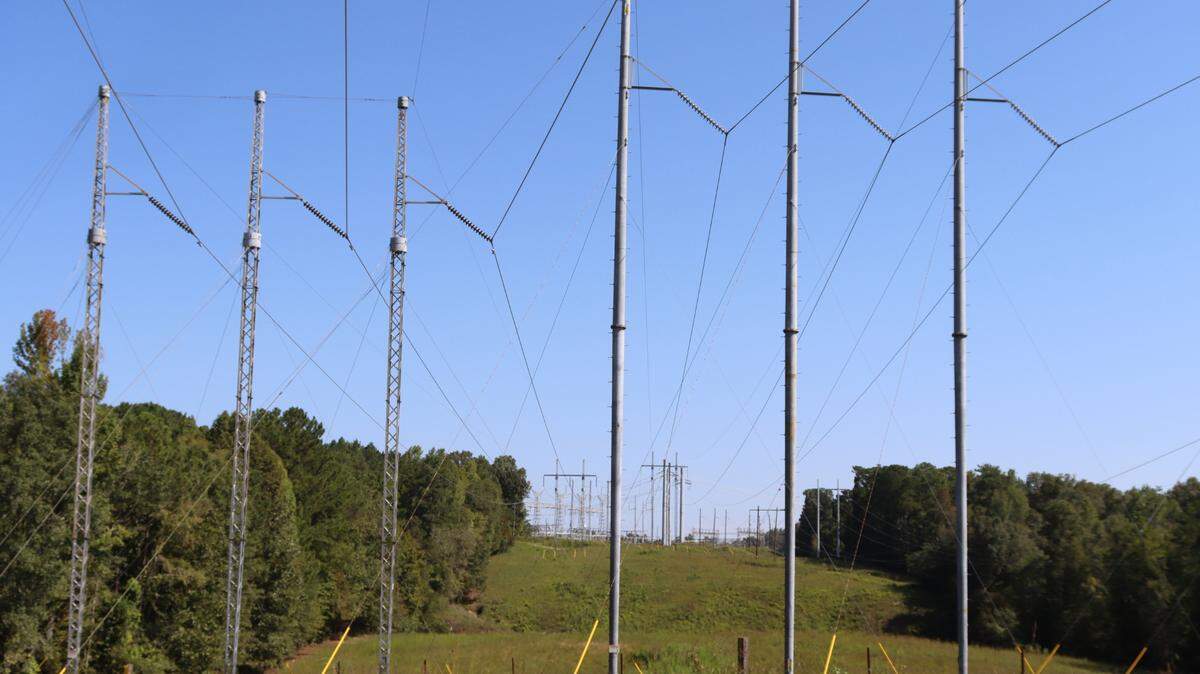
Power companies across the U.S., including in Georgia, have to deal with outdated infrastructure when they’re trying to provide reliable and clean energy sources, hindering progress.
In many cases, there are simply not enough transmission lines, or conductors, which experts say stall new renewable energy projects from coming online. This issue, along with the need for a more resilient grid and infrastructure from extreme weather events brought on by climate change, prompted President Joe Biden’s administration to award $2 billion to 38 power companies across 42 states last week.
“In order to reach President Biden and Vice President (Kamala) Harris’ climate and clean energy goals, we need to more than double our current transmission capacity in just over a decade,” John Podesta, senior advisor to the president for International Climate Policy, said in an Oct. 18 Department of Energy press release.
In Georgia, the Georgia Power Company and Georgia Transmission Corporation were awarded a combined $257 million of the $2 billion from the DOE to test new transmission technologies and infrastructure. The Tennessee Valley Authority, which gives a small slice of energy to Georgia, was also awarded money to work across nine states, but it isn’t clear how much of Georgia will receive those benefits.
This endeavor, seeking to help the Investment in America Agenda, is the largest grid investment in U.S. history, according to Secretary of Energy Jennifer Granholm. The funds have been distributed in several rounds, beginning in October 2023. With the latest additions of funding, $7.6 billion have been portioned out to eventually update 1,650 miles of transmission.
The efficacy of moving energy
Of the money going into Georgia, $160 million was awarded to Georgia Power and $97 million went to the Electric Membership Cooperative, which is served by the Georgia Transmission Corporation. Each will have different projects to test transmission technology.
Georgia Power owns 12,626 miles of transmission lines that serve its 2.7 million customers throughout the state. The company said it plans to use the money to do “dynamic line rating,” which tests how much power can be carried through existing transmission.
“These will help serve existing and new customers and connect a growing amount of clean generation required to serve Georgia’s growing electricity needs … and unlock additional opportunities for renewable generation within critical locations and disadvantaged communities,” the Georgia Power statement reads.
Daniel Tait, an Alabama-based researcher at the Energy and Policy Institute and a pro-renewables watchdog, is excited about this funding.
“These technologies would free up space in the transmission system for a new load to come in,” he said. “Renewable projects are often limited by available transmission space or the fact that there will be such crazy upgrade costs to do something.”
While Georgia Power did not give more detail on the number of projects they would be able to carry out with this money, Tait believes “a good amount can be done with $160 million.”
But he also said this should have been done a long time ago.
“Utilities are very reticent and gun-shy about new technology, there is a cultural component of not taking risks that is deep in their DNA,” Tait said. “I’m hopeful these projects overcome some of that reticence of fear.”
Georgia Power is committed to sharing its insights and learnings with other utilities during the testing of this new technology and says it will have multiple community benefits, according to a Grid Deployment Office fact sheet. The company must deploy some of this technology in disadvantaged communities per the Justice40 Initiative, which set a goal that 40% of the overall benefits of federal investments flow to communities marginalized by under-investment and overburdened by pollution.
Like Georgia Power, the Georgia Transmission Corporation will test a new method of electricity transmission. The Georgia Transmission Corporation is a not-for-profit cooperative owned by 38 Electric Membership Corporations (EMCs), owns more than 5,000 miles of transmission lines and delivers power to 4.5 million Georgians.
The transmission corporation will work with 11 other states – project partners – to build, rebuild, or re-conduct transmission lines using Advanced Overhead Conductors and then create a design guideline to be adopted and tested by other consortium members.
“This technology can push more current to double the capacity on an existing line without having to build a new one,” said Anne Lerner, public affairs director of Georgia Transmission Corporation. “If you can increase capacity you may not have to build another tower or lines, and it will help strengthen capacity and resiliency.”
Resilience to Extreme Weather
Other states received funding that the Department of Energy says will “harden the electric grid, to better face increasingly extreme weather.”
“We need our grid better adapted to storms like Hurricanes Helene and Milton – and other extreme climate disasters like the wildfires out west,” White House National Climate Advisor Ali Zaidi. “Today’s investment will do that. And today’s investment will lower energy costs and bolster grid resilience.
Hurricane Helene put 117 of the Georgia Transmission Corporation lines offline and nearly 200 substations, Lerner said in an email.
Georgia Power CEO, Kim Greene wrote in a Ledger-Enquirer op-ed more than 8,300 power poles, 350 transmission structures, 1,000 miles of power lines, and 4,500 transformers were damaged during Hurricane Helene. This caused 1.5 million Georgia power customers to go offline.
It is not clear how the Georgia projects will harness resilience to extreme weather. However, North Carolina funding recipient Randolph Electric Membership Corporation will improve service reliability to harden the grid, and reduce outages from severe weather events, according to the Department of Energy.
This story was originally published October 25, 2024 at 5:00 AM with the headline "The DOE is banking on Georgia electric companies to test new power grid technologies."