
Mercer professor helps develop important weapon in the fight against COVID-19
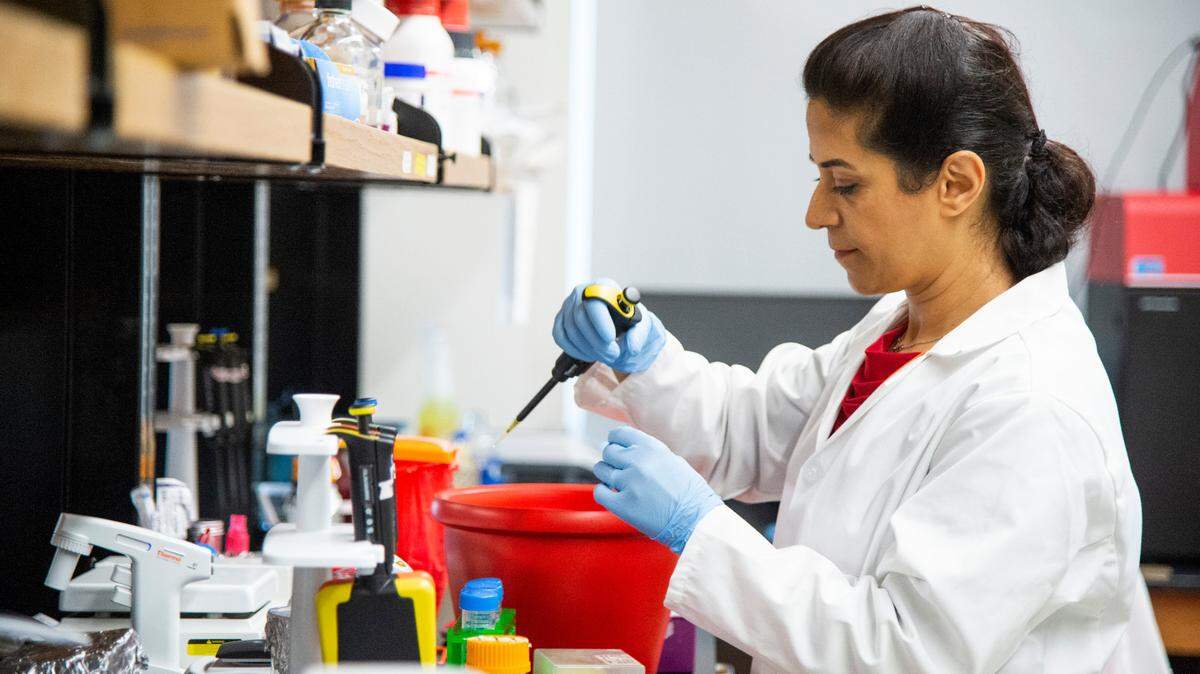
As the COVID-19 pandemic rages on due to the spread of the delta variant, a Mercer University professor’s work with her colleagues at Auburn University could play a key role in winning the war.
Dr. Sahar Hasim, an assistant professor biology at Mercer who specializes in microbiology and Immunology, is part of a team of scientists and engineers that created a device capable of providing instant COVID-19 test results.
“Hopefully, this helps people during this unfortunate pandemic; that’s the dream of all the researchers in this field, to help limit the spread of the virus. The long-term plan is to make an at-home version of this device to help detect the virus at a very early stage,” Hasim said.
Auburn’s Masoud Mahjouri-Samani, assistant professor in electrical and computer engineering, led the project along with Michael C. Hamilton, a professor of electrical and computer engineering and director of the Alabama Micro/Nano Science and Technology Center.
Team members included Marcelo A. Kuroda, associate professor of physics; Parvin Fathi-Hafshejani, first author and graduate student in electrical and computer engineering; Nurul Azam, graduate student in electrical and computer engineering and Lu Wang, graduate student in physics.
“I love collaboration, especially in an interdisciplinary area,” Hasim said. “It wouldn’t be possible without the help of everyone in the group. I always tell my students to work as a group because you can’t imagine what you can accomplish when working together.”
The device works by identifying a virus spike protein. When a protein interacts with an antibody in the testing device, it sends a signal to the device — or, to be more technical, “it impacts the electronic properties of the atomically-thin monolayer 2D material,” according to a release from Auburn. It replicates, in a way, the body’s own antibody response to the virus.
“At this stage, the device fabrication and functionalization process is done at the lab-scale, which takes a couple of days to fabricate. Then we just need to add a drop of the antibody sample, and the signal will be detected immediately,” Hasim said.
Hasim says the most challenging part of the development process was the initial communications between the engineers and biologists to explain the project and discuss initial findings. However, as the project moved forward, the communication and understanding between partners improved.
Engineers are working on producing faster results with an eye toward large-scale production, while Mercer students are testing the two-dimensional material. The team intends to apply for grants to help fund the expanded project.
Although the device was made to respond to the coronavirus spike protein, it can be modified to detect other pathogens.
Hasim thanked the biology department at Mercer for their help and collaboration on the project.
“I’m so glad that I did something for Mercer,” she said. “This would not be possible if Mercer did not provide me with this opportunity to run a comparative program and have collaborative research activities with other universities.”
This story was originally published September 23, 2021 at 11:48 AM.