
Most signs are promising for Georgia's 2016 economic outlook, midstate leaders hear
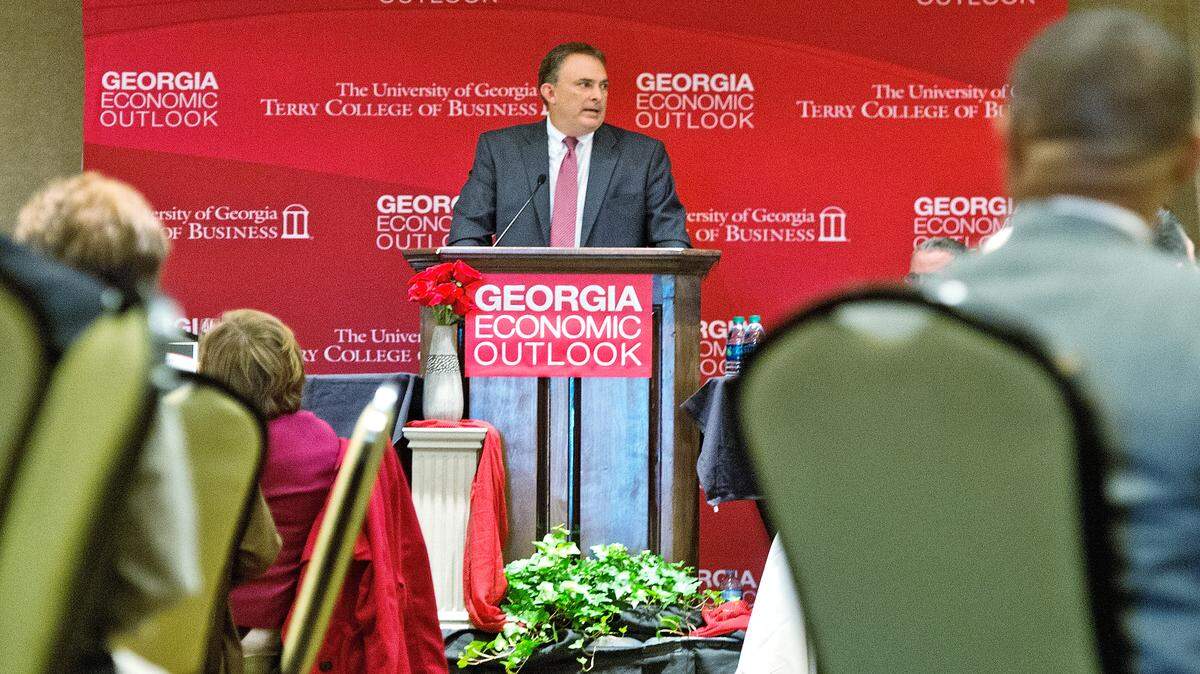
The pace of Georgia's job growth will diminish in 2016, but other indicators bode well for the state's economic outlook this year, community leaders were told Friday.
About 200 people from across Middle Georgia heard experts give their economic forecasts for the region and state for 2016. The annual gathering offers an assessment of how the state's major industries and financial strategies may fare.
"Georgia's economy will continue to grow, and it will expand faster than the nation's economy," said Benjamin Ayers, dean of the Terry College of Business at the University of Georgia, who presented the state outlook.
Several things contribute to that optimism, he said. Georgia has a large number of major projects in the development pipeline, and the state's economy "will get more leverage from the housing recovery ... and we will get more bang for our buck than the national economy does," he said.
Also, the state will see faster population growth than the nation. And continued low oil and gas prices are much better for Georgia's economy than for the U.S. economy, he said.
"Unfortunately, the pace of job growth will slow in 2016," he said. Ayers predicted that the nonfarm employment rate for the state would increase by about 2.3 percent this year, smaller than the 2.7 percent gain estimated for the state in 2015.
Georgia is expected to outperform the nation as a whole, so "we will have growth, but it will be slower" than last year, he said.
Several relocation and expansion projects that have been announced since 2012 contribute to the feeling of optimism, he said. And because it takes a long time to build out those projects, many of them "will continue to provide a tail wind" to the state's economy. He mentioned Geico's ever-expanding presence and the new Kumho Tire plant, expected to be in operation by this spring. Both facilities are in Macon.
Another reason the state will do well in 2016 is that Georgia is the "sweet spot" in the middle of the Southern auto corridor, Ayers said. It is home to or close to major assembly plants and suppliers, it has several interstates and there's access to rail and ports.
Home building and real estate development have always been important to the state's economy. That driver of growth finally got traction in 2012 and has continued to move forward. He forecast that construction of single-family homes would increase by about 23 percent this year, and that multi-unit residential facilities would increase by about 10 percent.
"We believe existing single-family home prices will rise by 5 percent in Georgia in 2016," he said. "We think lower-priced homes will appreciate the fastest."
After the meeting, Pat Topping, senior vice president of the Macon Economic Development Commission, said he was particularly interested in hearing what Ayers said about the kinds of jobs that need to be filled.
"We've got a major workforce development program this year, and we want to identify what the skill gaps are (and) what are the jobs people are having trouble finding," Topping said. "We would hook them up with our training partners, which are Central Georgia Technical College and our universities and the (Bibb County) Board of Education and make them aware that these are the jobs people are looking for right now and what can we do to address that.
"And then we want to know what kind of skills do they anticipate in the future, so we can get ready for that."
Antonio Saravia, an assistant professor of economics at Mercer University, presented information focused on Middle Georgia.
Saravia based his presentation on surveys conducted by Mercer at the end of 2014 and mid-year 2015. The surveys were emailed to 2,681 people, with 220 responding in 2014 and 391 for the mid-year 2015 survey.
The 2014 survey showed that business owners were optimistic for the prospects in 2015. But while the 2015 survey indicated Middle Georgia business owners seemed positive about the first half of the year, they were cautiously optimistic about the second half.
One reason for that sentiment is "a large number of businesses did not identify the second half of 2015 as a good time to expand their operations," Saravia said.
The main obstacles to expansion, according to the surveys, were federal government regulations and/or red tape, taxes and quality of labor.
Also, businesses felt it was "very difficult" to attract talent to the area to fill vacancies they had. Among the main obstacles were high salaries, experience and proper training, he said.
"My takeaway from the survey ... is if we can do something for Middle Georgia, it would be reducing regulations and red tape (and) reducing taxes. That will allow us to climb to a level you would be proud of."
The next survey will be sent out in February, and he encouraged attendees to respond to it.
To contact writer Linda S. Morris, call 744-4223 or follow her on Twitter@MidGaBiz.
This story was originally published January 15, 2016 at 5:02 PM with the headline "Most signs are promising for Georgia's 2016 economic outlook, midstate leaders hear ."