
'Nice increases' in recent years at Middle Georgia Christmas trees farms
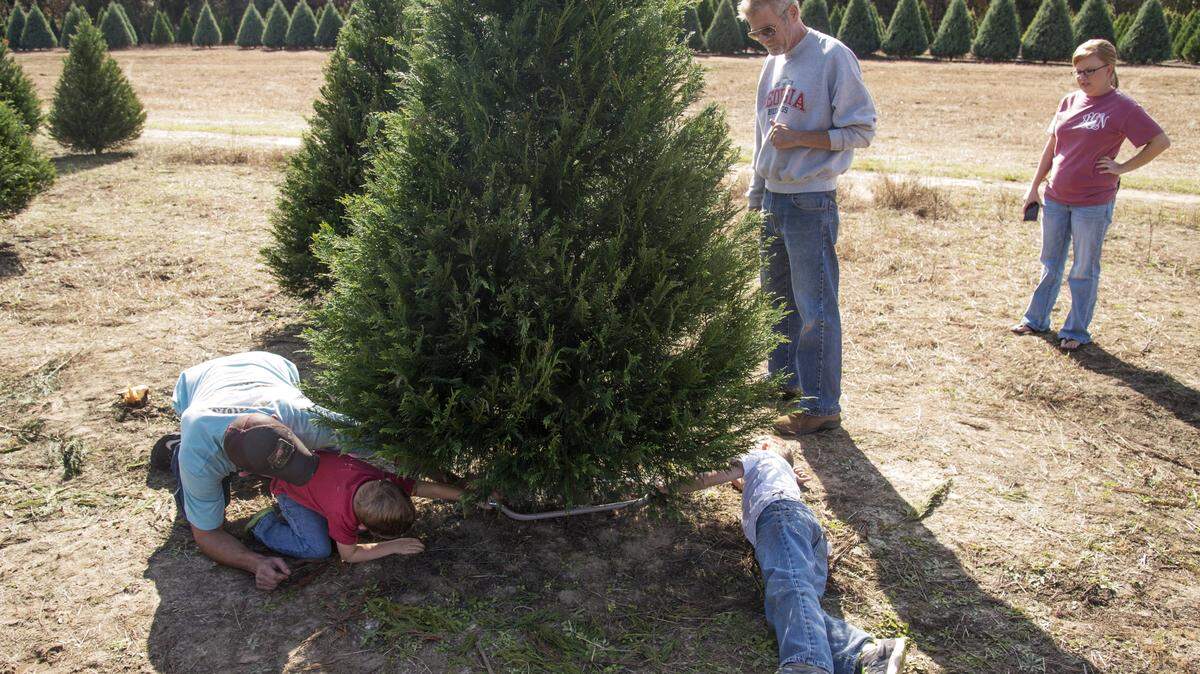
It's hard to think of anything that smells like Christmas more than a freshly cut Christmas tree.
And a number of Christmas tree farms sprinkled throughout the state -- many within 50 miles of Macon -- opened this weekend to provide pre-cut or cut-your-own trees.
Christmas tree growers have been preparing all year to help people fill their homes with the scent of evergreen. Actually, growers have been tending to the more popular-size trees, which are about 6 feet to 7 feet tall, for about six years.
Linda and Jim Wilson, owners of Our Cotton Pickin' Christmas Tree Farm in Hawkinsville, had their family Thanksgiving Day meal Wednesday so they would be ready for customers on Thursday.
The Wilsons planted their first trees in 2002 and opened the farm in time for Christmas 2007. They have about 3,000 trees on 60 acres. The land where the trees are now was once cotton fields.
The Wilsons grow Leland Cypress, Murray Cypress and Carolina Sapphire, which is kind of a bluish tree. They import Fraser Fir from North Carolina, put them in water and under tents to keep them fresh. They offer 2-foot trees in pots, which can be planted outside.
Some Christmas tree farms opened for customers last weekend, but most considered Thursday or Friday as the start of the season. Many of the farms in Middle Georgia offer you-cut or pre-cut trees and some operations sell more than trees, such as wreaths, tree stands and other products. Sometimes growers adjust their hours depending on the weather and other factors, so buyers should call in advance.
Choosing a family's Christmas tree should be more than just buying a tree, Linda Wilson said.
"We try to make it an experience, because the bottom line is all trees look beautiful when they are decorated in your house," she said. "It's about coming out to the farm, enjoying your time away and making this a part of Christmas."
Customers can sip a cup of hot chocolate, pet the horses, get a wagon hay ride out to the Christmas tree forest and sometimes toast marshmallows at the fire pit at the Wilsons' farm. Although finding a tree usually doesn't take very long, "most people spend some time here and just relax, instead of the hurry, hurry that Christmas brings on," she said.
Wilson wears two hats when it comes to Christmas trees. She also is the executive director of the Georgia Christmas Tree Association. It currently has about 90 members, but not all tree growers are members of the association.
The number of association members and the amount of acres devoted to Christmas tree farms have dwindled during the past several years. At its peak about 20 years ago, about 200 members belonged to the association. For a list of member farms, go to www.gacta.com.
Part of the decline is because members are "aging out," she said. "A lot of people took this on as a retirement or took it on as a second thing while they were working."
In 2008, Georgia had 2,285 acres of Christmas trees, but six years later that number had dropped to 1,383 acres, according to the University of Georgia Center for Agribusiness and Economy Development.
Don Watson, owner of Sandy Creek Christmas Tree Farm in Twiggs County, just outside Bibb County, said that while cut-your-own Christmas tree sales "were on a downward spiral for a long time ... it's looking up. During the last three years there have been nice increases."
Watson, who has been growing Christmas trees for nearly 40 years, used to farm 550 acres of trees in three counties when he had a wholesale business. He began scaling back about 17 years ago and has maintained about 30 acres of trees the past 10 years.
Watson blames the past decreased interest in fresh-cut trees on "misinformed environmentalism. I think people are beginning to see through artificial trees. They are petroleum-based trees. ... Also people are seeming to like natural things a lot better."
According to the Georgia Christmas Tree Association, a real Christmas tree is "a renewable resource that cleans the air by using carbon dioxide to grow and (by) reintroducing oxygen into the air." Tree growers replant fields with new trees after the older ones are cut. Also a natural tree can be recycled after Christmas and chipped for mulch.
Watson grows Carolina Sapphire, Deodar Cedar, Leyland Cypress and Virginia Pine. He also imports Fraser Fir from the mountains of North Carolina "because this climate is not conducive to commercial grade Fraser Fir," he said. "You need a cool, moist climate."
"The most poplar tree in the deep South is the Leyland Cypress because it never sheds," he said. "It's the only Christmas tree that I know of out of about 30 varieties being sold that doesn't shed."
Watson opened for business a week ago.
"We have had surprising numbers that came (last week)," he said. "We have sold a lot more than I thought we would. From Thanksgiving on, unless it rains a lot, we'll really be busy."
Often tree buyers return year after year and start the tradition with the next generation, said Wilson with Our Cotton Pickin' Christmas Tree Farm.
"Actually the first year we opened, there was a couple that came out with her parents," she said. "They became engaged the next year. They picked out a tree ... and put that tree in the church and decorated it for the wedding. And now they have a baby."
To contact writer Linda S. Morris, call 744-4223 or follow her on Twitter @MidGaBiz.
CHOOSING AND CARING FOR A REAL TREE
1. Do a freshness test. This will not be needed if cutting the tree yourself. Gently grasp a branch between your thumb and forefinger and pull it toward you. Shake or bounce the tree on its stump. Very few needles should come off if the tree is fresh.
2. Once the tree is home, keep it in a sheltered, unheated area such as a porch or garage to protect it from the wind and sun until ready to set it up and decorate it.
3, Before setting up the tree, make a fresh, straight cut across the base of the trunk (about a quarter inch up from the original cut) and place the tree in a tree stand that holds a gallon or water or more.
4. Keep the tree stand filled with water. A seal of dried sap will form over the cut stump in four to six hours if the water drops below the base of the tree, preventing the tree from absorbing water later when the tree stand is refilled. If a seal does form, another fresh cut needs to be made.
5. Water the tree. A tree will absorb as much as a gallon of water or more in the first 24 hours and one or more quarts a day thereafter. Water is important because it prevents the needles from drying and dropping off and the boughs from drooping. Water also keeps the tree fragrant.
6. Other do's and don'ts. Keep the tree away from heat and drafts such as fireplaces, radiators and television sets. Test all light cords and connections before hanging them on the tree to make sure they're in good working order. Don't use cords with cracked insulation or broken or empty sockets. Also be sure to unplug the lights before going to bed or leaving the house. Never overload electrical circuits.
SOURCE: Georgia Christmas Tree Association.
GEORGIA ACRES OF CHRISTMAS TREES
2008 2,285 acres
2009 2,177 acres
2010 2,130 acres
2011 1,859 acres
2012 1,629 acres
2013 1,524 acres
2014 1,383 acres
Source: The UGA Center for Agribusiness and Economy Development
This story was originally published November 28, 2015 at 9:04 PM.