
From an interfaith marriage, two daughters choose different religious paths
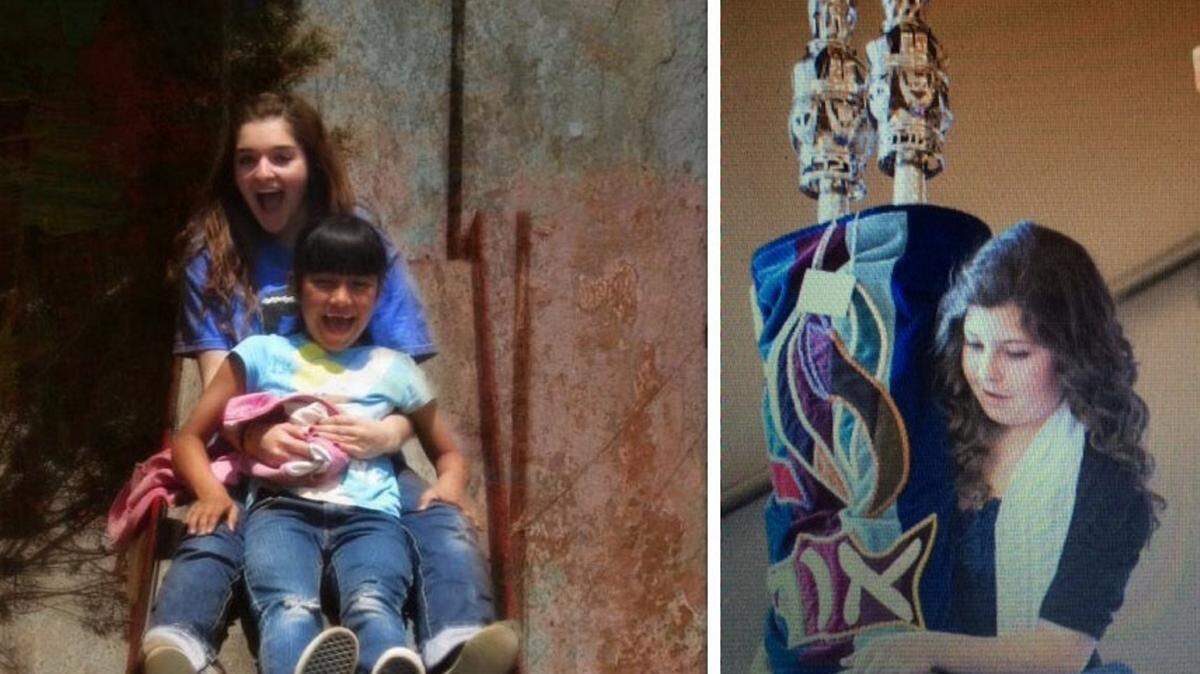
When my ex-husband and I married 22 years ago, our plan was to raise our children with aspects of both his Christianity and my Judaism. We wanted to share our faiths and heritages with our children, who we thought could be "both."
Unfortunately, things don't always go as planned. In more ways than one.
When our girls were 4 and 8, we divorced. And that was the beginning of the unraveling of our plan.
Prior to our split, our "two-religion household" arrangement had worked well. Our girls' world had included menorahs, Christmas trees, Santa's lap, Easter eggs, Passover and Purim. We were a blended faith family. Despite protests from my dad that the girls needed a single identity and anything else would confuse them, my husband and I told our girls they were "both" religions -- Jewish and Christian.
In truth, my heart was rooted in my own Jewish identity, and I remember it being difficult for me not to be able to blanket the girls solely in my religion. For the Jewish portion of their upbringing, I took the girls to "Tot Shabbat" -- kids' Sabbath services -- and Sunday School at our local synagogue.
For my ex-husband's part, while he felt strongly Presbyterian, he wasn't particularly interested in the organized religion part -- Jewish, Christian or otherwise. He said his childhood memories of attending church weren't so great.
I admit to being frustrated that he wasn't involved institutionally in his own religion yet still rejected the idea of our daughters being raised fully Jewish. Since our communication was lacking, I can't say for sure but I think our religious differences didn't sit easily with him either.
Looking back now I can see how our initial plan for our girls had at least one fatal flaw -- their parents weren't totally sold on it. And we weren't able to communicate well about it.
Shortly after we divorced, my ex-husband began going to church. On weekends, the girls would go with him to services. This was bigger than Santa and definitely new territory for me. My initial response was surprise and some disappointment. He had always been critical of the institutional part of his faith.
Even though I was perplexed, eventually I became amenable to it. Our girls were spending their time with him in a positive environment. Regardless of affiliation, only good can come from attending any kind of spiritual gathering, I felt. Part of the new normal of our post-divorce lives became church with Dad, synagogue with Mom.
As the years went on, our two homes fell into a routine of separately celebrating "our" respective holidays. Every Christmas Eve and Christmas day, the girls would be with him. For the eight nights of Hanukkah, they would be with me.
Our girls' identities remained that of being both Jewish and Christian, neither girl had a preference to either religion. These traditions were all they knew and they enjoyed experiencing so many different holidays and gatherings to share with extended family. My ex and I supported one another in this pattern. Our girls adored one another and were close. It was working.
But at the time my older daughter entered middle school, around 2008, there was a shift. Our original plan became complicated and went off-track, in a direction I had never anticipated.
My older daughter had joined the youth group at her Dad's church and made some terrific friends. Subsequently, her involvement at the church increased, as did her Christian identity. Her peers both at school and church were Christian, and she gravitated to that space and proclaimed she, too, was Christian. She decided to stop attending synagogue events and Hebrew school on Sunday.
Around the same time that my older daughter was going full-bore into her church youth group, my younger daughter decided to stop attending church on Sundays with her dad. She was starting to get a lot out of our synagogue experiences.
She was excited to have learned to read Hebrew and, one day when she was in fourth grade, she announced she wanted a bat mitzvah. She threw herself completely into her Hebrew and Torah studies.
It was becoming clear: our daughters had chosen -- completely on their own -- different religions.
One thing I never expected was for religious differences to cause contention between my own daughters. Of course, over history and time, religion has caused conflict, even World Wars. But between my own children? It was disheartening as a mom.
Although neither girl attempted to persuade the other of her own respective religious beliefs nor did they denounce the other religion's actual teachings, at times things got uncomfortable. It wasn't the word of their faith about which they felt competitive, it was their need to feel protective of their identity related to their own faith.
The things that became problematic were little, but to me they were big. Once, in what I consider to be a defining moment of their relationship changing, I observed the first verbal confrontation over religion. It involved my older daughter putting her sister's religious choice down.
By far, the biggest negative impact I saw initially from their contrasting faiths is that it prevented them from being as close to one another as they had been previously. A dividing curtain had now been dropped between them. The lack of sharing a big part of their life with their sibling negated much of the bonding that usually comes with common interests and values within a family.
During spring break her junior year of high school, in 2013, my older daughter ventured to Mexico with her church on a mission trip. The group attended church services with their Christian counterparts and interacted with many young children, encouraged church attendance and taught stories from the Bible.
I was thrilled for her to be a part of something so meaningful to who she was and she came home feeling she had contributed in a fantastic way.
Two years later, my younger daughter flew to Costa Rica with a Jewish organization for a different kind of trip. Unlike my older daughter's trip to Mexico, this trip was not intended to explicitly spread the word of the religion.
But the trips failed to pique the other sister's interest. The lack of excitement from one another for her sister hurt me more than I could have imagined. Their relationship had become more like roommates than sisters.
I'm happy to say things have improved between my daughters. Even though we never expected our girls to select different faiths, it seems to be evolving well. In the past year or so, their once-adamant identity stances both seem to have softened. Although they still both identify solely as Christian (older) or Jewish (younger), they don't feel the need to profess it so loudly to each other.
And, much to my delight, they have circled back to being closer. I attribute it to time, maturity and their physical distance -- my older daughter is away at college -- which I think makes them appreciate the other more. When religion or related observances are mentioned, there is no longer an uneasiness attached to it.
This story was originally published April 1, 2016 at 9:18 PM.