
Building the faith: Local churches gather in worship spaces old and new, historic and nontraditional
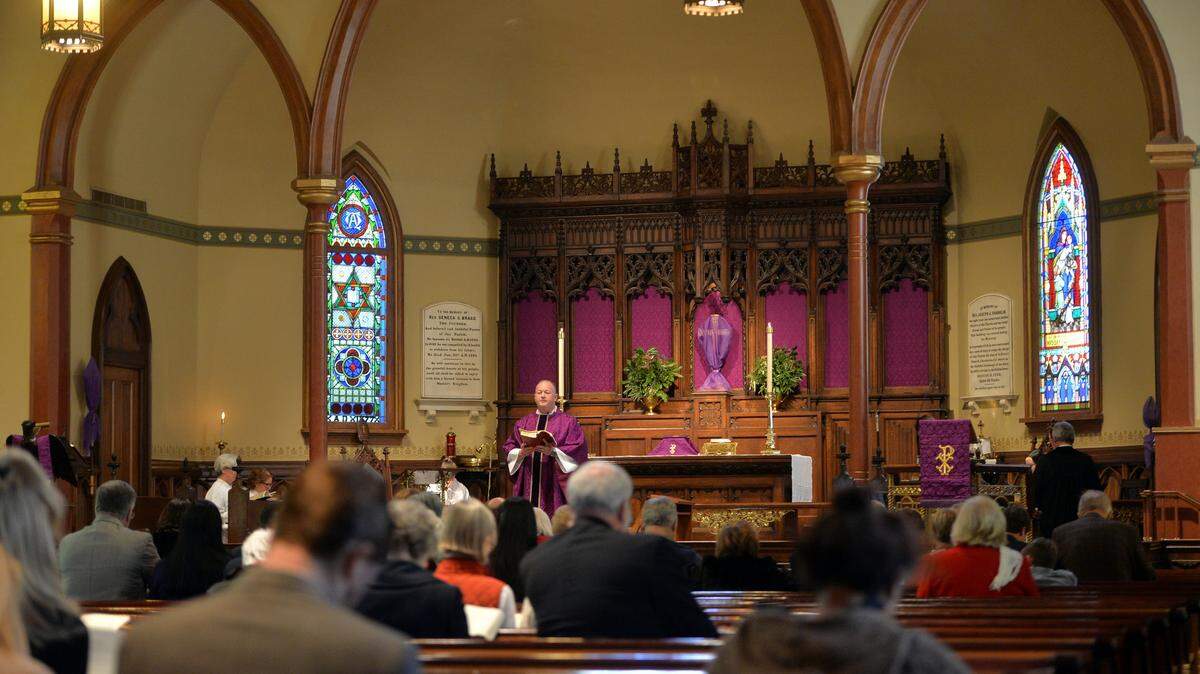
"Here's the church, and here's the steeple. Open the door and see all the people." This old rhyme reminds us that worship centers are more than just a building; they are the people as well.
However, the place is still a vital component, as it provides the setting for people to connect and practice their faith together.
The congregations of Middle Georgia have made homes out of a variety of venue types. Gathering spots range from historic buildings to modern architecture to nontraditional spaces. Here are a few of our area's unique worship locations.
HISTORIC HOUSES
Some churches in the area have been standing since the mid-1800s, including Christ Episcopal Church and First Presbyterian Church in downtown Macon. While they have been remodeled, renovated and added onto over the years, their foundations remain the same.
Christ Church's current Gothic Revival-style building on Walnut Street was completed in 1852, according to church historian Julie Groce. Bricks from the original 1834 structure on the same site were incorporated into the new church, which was given a stucco exterior.
The main building features arched windows, 12 pinnacles that symbolize Jesus' disciples, and four pinnacles on the front tower for the Gospels.
"It's served congregations of varying sizes for almost two centuries. It's both beautiful and functional," Groce said.
There are currently about 700 church members.
"I think everyone who comes to Christ Church has an overwhelming sense of being part of a rich heritage. It also makes you feel like you are but a small part of a larger body of faith," she said.
The Rev. Bryan Hinson said the Anglican tradition emphasizes real, concrete things that help people connect God to the world, which includes the church building itself. The building is just the start to worship and community outreach.
"It's a beautiful building. It gives you the beauty and the holiness and the ability to approach that beauty," he said. "I think it's possible to place a lot of emphasis on the building, and we do."
First Presbyterian Church, which has about 1,000 members, finished its current building in 1858 for about $26,000, said church historian Harriet Comer. Mulberry Street is actually the third location for the church, whose first building was at the corner of Fourth and Plum streets in 1826, and second building was on Fourth Street between Walnut and Mulberry streets, according to the Middle Georgia Historical Society book "Macon ... an Architectural Historical Guide."
The building borrows from the Romanesque and 12th-century Norman architecture styles. Its 183-foot steeple once held the city's official clock, and its outer walls are stuccoed brick and patterned ashlar stone, the guide reports. Comer said the original pews and flooring remain in the sanctuary.
"To me, we still have the footprint of the original church," Comer said. "They had 200 members (in the 1850s), and I think for them to have the foresight to build a building the size it is, it's just remarkable. We are still using the same building. We've added buildings around it, but the (original) building itself is the same."
MODERN BUILDINGS
Fellowship Bible Baptist Church in Warner Robins has been progressively expanding since it got started 36 years ago, said Pastor Tolan Morgan. The Dunbar Road campus now has seven buildings on 58 acres of land to accommodate its 2,200 members. The modern dome sanctuary completed in 2011 was the church's biggest project so far.
Founding Pastor Willie Reid and church leaders were inspired by a building in another state. The circular, stadium-like design was cost-efficient for maintenance and utilities as well as beneficial for sound quality and visibility, Morgan said.
It features all the technology necessary for contemporary worship services.
"The church is always pushing to be relevant, always pushing to be progressive, always pushing to meet and respond to the needs and attractions of the modern day, without compromising who we are as a church. We adjust our methods, but we don't adjust our message," Morgan said. "That has always been a goal of Fellowship Bible, to stay on the cutting edge of relativity."
While Tabernacle Baptist Church in Macon was founded in 1907, its present building is fairly new. The church was located on the 600 block of Second Street in 1908 and moved to Second and Arch streets in 1917, according to Tabernacle Baptist's website.
The Rev. Gregory Robert Jones said Tabernacle encountered some big expenses with this second downtown building, and members ultimately decided to relocate to Zebulon Road. When the downtown building sold, services were held at the AmStar Cinemas for a year or two until the new building was ready in 2004.
The modern-style, brick church is laid out so that two wings extend from the sanctuary. One side houses the kitchen and children's hall, and the other has offices and adult Sunday School classrooms.
The church has about 300 active members and hosts blended-style services. Jones said that the building has some elements that make worship easier, such as projectors and sound equipment, but it's just a meeting place in the end.
"I think for me as a pastor, I'm not so much tied up to a certain building," Jones said. "I feel like as long as I'm tied to the Lord's people, we could worship at a movie theater or a storefront downtown."
NONTRADITIONAL SPACES
New City Church's locations are casual and inviting to all types of people, said Lead Pastor Keith Watson. The contemporary Southern Baptist church, founded eight years ago in Macon, met at the Cox Capitol Theatre before moving to The 567 Center for Renewal. About 250 people attend services.
The church wanted to be a part of downtown's revitalization and create an art space that would encourage people to come to the area, Watson said.
New City renovated the vacant building at 567 Cherry St. and formed a separate, nonreligious, nonprofit organization to showcase local artists and musicians.
The 567 Center for Renewal is the building's tenant, and New City leases space inside. The building's history is highlighted through exposed brick and ceiling and old windows. The 567's concert area is also used for the church's worship services, and an art gallery can be found upstairs.
"As a church, we want to reach as many people as possible. We want to reach people who live, work and play in downtown Macon. We wanted our building to reflect downtown Macon. That was really a big reason for why our space looks like it does," Watson said. "Some people who might not go into a normal church feel comfortable to come into this place."
Watson said the Macon church has outgrown The 567 and has its eye on a new location. Church leaders are in the process of purchasing an old night club building behind Grow restaurant on Riverside Drive for renovation.
New City Church also has a Milledgeville location, John Milledge Academy on Log Cabin Road, which has about 350 attendees. This is its third venue, having started out at a bar/restaurant downtown in 2011 before moving to a former funeral home, Watson said.
Piedmont Church in Macon hosts about 300 worshippers each Sunday at Tattnall Square Academy on Trojan Trail. The contemporary church initially met at Stratford Academy when it was started eight years ago, but switched venues soon after when the headmaster at Tattnall approached church leaders about forming a partnership.
Lead Pastor Jerry Dingmore said the change came at a good time since space was getting limited at Stratford, and it was a way to aid the school financially and help the community. Meeting at this location gives the church more monetary resources to use for ministry.
"You think of how many churches spend large amounts of money for a building that's used one day a week," Dingmore said. "If your goal is ministry, you want a facility that will help you do ministry. You don't want your facility to define you. You want it to be a tool."
But not owning a church building has its challenges. Piedmont must set up its lighting, sound system and video screen every week in Tattnall's auditorium. The lunchroom is also transformed into a children's area. The work begins Saturday night and resumes at 5:30 a.m. Sunday.
Dingmore said the church hopes to eventually buy a building to renovate or construct their own facility. It would be a multi-use building with a large auditorium and big rooms that could be used for many different activities.
"Churches exist off of people giving money. People who give, they want to support making a difference in the world. I think the responsible thing to do is to take that understanding into the creation of a facility," Dingmore said.
This story was originally published February 19, 2016 at 9:46 PM with the headline "Building the faith: Local churches gather in worship spaces old and new, historic and nontraditional ."