
Pope Francis will find US church struggling to hold onto Latinos
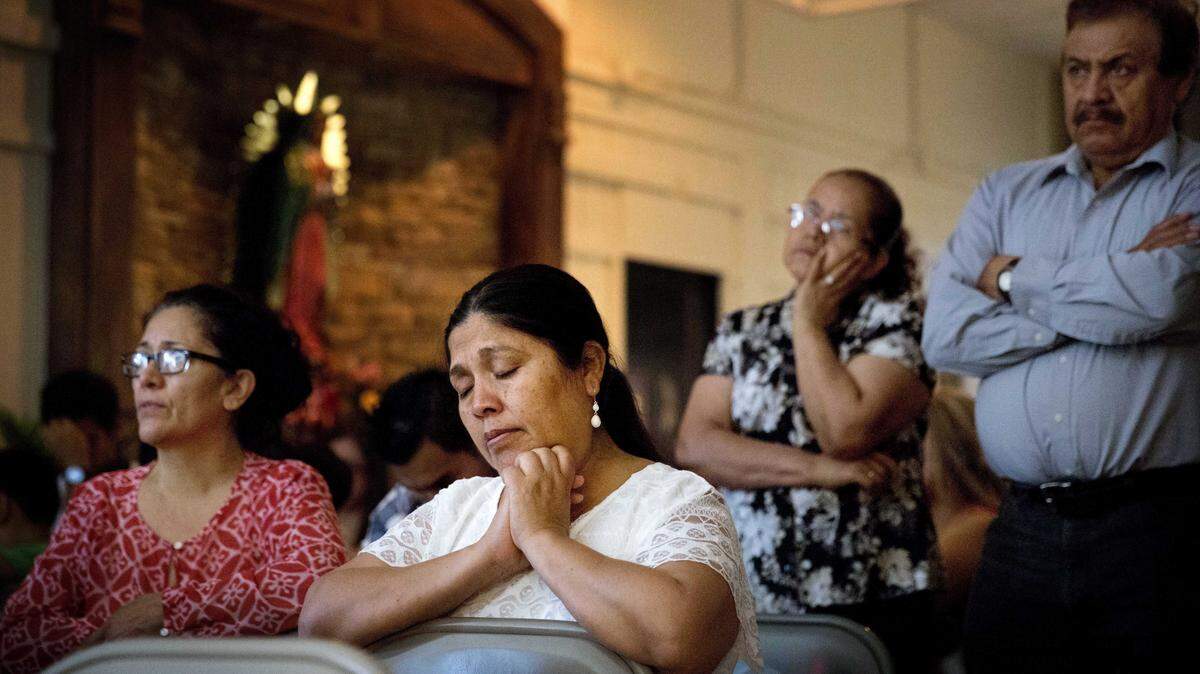
The St. John Paul II Pastoral Center, a Roman Catholic mission, sits at the rough end of a former strip mall in the shadow of an Arby’s. The space, church leaders say, was once used as a nightclub and movie theater, a history now hidden by multiple coats of paint, pews brought in from other congregations, and a stone-and-wood shrine to Our Lady of Guadalupe, the patroness of the Americas especially revered by Mexicans.
This mission, in the Archdiocese of Atlanta, was built in a hurry, to serve the many Latinos who labor at the poultry processing plants that form the economic backbone of Gainesville. On a recent Sunday, worshippers spilled onto the sidewalk in rows two and three deep, and by the end of the weekend, 5,000 people had attended Mass here.
Evangelicals have set up shop here, too. Georgia is Baptist country and a Bible Belt stronghold where Catholics had a small footprint until the latest immigration boom. The Rev. William Canales, the cherubic, Nicaraguan pastor of the mission, noted with a twinkle in his eye that a Protestant preacher in the same mall had recently moved on.
“The Catholic Church in Gainesville -- we are waking up now,” Canales said, on the eve of the first visit to the United States by Pope Francis, the first Latin American pontiff.
Francis will arrive in the U.S. on Sept. 22, carrying the hopes of many for what he might do for American Catholicism. But few of these goals have as much urgency for church leaders as affirming the place of Latinos in the church and inspiring them to stay in the fold.
About 38 percent of adult Catholics in the U.S. are Latino, according to the CARA research center at Georgetown University, and they are already the majority in several dioceses.
Their numbers are increasing at the same time a steady stream of American Catholics overall are leaving the faith. Immigration and the high birth-rate for Latino Catholics have more than made up for the losses, helping the 68-million-member denomination continue to grow.
Yet, Latinos aren’t sticking with the church the way they once did. In 2006, about 8 in 10 Latinos who were raised Catholic stayed in the tradition as adults. That figure dropped to 7 in 10 last year, according to CARA. Like many Latin Americans back home, U.S. Latinos are joining Pentecostal movements, or abandoning organized religion entirely, in numbers significant enough to raise alarm among U.S. bishops.
“One of the challenges for Latino immigrants is they continue to show up in places where there’s not a Catholic Church nearby,” said Mark Gray, the Georgetown center’s polling director. “Sometimes, they end up in an evangelical church.”
Georgia is one of the more dramatic examples. The Catholic population here had been so small historically that the state didn’t have a diocese until 1936 in Savannah, nearly 150 years after the first U.S. diocese was established in Baltimore. The Atlanta diocese is even newer, created in 1956 with just 24,000 parishioners.
Now, Peter Faletti, Atlanta archdiocese director of research and planning, is scrambling for space. He has been renting schools, former movie theaters and defunct car dealerships so he can turn them into worship sites. Even so, he says services fill to capacity within weeks. In Lilburn, an Atlanta suburb, Our Lady of the Americas draws 10,000 mostly Latino Mass-goers each weekend and is still growing.
“We have Hispanic Catholics who aren’t being served because they can’t get in the door,” Faletti said.
Non-Hispanic professionals relocating to the Atlanta area from the North and Midwest have helped increase Catholic numbers in recent years, but Latinos are the main drivers of the boom. From 2000 to 2011, the Latino population doubled in Georgia, putting the state in the Top 10 for Latino growth in that period, according to Pew.
Latinos and whites each make up about 44 percent of the 1 million members of the Atlanta archdiocese, and Latinos are on track to eventually become the majority.
“People are excited about the growth. They recall the days when they were such a minority presence that they were all but unnoticed,” said Archbishop Wilton Gregory. “The challenge is that we not only have to provide physical space for the communities who are expanding, but we also need to develop a spirit of inclusion.”
This is an area where the pope, an Argentine native, will help, church leaders say.
Los Angeles Archbishop Jose Gomez, the highest-ranking Latino in the U.S. church, whose archdiocese, 70 percent Latino, has been at the forefront of advocating for immigrants, said the role of Latinos “is a big part of the story of the pope’s visit.” In Washington, the pope will canonize 18th-century Spaniard and Franciscan missionary Junipero Serra, who evangelized the territory that would become California. Gomez called the canonization a “historic moment in the life of the Hispanic people” in which the pope is calling on Americans to reflect on “our legacy as immigrants.”
“He knows the face of the church is changing. He knows the country’s Hispanic Catholic heritage. He knows how important Hispanics are for the future of the church,” Gomez said.
Atlanta Catholic leaders say no one in the church anticipated how many immigrants would make Georgia their home. Jairo Martinez, a Colombian who leads Hispanic ministry for the archdiocese, said he was stunned they were choosing the state over Florida or California.
The surge in construction jobs ahead of the 1996 Summer Olympics in Atlanta brought a wave of mostly Mexican immigrants. More came to work in the carpet-making industry in Dalton, near the Tennessee line, and in the poultry plants in Gainesville, northeast of Atlanta.
Canales noted the pope’s exhortation for priests to be close to the marginalized and be “shepherds living with the smell of the sheep.” Canales joked, “I smell like the chicken here.”
The archdiocese, like dioceses across the U.S., is still badly in need of Spanish-speaking and bilingual priests. But one out of every three or four Masses in the archdiocese are now in Spanish, Faletti said.
At the St. John Paul II Pastoral Center in Gainesville, mission members are hoping for some local inspiration from the papal visit. They have taken up an activity more often associated in the U.S. with evangelicals: going house by house through the city inviting Latinos and others to Mass.
Parishioner Jose Vera, who has worked in poultry plants for about 20 years, said he appreciates Francis’ emphasis on compassion as a way to bring fallen away Catholics back to the church.
“We don’t have to be an expert to talk about God. We just go there and give the biggest smile to the person,” Vera said after mid-morning Mass. “We don’t need a big school. We don’t need to learn the whole Bible. You just have to hear what they have to say.”