
ON DESIGN: Gray gains respect as the new neutral
Before World War II, steel production contributed to the United States' reputation as the most industrialized nation in the world.
Steel was the muscle behind the growth of the automobile industry and the advances made in aircraft construction. Buildings resting on steel piers and beams soared to new heights in manufacturing centers throughout the country.
The color of raw steel meant healthy profits and power to the captains of industry; it was not a color embraced as a design element. Although gray was a color popularized by post-WWII fashion designers, including French couturier Christian Dior, it did not become universally popular in interior design until this century.
In the early 2000s, gray replaced beige as the new neutral, reflecting interest in the retro look -- re-purposing furniture once considered utilitarian; preservation of historic structures and the use of exposed raw materials in houses and commercial buildings.
What better place than Macon to see the numerous loft apartments, condominiums and offices housed in downtown buildings, which were once shuttered and in derelict condition.
They are remarkable because the infrastructure is now part of the interior design -- where it was covered with plaster ceilings and walls in the early 20th century. Pine floors were exposed only where they would not be seen by the public or were covered in terrazzo tile or carpet.
APPRECIATION FOR THE IMPERFECT
The origin of "shabby chic" lies in the rural provinces of England and Europe where the faded elegance of old chintz and linen and the chipped, worn finishes on furniture are admired as nostalgic reminders of earlier times.
New Orleans, the Louisiana city steeped in continental history, displays her imperfect buildings and interiors with pride. When Jean Bragg moved back to Macon from the Big Easy, she brought her love of that city's history with her, replicating the French interiors in her home, in loft apartments and at the Jean Bragg Emporium, her antiques, art and Georgia-made gift gallery on Cherry Street.
Enormous steel freight doors have been left on their rollers, sanded and painted in gray and gray-green; pine clad columns supporting the roof are incorporated into the décor in each space, stripped to reveal the warm patina of heart pine peeking through old gray paint.
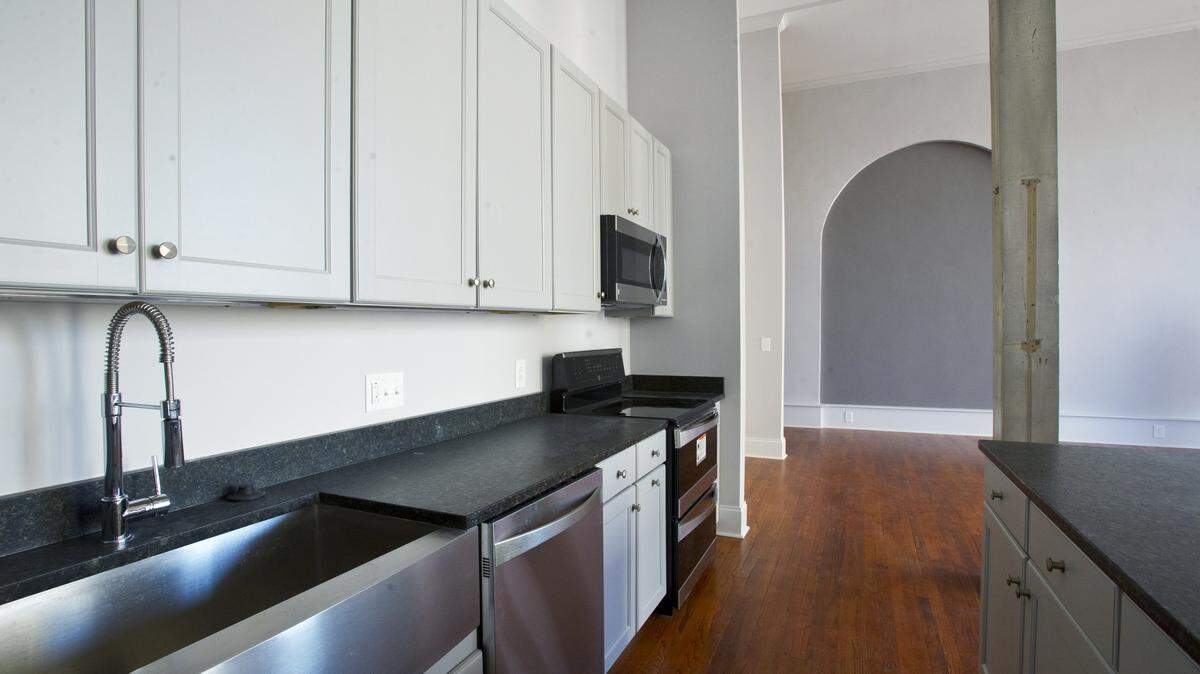
Bragg has used five shades of gray throughout the building to create a serene backdrop or to complement architectural elements -- including exposed brick walls. Wide pine floors have been refinished, the typical resin shade of the wood a rich counterpoint to the gray hues.
New kitchen cabinets, finished in lighter shades of gray, are unadorned in the barrier-free living areas, blending seamlessly with the palette. Brushed stainless plumbing fittings and fixtures complete the monochromatic aesthetic.
All of the original bead board ceilings in the building were painted a matte, gunmetal gray, cleverly disguising any imperfections. Many of the oversized interior doors were salvaged, stripped and sealed to reveal the fine gray grain of old growth wood.
Long hallways are relieved of the monotony of an unfurnished space with arched niches, painted in dark gray or green, which create areas of interest for large canvases or other collectibles.
MODERN CONVENIENCE WITH AN URBANE FLAIR
In heavily trafficked areas of the loft apartments and in the bathrooms, Bragg used stone and tile, which incorporate the grays she used on other surfaces. The large tiles are in proportion to the high ceilings and expansive spaces, textured in aged finishes that complement the ambience of the historic building.
Handsome vanity cabinets in the bathrooms resemble re-purposed, antique French dressers, which appear to be naturally aged, soft taupe oak. The doors are latched with distressed, bronze cremone bolts, as efficiently operated as those first used in 19th century Europe.
Bragg said she found the tall cabinets at Restoration Hardware, a presence in the preservation initiative for the integrity of their reproductions.
The chipped paint on the gracefully designed chandeliers Bragg installed in her apartments adds to the winsome charm of the spaces. Indirect lighting, from wall sconces, bathes the halls in functional light and is more effectual than recessed cans, the use of which is diminished by the height of the ceilings.
Vintage steel, pendant lamps, over the kitchen islands, replicate early 20th century, heavy duty industrial fixtures, which were never seen in a residential setting.
Although Bragg concealed plumbing and electrical conduits in most of her apartments, she retained a wall-mounted steel ladder and platform in the third floor for a quick escape to the roof in case of emergency -- of course, the ladder received a new coat of gray and green paint.
CARVING OUT PRIVATE LIVING SPACE
The walls of Bragg's personal space are covered with the paintings she has collected during her years as an art and antiques dealer in New Orleans and in Macon. They are the focal point of her schematic -- based on her five shades of gray, which are the backdrop for French antiques and luxurious fabrics.
With a view of downtown from the tall windows spanning the façade, the intimate setting defies the bustle of a main street, so dense are the solid masonry walls. The setting is lifted from the streets of Paris with several seating arrangements defined by comfortable, down filled, gray or greige sofas.
Bragg's penchant for rare objets d'art makes every angle of the condominium a fascinating, visual history lesson in sculpture, delicately embroidered silk panels and porcelains. Heavy wool and velvet, pewter-colored draperies flank the walls of windows but can be closed for complete privacy.
A SHORT COMMUTE TO THE OFFICE
What could be more retro than living above the store, as many merchants did, when these buildings housed Macon's first retail district? Going to work, Bragg goes downstairs to her gallery and to the adjoining events venue she has recently opened with the assistance of Scott Mitchell, her gallery manager.
The color scheme is the same several shades of gray, applied with that favorite gray-green, to dress the display cases. The engineered wood floor is finished in variations of stunning gray and taupe, which Bragg selected for its durability under heavy foot traffic.
Despite its newness, the color is understated in the gallery where the art, antiques and food selection take center stage.
According to Julie and Todd Suttles, owners of the flooring business on Vineville Avenue that bears their name, gray is also the most popular color in natural and engineered wood, and in luxury vinyl plank (referred to as LVP) flooring, the latter material also used to manufacture tiles that simulate ceramic and porcelain materials.
The styles are available in rough hewn or scraped finishes, or in traditional semi-gloss and waxed surfaces. Whether building or restoring a house, or creating a contemporary environment, appropriate flooring can be found for any style or period -- and, gray, the hot neutral color this year, is a surprisingly versatile choice for any surface.
Katherine Walden is an interior designer and freelance writer in Macon. Contact her at 478-742-2224 or kwaldenint@aol.com.
This story was originally published February 10, 2016 at 10:03 PM with the headline "ON DESIGN: Gray gains respect as the new neutral ."