
Home for the holidays: Decorating for Thanksgiving and Hanukkah
Summer clothes have been put away. Firewood is stacked and ready for the first cold night. This is the expectant time of year, full of anticipation for gifts, celebration, family gatherings and decorations!
Thanksgiving is exactly two weeks away -- it seems only yesterday we complained about the oppressive heat and irksome mosquitoes. If you are one of those enviable organizers, you probably have your menu planned, silver polished and guest list finished. But, does the house look festive?
You don't have to rearrange anything or do any shopping for decorations to set the scene for a Thanksgiving feast and holiday mood.
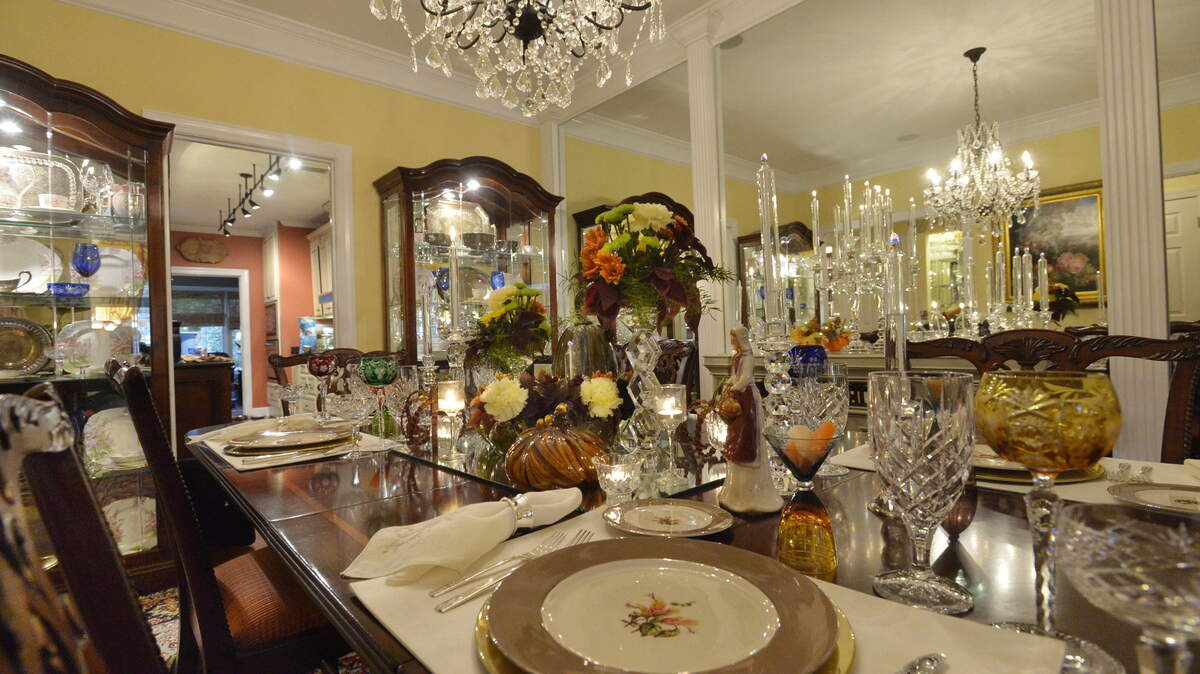
Phyllis Farmer has all she needs at her fingertips to wrap her guests in the warmth of her hospitality. Burnished leaves and clusters of chrysanthemums add texture and color to Farmer's dining room table.
If you are a purist, and only use your finest silver on such an occasion, use the champagne cooler for an arrangement of riotous colors. The earthen glazes of pottery are a wonderful foil for fall flowers and enhance the impact of natural materials like dried limbs and seed pods in your bouquet.
Small gourds or a variety of squash, found in the grocery store's produce section, can be arranged with leaves down the middle of your dining room table or on the mantle, with small pots of mums tucked in for contrast. You can later cook the squash and plant the mums -- no waste.
For the seamstress, fabric remnants can be used to make a runner, from which you select the color palette for dressing up the dining room table. You can also shop the department stores to find a perfect runner for the occasion.
On Farmer's table, the crystal, ceramics and flowers are arranged on mirrors, doubling the pleasure of the centerpiece. Brass is still attractive, though some naysayers think it passé. Polished or burnished brass candlesticks and containers warm up the arrangement and add reflective surfaces under the glow of candlelight.
If you have an aversion to brass, other textures work just as well -- silver, crystal or ceramic. Farmer collects crystal accessories for her dining room, which she displays with seasonal decorations, grouped together for maximum impact. The reflection of the faceted glass in the mirrored wall of the dining room is magical, especially in the evening when guests linger at the table after a fine repast.
TIME HONORED TRADITIONS
Chrysanthemums, or "mums" for short, are showy fall flowers with dense blooms. When arranged together in large pots, they are a welcome sight flanking the front door. By the way, the mum is the official November flower, celebrated in Japan at the Festival of Happiness.
According to Asian folklore, a chrysanthemum petal placed in the bottom of a wine glass ensures healthy longevity. The petals are edible, so that's a little surprise you might add before popping the cork.
Thanksgiving, the one day on the calendar when we pause to express gratitude for family, friends, achievements and experiences, deserves celebration. Don't stop with your decorations -- set the table with unusual china and linens you rarely use.
For this day of feasting, Farmer uses her silver napkin rings to hold patterned linen napkins. However, napkins can be wrapped in a raffia or ribbon bow, adorned with a few flowers and herb sprigs, to complement that colorful china that spends the rest of the year behind cabinet doors.
Be sure to photograph your handiwork before you carve the turkey -- once you sit down, the moment is lost. Savor the day!
FEAST OF LIGHTS AND DEDICATION
To commemorate the rededication of the Holy Temple in Jerusalem after the Maccabean revolt against the Seleucid Empire in the second century, when Jews reclaimed the temple, the Jewish community celebrates Hanukkah (also known as Chanukah) for eight nights and days.
According to the Talmud, the temple was cleansed of impurities and the candles in the menorah burned for eight days, even with little oil.
Marty and Evan Koplin will bring out the decorations shortly after Thanksgiving, when Hanukkah begins on the 25th day of Kislev, the date the fighting ceased after the Jews triumphed over the Seleucids. This year, it falls on Dec. 6 in the Gregorian calendar.
The religious aspect of the holiday starts with the lighting of one candle on the menorah, on the first night of Hanukkah. The menorah is a nine-branched candelabra with four candles on each side of a prominent center one, the Shamash, which is positioned either below or above the other eight.
A variety of menorahs are displayed throughout the Koplins' home -- some carved from wood, others wired for lighting and more that are brass and silver.
Since Hanukkah is known as the Feast of Lights, menorahs and candles can be displayed, lighting the way, in every room.
FUN FOR THE CHILDREN
Universally, children easily tire of the religious traditions of a holiday. During Hanukkah, children receive gifts and play with dreidels, which are small, square spinning tops inscribed on all four sides with Jewish letters forming an acronym translated, "a great miracle happened there."
The miracle refers to the day the temple was restored to the Jews. In Jewish folklore, children learning the Torah, while hiding in the caves during the reign of the Seleucids, were cautioned to hide their Torahs and play with their dreidels if soldiers approached.
The Koplin daughters are now grown, but the dreidels, mementoes of their childhood, are still part of the Hanukkah display.
Dreidels date to the medieval era when they were first used for gambling and called teetotums; the present day game uses candy or other treats for "the pot." After spinning the top, depending on which side lands face up, and the Hebrew letter chosen, the player may be victorious, lose the pot or have to pay back some of the prize, which is often foil-wrapped flat, chocolate candy resembling gold coins.
Gifts and rich, oil-based foods figure prominently in the Hanukkah celebration -- not the time to count calories or carbohydrates. Potato pancakes, or latkes, and jelly doughnuts are favorite indulgences.
The Koplins have scaled down the Hanukkah celebration now that there are no small children at home to appreciate the traditional blue and white decorations. According to the Koplins, Hanukkah is not the most significant holiday in the Jewish calendar.
Because Hanukkah usually falls on a date close to Christmas, the eight days memorializing the victory over the Seleucids has gained importance, especially in families with children, to compete with the frenzy of activity associated with the Christian holiday.
However, the Koplins enjoy their home and their children -- any excuse to get together with extended family and friends is celebrated with gusto!
Contact writer Katherine Walden at 478-742-2224.
This story was originally published November 11, 2015 at 9:52 PM.