
With two autistic teenage sons, a family struggles to cope
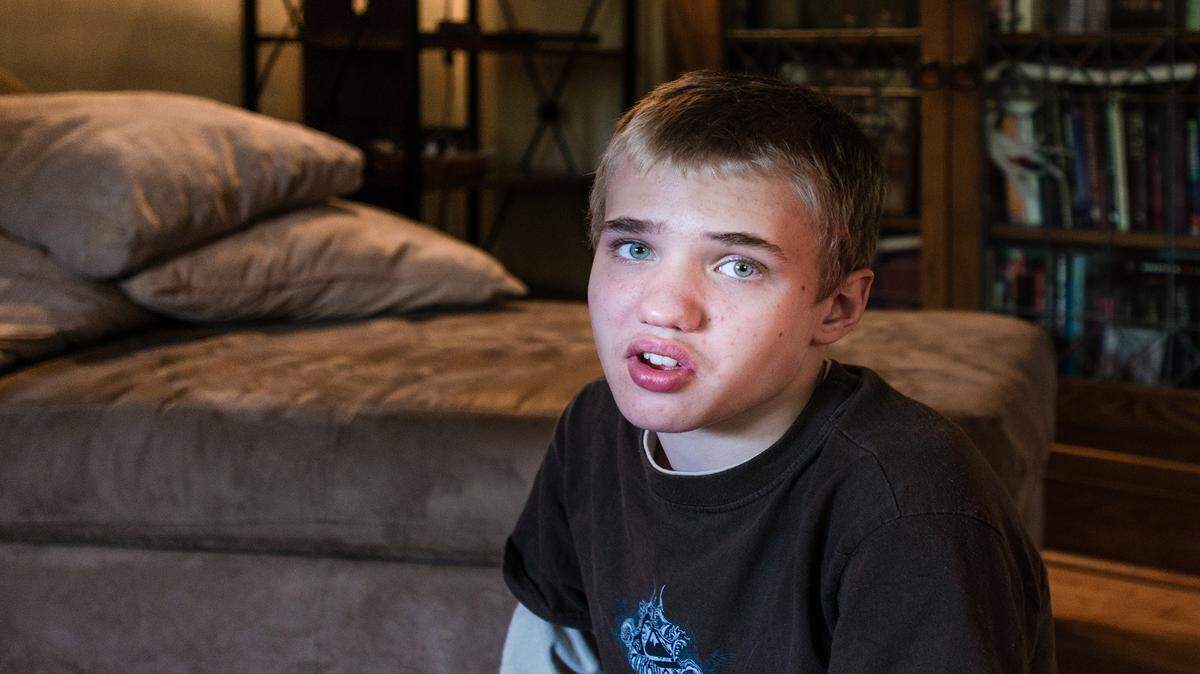
Alexander Brown swings back and forth on a makeshift hammock bolted to a wooden beam in his living room. The swaying seems to soothe the otherwise uneasy 14-year-old. His mother gazes at him from the couch and their eyes briefly connect.
"I would love to be in Alexander's head just for a few hours," said Diane Brown, her head slumped against her hand. "He's having a hard time going through puberty right now."
Alexander is confused, moody and frustrated -- all very typical for a teen during adolescence. But Alexander's transition is especially difficult for the Browns, a family of six in Sherrill, New York, because he is severely autistic.
Puberty is causing chaos in Alexander's once-predictable world. He can't talk and struggles to express himself. "He's angry and he's sad .... and he doesn't understand why," Brown said. "I truly feel for him."
Alexander, the third of four children, rarely sleeps through the night. He gets up at all hours to wander the kitchen, take a shower or throw a tantrum. He's begun lashing out physically.
Brown, 45, is exhausted. She averages four hours of sleep a night and powers through most days with the help of Red Bull.
The Browns all have what they call "war wounds" from dealing with Alexander: scratches, bite marks and bruises. When he's in a mood, they say, no one is safe, not even the family dog.
"He clawed up my arm and it angered me," said Alexander's 11-year-old sister Maya, the youngest in the family. "But what are you going to do?"
The sixth-grader has to be alert when her brother is around. "If I see Xander run towards me, I just run into another room so I don't get attacked," she said. "You grow used to it."
Brown, who sneaks cigarettes every now and then to calm her frayed nerves, compares the experience to riding a roller coaster without a restraint -- for both child and parent.
Worse, she said, it's the family's second time on this terrible ride.
Alexander has a 19-year-old brother, Connor, who also has severe autism. The eldest child, he can't speak much or care for himself. Six years ago, he became so physically aggressive that the Browns couldn't handle him.
The final straw came when Connor knocked his parents down as they tried to force him onto his school bus. The driver insisted he be secured to the seat using a soft body restraint to keep his arms from flailing. After that, the Browns decided to move Connor to a 24-hour-care facility at the same site where he and Alexander attend school during the day.
"We sat on the back step ... and we cried," said Brown, her voice trembling. "It was a realization at that moment that this was something that we had to do for all of us."
Coping with two severely autistic sons five years apart, the Browns have often felt isolated. But their troubles are far from unique.
For every 68 American children, about one is estimated to have autism spectrum disorder, a developmental condition that impairs communication, behavior and social interaction, according to the Centers for Disease Control and Prevention. Some cases are more severe than others.
Scientists don't know all the causes, but most agree that the condition has a strong genetic component. It afflicts many more boys than girls, and parents of one child with autism are at higher risk of having another. One study found that nearly a fifth of young children with older autistic siblings had the disorder, and the risk was substantially higher for boys.
Many families are unprepared for a second diagnosis, much less for guiding two autistic children into adulthood.
Aggression is relatively common though hardly universal in autistic kids. According to one study, parents reported that 68 percent had demonstrated aggression toward a caregiver at some point and 49 percent to non-caregivers.
Other research has found that aggression among autistic children contributes to parental isolation and exhaustion, threatens the safety of the kids themselves and other family members, is the leading cause of stress for caregivers and is the primary reason that families seek to have children placed outside the home.
Research is limited on autistic kids who are going through puberty. But some experts suggest that while children's behavior may improve during elementary school years, it can deteriorate with the physical and hormonal changes that come with adolescence.
The vast majority of autistic children remain in the family home, and just 2 percent live in outside supportive facilities, according to one study. Some advocates and providers say home is the best setting for such children, because the risk of abuse, neglect and exploitation is greater elsewhere. Others say living in a more structured setting may offer advantages for some kids and their families.
"The reality is that for a lot of autistic kids, normal family life is pretty chaotic. A group home might add a little bit of structure to the equation," said Brad Boardman, executive director at the Morgan Autism Center, which provides individualized education but not residential care for children with autism in the San Francisco Bay area.
"It can also be beneficial to families who have got into a negative pattern with a child or are seeing aggressive behavior at home," he added. "Sometimes a move into a residential group home can be a way to reset the relationship."
The Browns have wrestled with this question for years: What is the right thing to do -- for the child and for the family as a whole?
On their good days, Maya said, Connor and Alexander can be "the sweetest boys."
Lately, though, Alexander has become harder to handle. He doesn't lash out as violently as Connor did, but she can't control him when he does.
"When you have a child who just existing is so hard for them and you can see them struggle with it every single day ... you want to make it better," Brown said. She has sadly come to believe that "making it better" means moving Alexander into the same around-the-clock care that his older brother receives.
"Alexander, just like Connor did, has outgrown our little family here," she said. "I'm certain at this point it's time. Time for someone to step in and be stronger and more awake than I am."
This story was originally published October 19, 2015 at 10:05 PM with the headline "With two autistic teenage sons, a family struggles to cope ."