
Former UGA LB Reuben Faloughi talks protests at Missouri, impact on college athletics
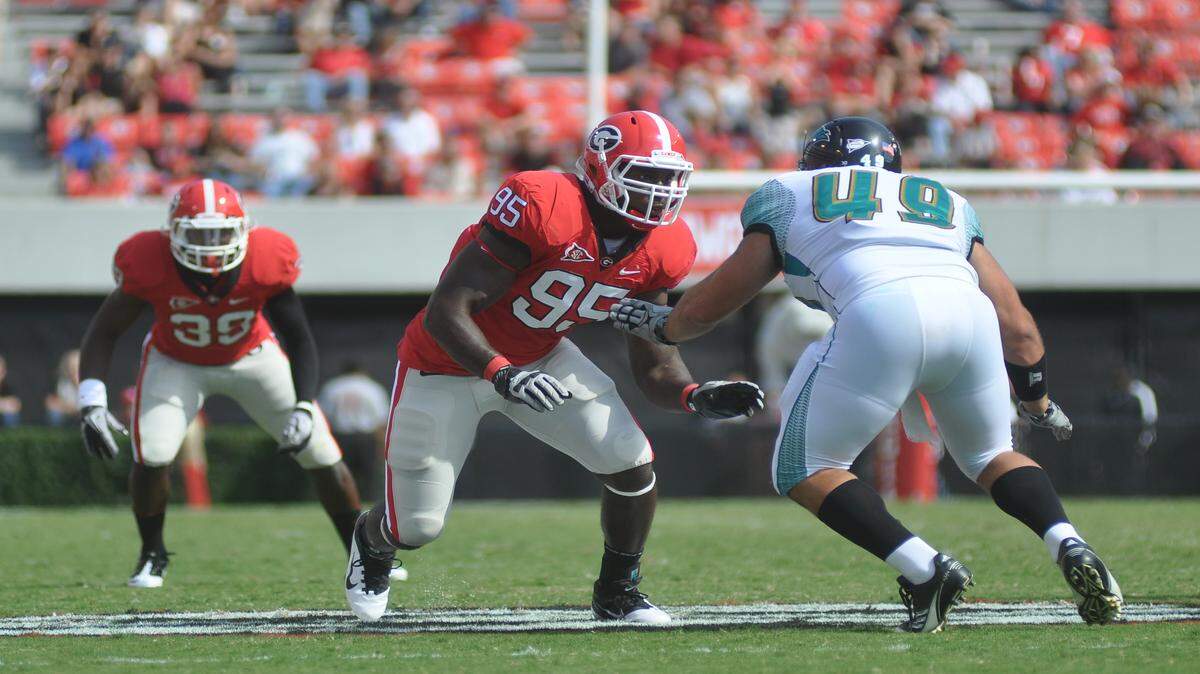
When Reuben Faloughi arrived at Georgia in 2009, he was the quintessential underdog.
A walk-on linebacker from Martinez, Faloughi forced the coaching staff to take notice of him practice from the start. After one year, Faloughi did enough to earn a scholarship for his remaining three seasons. These days, Faloughi, as he says, fights for the underdog now that he has become involved in social activism on the campus at Missouri, where he’s a third-year doctoral student pursuing a Ph.D in psychology.
Faloughi has helped call for change of Missouri’s university power structure, after a series of racist incidents occurred on campus with what students on campus deemed were a lack of response from university president Tim Wolfe and chancellor R. Bowen Loftin.
When a group of black players from the Missouri football team announced it would boycott practice and games until Wolfe and Loftin stepped down, it became a national story. Not long after the players’ announcement, Wolfe resigned and Loftin announced he would transition out of his chancellor position and into another role at the university. This also followed calls from the student body for both to resign.
In a 20-minute interview, Faloughi spoke about his experiences at both Georgia and Missouri and why being an activist is important to him.
The Telegraph: What experiences at Georgia helped you get into some activism at Missouri?
Reuben Faloughi: I think it would be my position as a walk-on. I think as a walk-on I had to advocate on my behalf as a player and prove myself. That gave me a lot of the tools to get into the activism I’m in now.
TT: What were the first steps that got you into organizing? How did it all start once you got to Missouri?
RF: It definitely didn’t start immediately when I got here. I think the Michael Brown shooting and the subsequent non-indictment of Darren Wilson definitely changed things for me. It changed my perspective. I think the institutional response here woke me up. I thought a lot more people cared about social issues than they really did. I also think participating in my first protest – it was a demonstration at the student center here under a group called “MU for Mike Brown.” I really saw what activism looked like and that was really the catalyst.
TT: Was (what’s happening at Missouri) the first instance of racism you felt you encountered out there or were there any other personal experiences that you’ve had?
RF: No, this definitely wasn’t the first one. When I got here, I definitely noticed racism. It’s almost like you can feel it when you get here. I’ve had personal experiences where I’ve had professors ask me to play rap music in the middle of a class. As a former student-athlete, even though I wasn’t playing football, I would still get introduced as a football player instead of a scholar. It might seem trivial to some but I think it reinforces the narrative that African-Americans can’t be scholars, all we can be are entertainers and athletes.
TT: Was that also something you experienced when you were at Georgia, given your status as a football player? That if you’re around campus and they knew you were a football player, you got that kind of treatment as opposed to being on campus trying to study and get a degree?
RF: I definitely felt that as a student-athlete.
TT: Were there any specifics when you were on campus at Georgia? I know (head) coach (Mark) Richt, the other day, he was asked about it and said he’d like to talk to you about any negative experiences you had in that aspect.
RF: Yeah, you’re a student-athlete and those are two different identities. I think you’re privileged because you are an athlete. But as a student, you’re marginalized at a predominantly white institution. They might not have been directly related to football, but I’ve had professors who told me I couldn’t get into a Ph.D. program, that I wouldn’t succeed in psychology. They had low expectations for me. I had other students who thought I was a jock and that I couldn’t make good grades, and that I wasn’t intelligent. I’ve been called racial slurs downtown. Those things happen as an athlete. Even though you’re privileged, you still have the black experience at a predominantly white institution.
TT: With everything that’s happened in the last month or two months at Missouri, when it came the response, or the lack of response, from the administration, from (former president) Tim Wolfe and the chancellor (R. Bowen Loftin), what is it like knowing that all of the efforts came to a head and you got the first step of change?
RF: I think it’s been a very, very long road. I think it’s important to note that it hasn’t just been this last two or three months. It’s been at least a year of constant resistance, many emails, many tweets, many one-on-one conversations with the administration and it’s all fallen on deaf ears. It’s been difficult. On one hand, you understand how the system works and how they’re slow, and how it can be negligent. A lot of times there can be a learning curve for people. I don’t think everybody’s racist but I think it takes time for people to change years and years of biases. On another hand, you see what students go through. I’ve created some groups where some students have contemplated suicide, black students particularly, simply because they don’t feel they belong at the institution. That’s difficult to navigate. It’s been a long, difficult journey. But it feels good to have one step in the ground. But there’s still many more to be taken.
TT: It seems like from a national perspective, or for folks like me who aren’t there or haven’t been there from the beginning, that the football team had a huge impact with the players deciding to boycott. Did anybody reach out to them or were there any players involved with what you guys were doing, to where they decided to rally and make that decision?
RF: I think that’s a very complex question. I think it’s important to acknowledge that those athletes had already been thinking about this on their own. Nobody approached them. Whatever conversations they were having, they were ready to act on their own. They were looking for ways to get involved. I think it was a matter of mixing those ingredients together. I think it was multiple people involved, the student-athletes themselves, and other parties who made those meetings happen. They were already thinking about how they could get involved with the black experience on campus. Again, they’re athletes but they’re also students. They began seeing and hearing about the events on campus and it created the perfect storm, so to speak.
TT: What does it say about the power of college athletes where – and you said it’s been a year you have been working at this – once it became a national ordeal with finances at stake, that all of a sudden a change at the top is made?
RF: Shoot, I think what you’re saying speaks for itself. We’re seeing where the value and the priority is of these large institutions, especially the ones that have football teams that bring in high revenue. It’s important that student-athletes, and students in general, know that change can come. It’s particularly for athletes who are kept in a bubble. They have a lot more power than they realize. A lot of times that power gets overlooked or football is sold to them as a privilege. When in reality, it’s a mutual business relationship. The university is getting a lot more than the player in a lot of instances. And a lot of players don’t even understand that.
TT: Do you worry that, on one hand, this just reflects the system that’s in place at the NCAA level or the university level – that change only happened because of the financial structure? Or do you think this can be something where players can provide a check in the power that some of these places have when it comes to these issues?
RF: I think that’s a good question. I would challenge that notion and say it’s not either/or but that it’s both. I think this incident highlights a systemic issue. How can college athletics be of more value than the student voice or student-lived experience? It’s the “money talks” narrative. It’s definitely true. It’s definitely reflective of a systemic issue. Universities value their athletics and their revenue more than the student experience, particularly marginalized students. On another hand, I think it does highlight players rallying together to understand the system that they are working in. How many times do players really look at their contracts? How many times do players really understand what they need or what they’re going to be doing after college, or if they have a job lined up? Or what happens if they’re not in the 2 percent of athletes who make it to the league? I think it’s an “and” for both issues. I think it reflects a broader systemic issue but I also think it points to the power within these teams, especially when they collectively organize.
TT: I don’t know if you’ve read, but FOX Sports columnist Clay Travis and Jason Whitlock, formerly of ESPN, they’ve had some critiques of what’s going on. Clay Travis wrote people are going to be mean and rude and it’s something you have to deal with. Jason Whitlock wrote people need to focus their energy with what’s happening right now in places like Chicago. You’re at Missouri, so what’s your response when you hear those kind of criticisms with some of the things you’ve been working and dealing with at your time out there?
RF: I think it’s easy to make those assumptions when you’re an outsider. When you talk to these players and you talk to these students, and you see how they’re being treated by the institution, there’s a very clear picture being painted. What I wish those two would do is come talk to these athletes, come talk to the students. Read the trends of the administration. It paints a very clear picture of neglect and oppression they experience. It’s very real here. I wouldn’t even engage in a conversation with them because it doesn’t sound like they’re well-versed in the experience of marginalized students or student-athletes.
TT: When you look back to your freshman year at Georgia, how would you say you’ve grown or evolved in your beliefs in activism, now that you are who you are today?
RF: Wow, freshman year. I think there have been some things I’ve kept the same from that time and some things I do different now. Some things that are the same from my freshman year as an athlete are my drive and my resilience. It took me a long time to realize how resilient I was and how many obstacles I’ve dealt with. Even becoming a walk-on and earning a scholarship in a year, most people don’t do that. Most people get it in their last year. I think that hard work and resilience is a big part of my identity that’s stayed the same. On another hand, some things that I do differently are I really challenge myself every day. I challenge my thoughts, I challenge my feelings, I challenge my behavior to really become a better person every day. Whether that’s keeping a positive attitude, checking in on somebody, smiling at somebody, asking somebody how they’re doing, checking in with my feelings and am I treating myself well. Am I treating my colleagues well? It’s that every day commitment on be a better person.
MT: Now that Missouri’s looking for a new president and a successor at chancellor, what’s next in terms of what you would like to see, what the campus would like to see when it comes to getting somebody in creating a better atmosphere?
RF: I think for Concerned Student 1950 group, the next big push will be for shared governance. Right now, students, faculty and staff aren’t at the table when those positions are being discussed, filled and appointed. I think that’s the next step for both the president and the chancellor positions. But then there are other things, there’s a list of demands. Other things like having a more diverse faculty, particularly black faculty. And that’s really for all students and student-athletes. I’ve been on some panels student-athletes have asked how do we know we can be professors or be doctors if we don’t have them on our campus? It’s important to have those positions filled with diverse faculty members, staff and admin so people can symbolically believe they can fill those positions.
TT: When you’re finished with your (doctoral) degree (in psychology), what’s the next step for you personally in terms of the job force? And is social justice activism something you plan to continue on once you’re done with school?
RF: I think that’s going to be my job description. I don’t know if that’s an actual job but it’s going to be a part of my identity. I’m always going to fight for the underdog or the marginalized group. I think it’s only fair. I think everybody should have the ability to live life with dignity, be respected and have an equal and inclusive experience, wherever they go. That’s what America’s built on, right?
This story was originally published November 13, 2015 at 7:39 PM with the headline "Former UGA LB Reuben Faloughi talks protests at Missouri, impact on college athletics."