
Three Middle Georgia law enforcement heads talk about policing issues at FVSU event
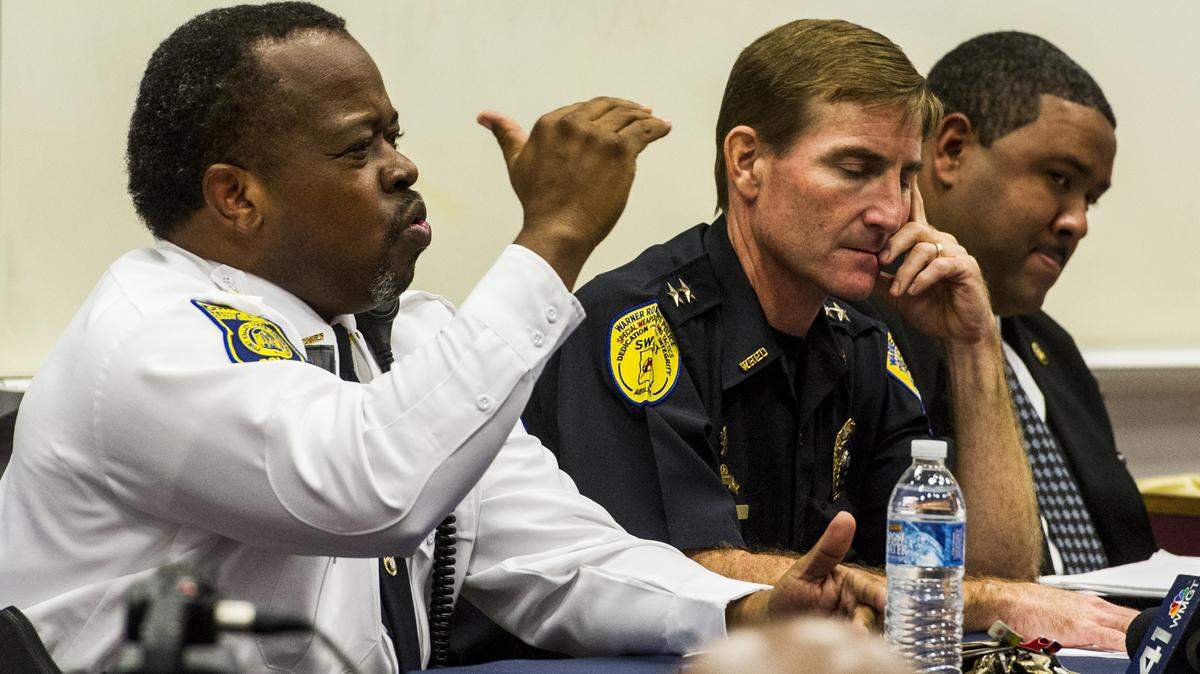
FORT VALLEY -- The public and the Fort Valley State University community had the opportunity Thursday to talk with the heads of three law enforcement agencies about policing issues.
FVSU Campus Police Chief Kenneth Morgan, Fort Valley Public Safety Director Lawrence Spurgeon and Warner Robins Police Chief Brett Evans served on a panel at a forum billed as addressing policing and race.
The 90-minute event at the Blanchet CTM Building Auditorium was moderated by Julius Trimble, an assistant professor of criminal justice, and included a question-and-answer session.
Morgan talked about the use of force, highlighting the fatal shooting of Sam DuBose July 19 by a University of Cincinnati campus police officer.
Morgan said there is the use of force, and then there is excessive force.
When force should be used by police depends on the circumstances and should only come after other methods from verbal commands to less lethal actions such as police batons or pepper spray are exhausted, he said.
Noting there are about 300,000 law enforcement officers in the nation, wrongful police-involved shootings involve only a handful of officers.
Morgan also said FVSU campus police are equipped with body cameras, which proponents say provide accountability and protection from false claims. Fort Valley police also have them, and Evans said Warner Robins police expect to get them.
In response to a question from the audience, Morgan said the best way to respond when interacting with law enforcement is to be respectful of authority and compliant.
Evans talked about police and community relations, education, training, ethics and professionalism in policing.
Warner Robins police are encouraged to seek higher education, although state law only requires officers to have a high school diploma, Evans said. He said the city offers a tuition reimbursement for officers who maintain good grades in higher education courses.
Evans said the state has improved in requiring mandatory training, which is now 400 hours before an officer is given a badge and a gun. But Evans said that threshold still needs to be raised.
He noted that a cosmetologist must earn 1,500 hours of training to earn state certification, which is nearly four times the amount of training required for a law enforcement officer.
“Think about that,” Evans said. “That’s a lot of hours -- 1,500 hours if you want to cut hair, right? Four hundred hours if you want to carry a gun, a badge and take away people’s freedom.
“So we’ve got some catching up to do,” he said.
Evans said his agency also upholds tried and true policing policies and holds its officers accountable.
The state automatically conducts investigations on officers who have been terminated, he said. But an officer who is suspected of wrongdoing may resign before an investigation by an individual agency and never be investigated by the state. That can lead to a bad officer finding employment elsewhere, he said.
Evans also talked about the importance of building community relationships before a high-profile incident occurs.
Warner Robins police have been able to build trust with most in the community, which has been beneficial when an officer involved shooting has occurred, he said. The community reaction has been to wait and hear the facts of the circumstances of the shooting, instead of a knee-jerk reaction, he said.
Spurgeon talked about how there is no escaping the fact that based on the racial history of our nation, there have been times when certain groups of people received better policing services than others. He said certain groups of people were treated more harshly than others based on race.
But a way to continue to improve race relations is to work within the system to improve the system itself, which is partly what led Spurgeon into a law enforcement career, he said.
Another way to improve relationships is to look at circumstances and situations from the other person’s perspective, he said.
“Our reality is not everyone’s reality,” said Spurgeon, noting that is why exercising empathy and understanding is important in policing.
To contact writer Becky Purser, call 256-9559, or find her on Twitter@becpurser.
This story was originally published September 17, 2015 at 4:35 PM with the headline "Three Middle Georgia law enforcement heads talk about policing issues at FVSU event ."