
Gambling settlements could yield big windfall for law enforcement
With several settlement agreements signed and others in progress, a racketeering lawsuit filed in Macon involving defendants across the state could produce a seven-figure payday for law enforcement and prosecutors.
The suit, filed in October, alleges that there were racketeering and illegal gambling violations at 85 convenience stores, involving 65 people and a corporation that owns more than 600 coin-operated game machines.
The case is the third commercial gambling suit filed by Macon Judicial Circuit prosecutors since a 2014 raid closed 10 Bibb County stores in the county’s largest-ever commercial gambling initiative.
Those stores agreed to pay nearly $1.2 million to settle a racketeering suit that prosecutors filed.
Forfeited funds collected from the statewide suit are expected to eclipse the Bibb County settlement.
Six defendants have already agreed to pay $390,000 to settle their cases, said David Cooke, the circuit’s district attorney.
More than a dozen other stores and individuals have failed to respond to the lawsuit and have lost their portion of the case by default, according to Bibb County Superior Court records.
Forfeited funds from the suit will be shared among law enforcement, Bibb prosecutors and prosecutors in jurisdictions involved in the case based on their participation, Cooke said.
A similar suit, stemming from raids in Peach and Crawford counties in 2015, is pending. Criminal charges in each of the three cases also are pending and are expected to move forward, Cooke said.
While he said his office’s priority is focusing on crimes that affect families the most and making communities safer, he added, “I can’t let something like this get out of hand and turn a blind eye to an open violation of the law.”
Commercial gambling can lead to armed robbery and other unintended crimes, he said.
“If you break the law in a continuous fashion like this, there will be consequences.”
Alleged underreporting
Forest Park-based Sudama Resorts LLC and stores in 31 counties — including many in Middle Georgia — are accused of underreporting the amount of money that players put into the gambling machines, as well as net profits, before the machines were connected to a central computer system July 1, 2015.
The system records customers’ winnings electronically, without the previously self-reported input from the stores and machine owners.
Records from the system showed that between July 1, 2015, and Sept. 30, 2015, customers pumped in more than $12 million, compared with a total of $15 million that was self-reported for all of calendar year 2014.
In the same three months, system records showed that customers won about $8 million, compared with the $8 million self-reported for all of 2014, according to the lawsuit.
Net profits for the same period were $4 million, according to system records, compared with $3 million self-reported during 2014, according to the suit.
If you break the law in a continuous fashion like this, there will be consequences.
District Attorney David Cooke
Ken Gordon, an attorney representing a number of defendants in the case, said the majority of his clients told him “they correctly and accurately reported all income and paid the use tax.”
An analysis of income tracked from before and after the central computer system went online shows that the figures in all but one case were “very consistent,” he said.
Beau Worthington, another attorney representing about 30 defendants in the suit, said at least eight of his clients have settled or are in the process of striking a settlement with prosecutors.
Without admitting any wrongdoing, settling a case can avoid additional legal expenses and a trial, said Worthington, who said he and his clients “disagree with how the state presents some of the facts.”
But for some of his clients, agreeing to a settlement can be a “matter of convenience,” he said, “especially when you’re talking about people’s livelihoods.”
Authorities allege that Sudama Resorts and the stores also submitted false tax returns and failed to pay state sales or use taxes on about $32 million paid to customers as winnings.
Undercover police officers posed as customers during an investigation of the stores and were given illegal cash payouts at more than a quarter of the locations where Sudama-owned machines operate, according to the suit.
Georgia law allows stores to pay winners only in store credit that can be used for merchandise, gas or lottery tickets. Redemptions for alcohol and tobacco products are prohibited.
Prosecutors contend that customers have played about $240 million on Sudama-owned machines in the past five years and been paid $168 million.
The suit also maintains that Sudama and the stores made false reports on regulatory applications in saying the entities weren't delinquent in tax payments.
Paul Oeland, a lawyer representing Sudama Resorts, said his client denies all wrongdoing, has paid all taxes assessed and reported all income.
The machines Sudama Resorts owns are “completely lawful” and subject to strict monitoring and regulation by the Georgia Lottery, he said.
Oeland said his client is ready to go to trial, although the trial won’t occur until at least this coming fall.
“We are preparing for trial,” he said.
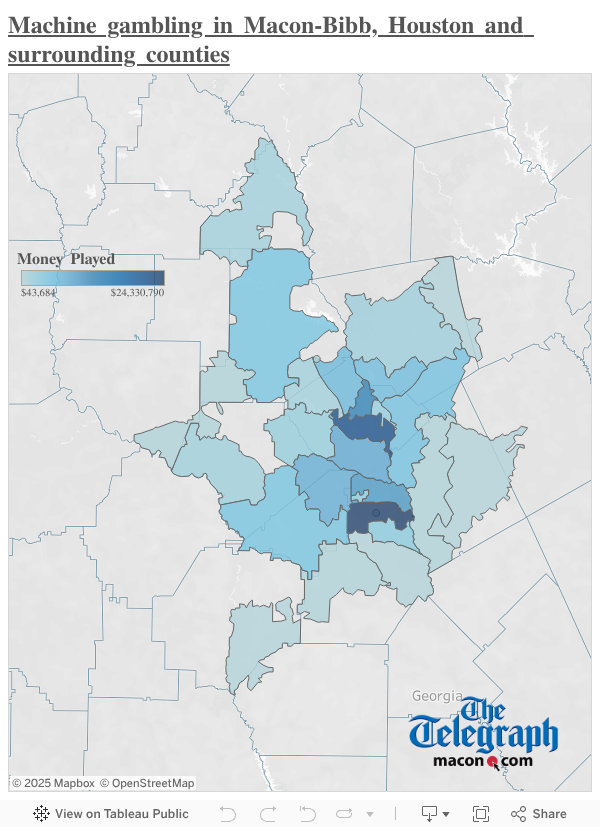
The data provided for this map came from the information stores self-reported to the Georgia Lottery Commission.
Forfeited funds
As part of the settlement agreements signed, the defendants also must pay more than $85,000 in attorney fees, according to court records.
Cooke said his office has paid Michael Lambros, a special prosecutor hired to handle the gambling cases, $137,000 in the past two years.
Prosecutors received $671,000 for their part in the 2014 suit. Of that amount, about $288,000 has been spent, he said.
Charities and nonprofit organizations that provide victim services to women and children have received $44,000.
Cooke’s office matched the $20,624 raised at a recent golf tournament benefiting the Family Counseling Center of Central Georgia.
The office also has pledged to match money raised at Crisis Line & Safe House of Central Georgia’s June 7 celebrity waiter contest.
The Bibb County Sheriff’s Office is using money it received from the suit’s forfeitures to buy 100 body cameras, set to be in use later this year.
Information from Telegraph archives was used in this report. Amy Leigh Womack: 478-744-4398, @awomackmacon
This story was originally published May 13, 2016 at 2:14 PM with the headline "Gambling settlements could yield big windfall for law enforcement."