
Macon company designed unique alternative energy project in Albany
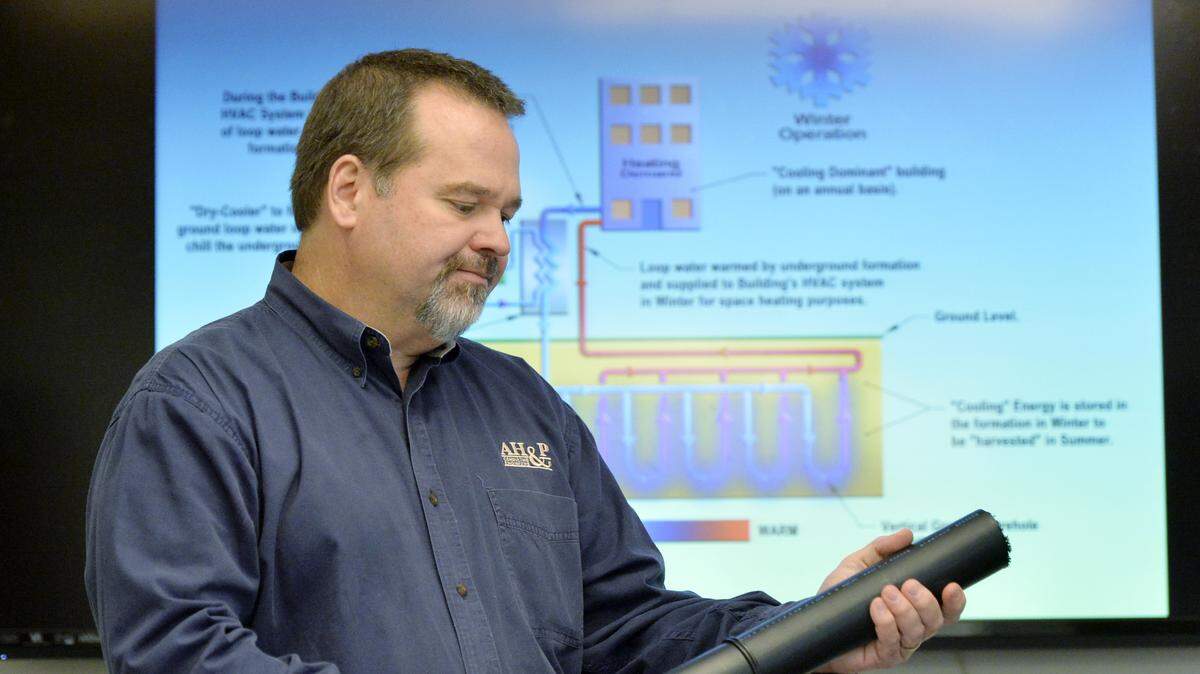
A Macon company has conceived and designed a unique, new alternative energy project at the U.S. Marine base in Albany.
It's not every day, if ever, that a ribbon-cutting ceremony is held for a heating and air-conditioning system, but that's what Marine Corps Logistics Base Albany is doing Monday.
The base and the system's designer say it's the first borehole thermal energy storage system in the nation. It provides heating and air for the Marine Corps Logistics Command headquarters.
To put it in simplest terms, the system uses heat pumps, circulating water and a series of pipes to store winter's cold under the ground, which is then used during the summer to create air conditioning.
The system cost $5.1 million to build and was engineered by Andrews, Hammock & Powell of Macon.
Chuck Hammock, a founding partner in the firm, said the company spent nearly three years designing it and created 35 computer models to get it exactly right.
"There's a lot of work done before you put the shovel to the ground and build the thing," he said.
Although it's still being tweaked, the system began operating in August and in the first 30 days showed a 53-percent reduction in energy cost from the same period the previous year.
The engineers have guaranteed at least a 30-percent reduction in the energy it takes to heat and cool the building. At that rate, the system is expected to pay for itself in 14 years. Hammock said the borehole system itself should last for decades.
"This is the most exciting project I've ever been involved with," Hammock said.
Next to the Logistics Command headquarters building is a circular field of 306 boreholes drilled 210 feet into the ground. About 1.5 miles of fiber optic cable is used to monitor the temperature in the system.
Hammock explained it as a battery effect. The water circulating through the pipes in the winter cools the limestone, which is like Swiss cheese and is filled with ground water. The water from the pipes in effect cools or "charges" the limestone and ground water, which doesn't move. That is what cools the water that circulates through the system during the summer.
Then in the winter, the limestone and groundwater around the pipes remains at about 70 degrees, and that allows heating.
Hammock said that while the system is a first for America, he was never concerned about whether it would work.
"It has been used in other places around the world, and physics are physics," he said.
It is just one of many alternative energy projects at the Albany base, which expects to become the first base in the Department of Defense to produce more energy than it consumes.
Michael Henderson, the base's chief engineer of public works, said the base is under federal mandates to reduce energy consumption. He said the base expects in 2017 to be energy self-sufficient after an 8.5 megawatt biomass generator under construction is completed. The generator largely will be fueled by pine chips and potentially other by-products of the agriculture industry.
The base partnered with Dougherty County to build a methane collection system at the adjacent county landfill that will produce 4 megawatts of electricity.
Henderson said the borehole system is a significant addition to the base's efforts. The command building had needed a new heating and air system, and leadership chose the borehole system over a conventional system.
"We are just thrilled," he said. "It makes us more valuable on the totem pole, because we have energy systems that can operate at less expense to the taxpayer."
The base, which employs about 4,000 people, supplies equipment to Marines throughout the world.
To contact writer Wayne Crenshaw, call 256-9725.
This story was originally published October 18, 2015 at 10:41 PM with the headline "Macon company designed unique alternative energy project in Albany ."