
New timetable in the offing to settle Bibb-Monroe border dispute
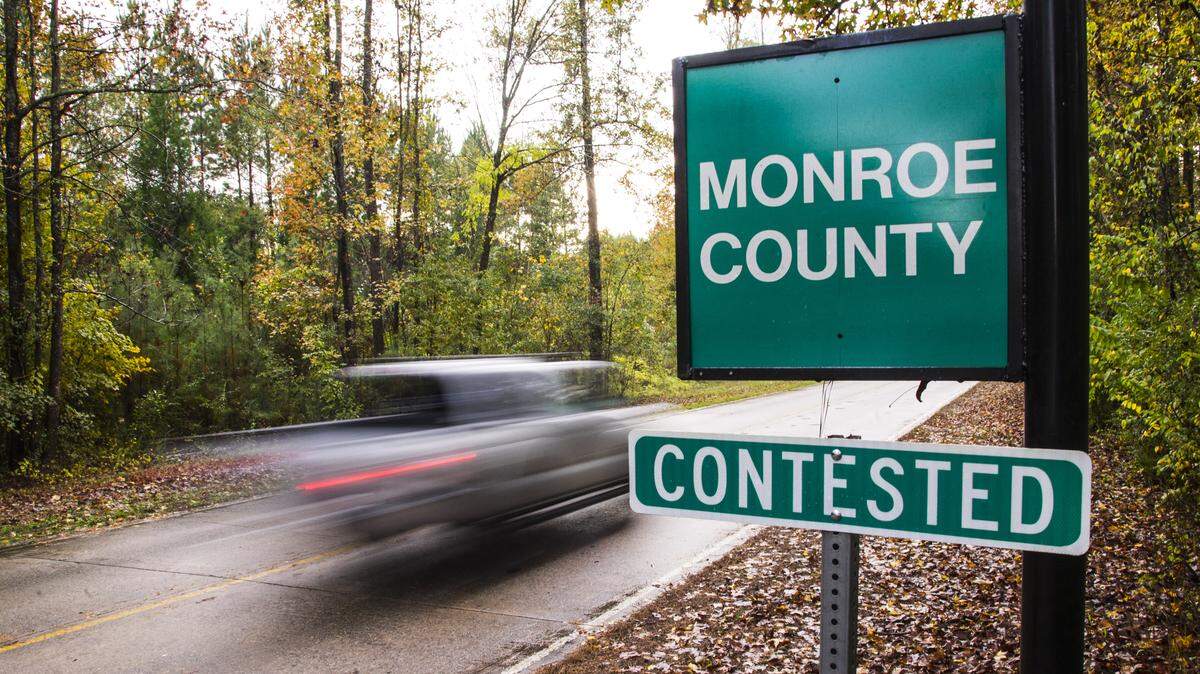
The state Supreme Court ruled in favor of Bibb County and Secretary of State Brian Kemp on Monday by reversing a Fulton County judge’s decision regarding a boundary dispute with Monroe county.
The Fulton court erred by prohibiting Kemp from holding a hearing and considering new evidence before determining where the land boundary lies, as he is required by law to do, according to Monday’s ruling.
“We therefore reverse the trial court’s order and remand to the trial court for proceedings consistent with this opinion,” said the ruling, written by Chief Justice Hugh Thompson.
The precise location of the boundary line between Bibb County and Monroe County has been in dispute for years. It’s the second time the case has gone to Georgia’s high court.
As for what might happen next in the matter, attorney Virgil Adams, who has represented Macon-Bibb County in the case, said Monday, “I suspect we’ll be hearing something in the next few weeks from the secretary of state setting out the process and the timetable.”
Asked if the end may be in sight in the back-and-forth border battle, Adams said, “I don’t know. That’s a question I think that’s better addressed to Monroe County. At what point do you just say it’s time to go ahead and get this resolved? ... They keep pushing it and they keep coming up short.”
Attempts to reach Atlanta attorney Letitia McDonald, who helped represent Monroe County, were not successful Monday.
This round of the border dispute dates back years. The boundary dispute includes part of Bass Pro Shop and homes in the area — and the tax proceeds that would flow from them.
The high court had already heard portions of the case last year, when it told a Fulton County judge that she had exceeded her authority to give Kemp orders. The court ruled that Fulton County Superior Court Judge Kelly Lee Ellerbe could order Kemp to fulfill his duty by establishing a border, but she could not order him to establish a specific location for the border.
Key among the issues lately has been whether Kemp could, or should, take any additional evidence in the case.
The only proposed line in the current case was drawn by Terry Scarborough, who refused to testify in subsequent proceedings because Bibb County wouldn’t pay him.
Kemp had proposed letting Scarborough submit additional evidence in the case, as well as taking any additional evidence from the counties.
Scarborough’s line set the border south of where it is now. Another judge had praised the survey and recommended keeping Scarborough’s line. Kemp rejected Scarborough’s line but did not establish one of his own, leaving the location ambiguous.
Attorneys with the state Attorney General’s Office argued that Kemp had the legal discretion to take new evidence in the case.
Monroe County wanted Kemp’s appeal to the Supreme Court rejected, saying Kemp stopped taking evidence years ago after six years of wrangling.
In Monday’s opinion, the Supreme Court found that the Fulton County trial court erred.
The court misconstrued the high court’s first decision in the case as a ruling intended to “expressly preclude (Kemp) from allowing the record to be reopened and new evidence developed.”
“This was not our intent,” the opinion said.
The Supreme Court’s first decision in the case “was not intended, either explicitly or implicitly, to address the manner in which the
secretary was authorized to proceed in the exercise of his discretion as he continued to perform his statutory duties …,” the opinion said.
As for the trial court’s ruling that the Kemp no longer had the discretion to hold hearings because he had already held a hearing and closed the record, “We disagree,” the opinion said.
“Contrary to the trial court’s order, we find nothing in the process announced by the secretary that contravenes his broad statutory discretion, and more specifically, we find nothing in the language of the statutory scheme that indicates a legislative intent to preclude the secretary from exercising his discretion to re-open the evidence on remand or that imposes upon the secretary the obligation to receive evidence and determine the boundary line within a single hearing.”
It continued, “As for the trial court’s finding that the secretary’s decision to hold another hearing at which the parties would be allowed to present new evidence was generally ‘unfair,’ that is a question for the legislature, not the courts.”
And if “either party wishes to challenge the secretary’s final decision or the process by which it ultimately is made, it will be entitled to ... relief if it can be shown that the secretary, in performing his statutory duties, acted arbitrarily and capriciously or grossly abused his discretion.”
Staff writer Joe Kovac Jr. contributed to this report. To contact writer Liz Fabian, call 744-4303 and find her on Twitter @liz_lines.
This story was originally published November 2, 2015 at 8:10 AM with the headline "New timetable in the offing to settle Bibb-Monroe border dispute."